
Optical printer — film re‑photography device for effects, copying and restoration
A laboratory motion‑picture device that re‑photographs film to create fades, dissolves, mattes and composite effects or to copy and restore film elements using photochemical methods.
Overview
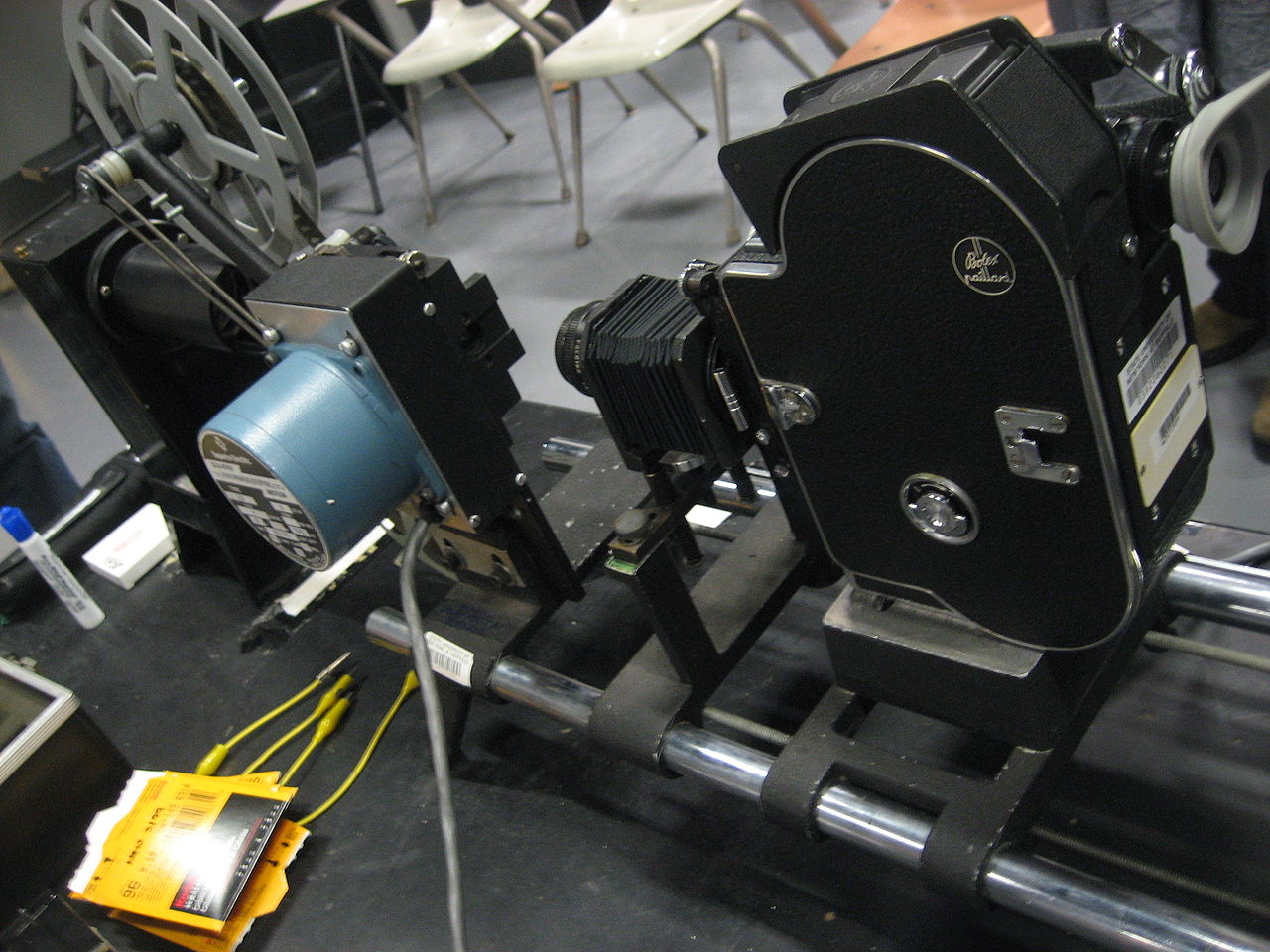
An optical printer is a mechanical and optical laboratory device used to re‑photograph strips of motion picture film. By projecting one or more source films and recording them onto fresh raw stock with a camera, an optical printer makes it possible to create composite images, controlled fades and dissolves, speed changes, and other photochemical special effects. It also serves archival and restoration roles when copying or repairing film material that predates digital workflows. The technique is inherently analogue and alters the original through a second generation of exposure.
Image gallery
2 Images
Design and principal parts
At its core an optical printer links projector(s) to a camera so that projected frames can be re‑shot precisely. Typical elements include:
- one or more precision film projectors or light gates that feed the source elements;
- a camera or film gate mounted to record the projected image onto new film stock;
- optical lenses and bellows for focusing and framing;
- registration mechanisms and sprocket drives to keep frames aligned;
- adjustable shutters, iris and exposure controls for timing and density;
- matte or holdout devices for creating mattes and combining multiple elements.
All parts must synchronize so that frame‑by‑frame exposures align precisely; multiple passes are often required to build a final composite image.
Common effects and methods
Optical printers enable a wide range of established photochemical techniques. Common results include:
- fades and dissolves achieved by varying exposure over consecutive frames;
- slow or fast motion via stepwise re‑photography at different frame rates;
- split‑screen composites and multiple exposure mattes, including travelling mattes used to combine foreground and background action;
- rear projection, where live action is filmed in front of a projected background; and selective hand‑painted or physically altered frames for experimental looks.
History and development
Early experimental optical printers appeared in the 1920s as filmmakers sought reliable ways to duplicate and manipulate film imagery. During the 1930s inventors and technicians refined the basic concept; among the notable contributors was Linwood G. Dunn, who advanced the precision and utility of the device. Through the mid‑20th century optical printing was central to studio special effects and practical compositing. For many decades printers were operated mechanically and manually, but by the 1970s and 1980s control systems and timing devices became more sophisticated and some printers were integrated with electronic controllers and minicomputers to manage complex multi‑element passes and repeatable timings (see computing control).
Uses, advantages and limitations
Before digital compositing became widespread in the late 1980s and 1990s, optical printing was the primary method for combining image elements. It offered a photochemical look and produced results on actual film stock, which remains desirable for some filmmakers and archivists. Optical printing also supports restoration and copying of delicate or hand‑worked material that does not exist in digital form. However, each re‑photography introduces generational loss: increased grain, reduced sharpness, potential color shifts and added noise. Aligning elements precisely is technically demanding, and elaborate effects can require many passes, increasing cost and degradation.
Legacy and contemporary practice
With the rise of digital compositing, optical printing largely moved out of mainstream visual‑effects production. Digital tools offer more flexible, lossless compositing and faster iteration. Nevertheless, optical printers persist in a niche: film restoration labs, artists and experimental filmmakers continue to value the tactile, photochemical qualities an optical printer provides. They are also used to produce film‑outs from digital work and to reproduce hand‑painted frames that must remain on film stock. For historical study and preservation the optical printer remains an important piece of cinematic technology and practice (further reading on film copying).
Questions and answers
Q: What is an optical printer?
A: An optical printer is a device used to copy rolls of movies, made of one or more movie projectors linked to a movie camera.
Q: What is the purpose of an optical printer in filmmaking?
A: An optical printer is used for making special effects for motion pictures or for copying and restoring old movie material.
Q: What are some typical optical effects created using an optical printer?
A: Common optical effects include fade outs and fade ins, dissolves, slow motion, fast motion, and matte work.
Q: Why is it important for optical printer work to be seamless?
A: Ideally, the audience in a theater should not be able to notice any optical printers work, but this is not always the case.
Q: When were the first optical printers constructed?
A: The first, simple optical printers were constructed in the early 1920s.
Q: Who expanded the concept of the optical printer in the 1930s?
A: Linwood G. Dunn expanded the concept of the optical printer in the 1930s.
Q: What technology began to replace optical effects in the late 1980s?
A: Since the late 1980s, digital compositing began to replace optical effects.
Related articles
Author
AlegsaOnline.com Optical printer — film re‑photography device for effects, copying and restoration Leandro Alegsa
URL: https://en.alegsaonline.com/art/72892