
Ophthalmosaurus — a large-eyed Jurassic ichthyosaur
Ophthalmosaurus was a dolphin‑like marine reptile of the Upper Jurassic, notable for enormous eyes and adaptations for low‑light or deep hunting; well‑preserved fossils are known from several continents.
Ophthalmosaurus was a genus of ichthyosaur that lived in the open seas of the Upper Jurassic, roughly during the later part of the Mesozoic era. The name highlights a defining trait: exceptionally large eyes relative to body size. As a member of the wider group of ichthyosaurs, Ophthalmosaurus had a streamlined, fishlike body adapted for sustained swimming and predation in marine environments.
Image gallery
10 Images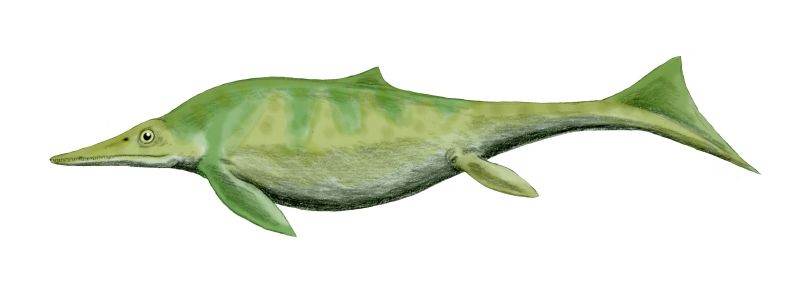


Anatomy and size
Ophthalmosaurus combined a fusiform (tapered) body, a narrow, pointed snout, and limbs modified into paddles. The vertebral column and tail supported powerful lateral undulations for propulsion, and a relatively rigid trunk suggests specialization for efficient cruising. Teeth, when preserved, are usually slender and conical, indicating a diet of fish and soft-bodied prey rather than hard-shelled animals. Adult size estimates vary among species in the group, but Ophthalmosaurus is generally described as a medium-sized ichthyosaur compared with the largest members of the order.
Eyes and vision
The most famous feature of Ophthalmosaurus is its enormous eyes, among the largest known relative to body size in vertebrates. Individual eyeballs have been estimated at several centimetres across and were supported by robust bony sclerotic rings. These rings likely helped maintain eyeball shape under water pressure during dives and may have aided focusing. The combination of large eyes and sclerotic support has been interpreted as an adaptation for seeing in dim light—either at depth, in twilight, or during nocturnal activity—making Ophthalmosaurus an efficient hunter under low‑light conditions.
Locomotion, diving and physiology
Ophthalmosaurus was built for active pursuit: a hydrodynamic form, strong tail musculature and limb paddles for steering and stabilization. Comparative studies of ichthyosaur body plans suggest they could sustain considerable swimming speeds for brief intervals and make relatively deep dives compared with many modern marine reptiles. Some estimates, based on respiratory and metabolic inferences from bone and body proportions, indicate that individuals could remain submerged for many minutes, enabling them to exploit a range of water depths while foraging.
Diet and feeding behavior
The tooth morphology and jaw shape of Ophthalmosaurus point to a diet dominated by small to medium soft-bodied prey such as fish and squid‑like cephalopods. A long, narrow rostrum would have been effective for snapping at agile prey. Hunting strategies probably combined vision in low light with fast, maneuverable swimming, allowing the animal to pursue and capture swift targets in open water.
Reproduction, growth and life history
Like other ichthyosaurs, Ophthalmosaurus is thought to have been viviparous (bearing live young), a reproductive mode well documented in the order. Fossil assemblages preserving juveniles and adults together allow researchers to study growth stages and ontogenetic changes in proportions. Well‑preserved specimens spanning age classes contribute to understanding of growth rates, maturity, and population structure in Jurassic seas.
Fossil record and distribution
Well‑preserved skeletons of Ophthalmosaurus, including juvenile and adult individuals, have been found across several continents. Notable finds come from Europe (including classic Jurassic marine deposits in England and Germany), North America, and Argentina. These fossils have provided the anatomical detail that underpins interpretations of vision, locomotion and ecology. Collections and regional studies continue to refine the genus’s diversity and geographic range.
Evolutionary context and extinction
Ophthalmosaurus belongs to the family Ophthalmosauridae, a successful lineage of ichthyosaurs that persisted into the Upper Cretaceous. The genus Ophthalmosaurus itself did not continue beyond the end of the Jurassic period, but its relatives show the continued success of ichthyosaur body plans in Mesozoic oceans. The rise and fall of individual genera within Ophthalmosauridae reflect changing ecosystems, faunal turnovers and competition in marine environments.
Scientific importance and further reading
- Model taxon: Ophthalmosaurus is important for studies of sensory adaptation because of its exceptional eye size and the presence of sclerotic rings (eye studies).
- Comparative anatomy: Its well‑preserved skeletons help compare ichthyosaur locomotion and physiology with modern marine vertebrates such as dolphins and tuna (ichthyosaur overviews).
- Regional records: Detailed site reports and museum collections document occurrences in Europe, North America and South America (Europe, North America, Argentina).
For accessible summaries and specimen records consult specialist databases and regional syntheses on Jurassic marine faunas (Upper Jurassic context, anatomical summaries, and genus‑level entries such as Ophthalmosaurus). Additional perspectives on family‑level patterns and the later survival of ophthalmosaurid lineages are discussed in broader paleontological treatments (Ophthalmosauridae through time, Jurassic faunal lists).
Questions and answers
Q: What is an Ophthalmosaurus?
A: Ophthalmosaurus is an ichthyosaur with large eyes that lived during the Upper Jurassic period.
Q: Where have Ophthalmosaurus fossils been found?
A: Fossils of Ophthalmosaurus have been found in Europe, North America, and Argentina.
Q: What is unique about Ophthalmosaurus' eyes?
A: Ophthalmosaurus had the largest eyes of any vertebrate relative to its body size, with eyes that were 4 inches in diameter and occupied most of the space in the skull.
Q: How were Ophthalmosaurus' eyes protected?
A: Ophthalmosaurus' eyes were protected by bony plates called sclerotic rings, which helped maintain the shape of the eyeballs against water pressure at depth.
Q: What does the size of Ophthalmosaurus' eyes suggest about its hunting habits?
A: The size of Ophthalmosaurus' eyes suggests that it hunted at a depth where there is not much light or that it may have hunted at night when a prey species was more active.
Q: How long could an Ophthalmosaurus stay submerged?
A: Calculations suggest that a typical Ophthalmosaurus could stay submerged for approximately 20 minutes or more.
Q: When did Ophthalmosaurus become extinct?
A: Ophthalmosaurus became extinct at the end of the Jurassic period, although other members of its family continued into the Upper Cretaceous.
Related articles
Author
AlegsaOnline.com Ophthalmosaurus — a large-eyed Jurassic ichthyosaur Leandro Alegsa
URL: https://en.alegsaonline.com/art/72845
Sources
- ucmp.berkeley.edu : ucmp.berkeley.edu/people/motani/ichthyo/eyes.html
- ucmp.berkeley.edu : ucmp.berkeley.edu/people/motani/ichthyo/diving.html