
Ophthalmosauridae: the large‑eyed ichthyosaur family
Ophthalmosauridae were a worldwide family of ichthyosaurs from the Middle Jurassic to the mid‑Cretaceous, notable for very large eyes and marine adaptations for active swimming and deep hunting.
Ophthalmosauridae is a distinctive family of marine reptiles grouped within the ichthyosaurs, a clade of dolphin‑like Mesozoic swimmers. Members of this family first appear in the fossil record during the Middle Jurassic and persist until the mid‑Cretaceous. They are best known for disproportionately large eyes and streamlined bodies adapted to life in open seas. For general context on their larger group see ichthyosaurs and for taxonomic summaries see family treatments.
Image gallery
10 Images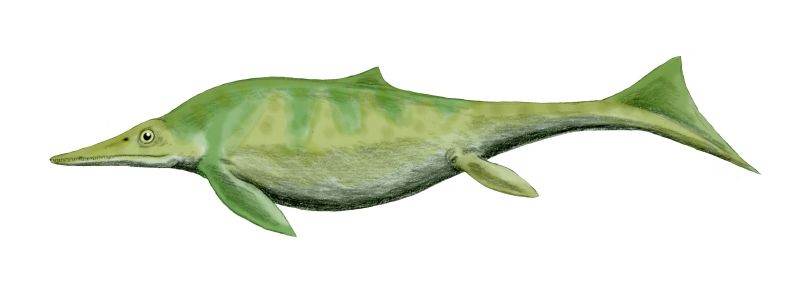


Anatomy and adaptations
Ophthalmosaurids combined a fish‑shaped body with highly modified limbs: fore‑ and hindlimbs were transformed into broad, paddle‑like flippers and the tail bore a strong, lunate fin. Their large orbits contained substantial bony sclerotic rings, indicating adaptations for vision under low‑light conditions, which supports interpretations of deep or crepuscular hunting behavior. Other features often cited in descriptions include shortened snouts, dense vertebral columns for powerful swimming, and limb bone proportions that reflect extreme aquatic specialization. These anatomical traits illustrate how ophthalmosaurids were effective, fast swimmers and capable predators in pelagic environments.
Phylogeny and notable genera
Within Ophthalmosauridae two main lineages are commonly recognized. One lineage includes genera such as Aegirosaurus and Ophthalmosaurus, characterized by relatively gracile builds and certain cranial traits. The other lineage contains forms like Brachypterygius, Caypullisaurus and Platypterygius, often with broader bodies and different fin proportions.
- Aegirosaurus and Ophthalmosaurus: classic Jurassic representatives.
- Brachypterygius, Caypullisaurus, Platypterygius: members more common in later deposits.
- Maiaspondylus: one of several genera known from Cretaceous sediments.
Temporal range, distribution and extinction
Ophthalmosaurids had a cosmopolitan distribution, with fossils found in Europe, the Americas, Asia and the Southern Hemisphere. Only a few genera appear to have crossed the end‑Jurassic extinction boundary: the Cretaceous record includes Caypullisaurus, Maiaspondylus and Platypterygius. The family disappears from the fossil record in the mid‑Cretaceous, several tens of millions of years before the mass extinction that ended the age of dinosaurs. Paleontologists have suggested links between their decline and large‑scale ocean changes, including episodes of reduced oxygen in deep waters and shifts in marine food webs; however, the precise causes remain an active subject of research. See discussions of later Mesozoic stages at Upper Cretaceous contexts.
Importance to paleontology
Ophthalmosauridae are important for understanding marine reptile evolution, functional morphology and Mesozoic ocean ecosystems. Their well‑preserved skeletons provide data on sensory capabilities (large eyes and sclerotic rings), swimming mechanics (flipper and tail structure), and developmental patterns. Because they survived multiple environmental changes before their eventual extinction, ophthalmosaurids are also used in studies of biogeography and extinction dynamics. For more on reptile physiology and respiratory behavior as it relates to marine life, see reptile biology summaries.
Research on ophthalmosaurids continues to refine their classification and paleobiology: new specimens and modern imaging techniques keep improving our picture of how these large‑eyed predators lived and died in Mesozoic seas. For further reading and specimen databases consult resources linked at genus overviews and general repositories at taxonomic databases and stratigraphic summaries.
Questions and answers
Q: What are Ophthalmosauridae?
A: Ophthalmosauridae were a family of Ichthyosaurs which lived from the Middle Jurassic to the Upper Cretaceous period.
Q: How many lineages are there within Ophthalmosauridae?
A: Within Ophthalmosauridae there are two lineages.
Q: What are the genera that survived the end-Jurassic extinction event?
A: The genera that survived the end-Jurassic extinction event are Caypullisaurus, Maiaspondylus, and Platypterygius.
Q: Did Ophthalmosauridae have a worldwide distribution?
A: Yes, they did have a worldwide distribution.
Q: When did Platypterygius become extinct?
A: Platypterygius became extinct about 30 million years before the end of the Upper Cretaceous period.
Q: What caused the extinction of Platypterygius?
A: The extinction of Platypterygius happened when there was a deep ocean anoxic event, which wiped out all the animals below pelagic waters. Ichthyosaurs, being reptiles, came to the surface to breath, but the extinction event removed their prey species.
Q: Which are the genera in the lineage that includes Aegirosaurus and Ophthalmosaurus?
A: The lineage that includes Aegirosaurus and Ophthalmosaurus includes only those two genera.
Related articles
Author
AlegsaOnline.com Ophthalmosauridae: the large‑eyed ichthyosaur family Leandro Alegsa
URL: https://en.alegsaonline.com/art/72844