
Olinguito (Bassaricyon neblina): a cloud‑forest mammal of the Andes
A small, nocturnal, arboreal mammal of the Andes cloud forests. Described in 2013, the olinguito (Bassaricyon neblina) belongs to Procyonidae and was recognized through museum specimens and DNA analysis.
Overview
The olinguito (Bassaricyon neblina) is a small, tree‑living mammal native to humid cloud forests of the Andean foothills. It is a member of the genus Bassaricyon and belongs to the raccoon family, Procyonidae, a group that also contains animals familiar to many people such as raccoons. The species became widely known after scientists identified it as distinct and formally described it in 2013.
Image gallery
4 Images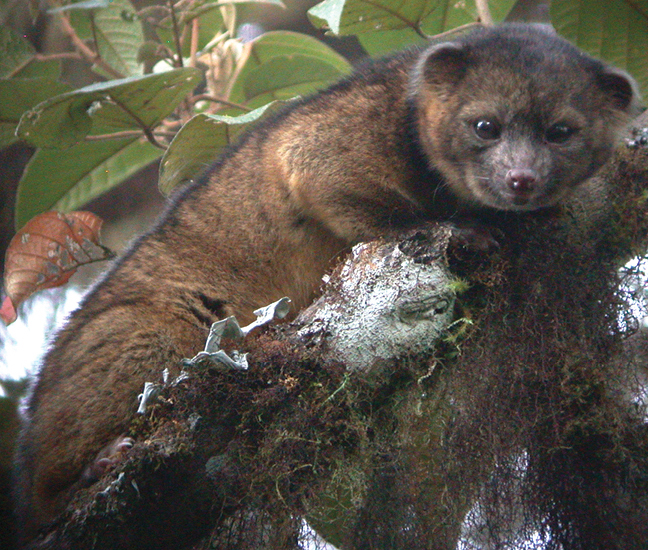

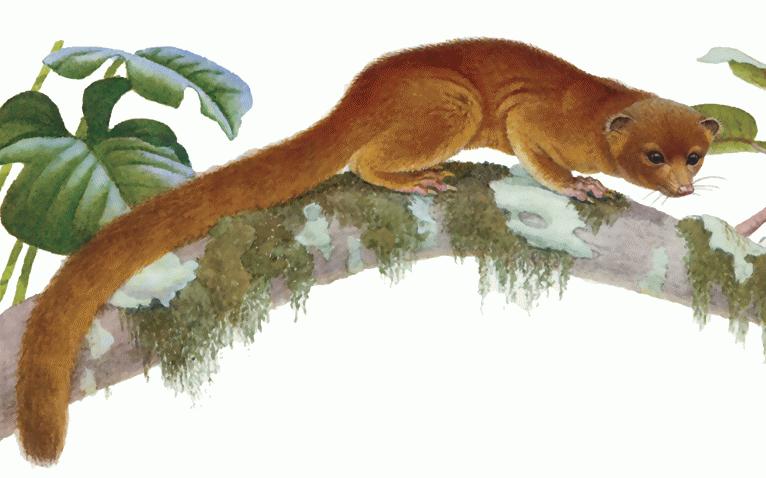

Appearance and behavior
Olinguitos are small, compact mammals with dense, soft fur that ranges in various shades of reddish‑brown. They have rounded faces, short snouts, and long tails that help with balance in the trees. Primarily active at night, olinguitos move slowly among branches and feed largely on fruit, making them important seed dispersers in their habitat. Observations suggest they are largely solitary and occupy home ranges within complex montane forest canopies.
Discovery and scientific study
The species was announced in August 2013 following work that combined careful examination of museum specimens with modern genetic methods. Researchers, including curators at major natural history institutions, recognized that some preserved animals previously assigned to related species represented a distinct taxon. Comparisons of morphology and analyses of DNA supported the decision to describe the olinguito as a new species. Specimens in collections such as those at the Field Museum were essential to this process, illustrating how museum archives can reveal undiscovered diversity.
Habitat, range and conservation
Olinguitos are native to cloud forest zones on the western slopes of the Andes in parts of northwestern South America. These forests are characterized by persistent mist, dense epiphytes and a multilayered canopy. Because their distribution is tied to these specialized habitats, olinguitos are vulnerable to habitat loss and fragmentation associated with agriculture and development. Conservation attention focuses on protecting remaining cloud forests and improving knowledge about the species’ population size and ecology.
Notable facts and distinctions
- The species name neblina refers to fog or mist, a reference to its cloud‑forest home.
- Its formal recognition in 2013 highlighted that even well‑studied animal groups can contain previously unrecognized mammals.
- Olinguitos play an ecological role as frugivores and seed dispersers in montane forest ecosystems.
- Scientific description relied heavily on museum collections and genetic testing, demonstrating the value of preserved specimens for modern taxonomy.
Research on the olinguito continues to refine understanding of its life history, distribution and conservation needs. Its discovery was widely reported as a reminder that biodiversity in complex habitats like cloud forests remains incompletely known and that protecting those habitats benefits both described and yet‑to‑be‑discovered species.
Questions and answers
Q: What is an Olinguito?
A: An Olinguito is a newly discovered mammal belonging to the genus Bassaricyon and part of the Procyonidae family, which also includes raccoons.
Q: Who announced the discovery of the Olinguito?
A: The curator of mammals at the Smithsonian National Museum of Natural History announced the discovery of the Olinguito on 15 August 2013.
Q: How was the discovery of the Olinguito made?
A: The discovery of the Olinguito was made by the curator of mammals at the Smithsonian National Museum of Natural History, who found specimens of the species in storage at the Field Museum of Natural History and used DNA testing to confirm a new species.
Q: What family does the Olinguito belong to?
A: The Olinguito belongs to the Procyonidae family, which also includes raccoons.
Q: Is the Olinguito a new species?
A: Yes, the Olinguito is a new species that was recently discovered.
Q: When was the discovery of the Olinguito announced?
A: The discovery of the Olinguito was announced on 15 August 2013.
Q: What is the significance of the discovery of the Olinguito?
A: The discovery of the Olinguito is significant because it is a new species that had not previously been identified or documented. It also provides insight into the biodiversity of the Procyonidae family.
Related articles
Author
AlegsaOnline.com Olinguito (Bassaricyon neblina): a cloud‑forest mammal of the Andes Leandro Alegsa
URL: https://en.alegsaonline.com/art/72383
Sources
- bbc.co.uk : bbc.co.uk/news/science-environment-23701151
- smithsonianmag.com : "For the first time in 35 years, a new carnivorous mammal species is discovered in the American continents"
- smithsonianmag.com : Smithsonian Magazine