
Old Prussian language
Extinct Western Baltic language once spoken by the Old Prussians in the area of modern Kaliningrad and northeast Poland; known from fragmentary texts and subject to limited revival.
Overview
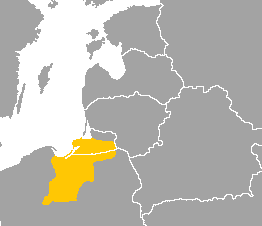
Old Prussian was a member of the Baltic branch of Indo-European languages and is commonly described as a Baltic language. It served as the vernacular of the indigenous Old Prussians in the region historically known as Prussia. Its geographic range corresponds roughly to parts of what are now north-eastern Poland and the Kaliningrad Oblast of Russia. The term "Old Prussian" distinguishes this extinct Baltic tongue from the later Germanic and Polish languages that became dominant in the same territory.
Image gallery
4 Images


Classification and characteristics
Scholars place Old Prussian in the Western Baltic subgroup, separate from the Eastern Baltic languages represented today by Lithuanian and Latvian. Although only fragments remain, comparative study indicates Old Prussian preserved several archaic features lost in its eastern relatives. Its surviving material shows a complex inflectional morphology with cases and verbal distinctions typical of Baltic languages, while also displaying local lexical and phonetic developments.
History and extinction
Old Prussian was spoken through the Middle Ages but declined after the Teutonic conquests, German settlement, and later political changes that shifted the population and language balance. Assimilation, demographic change, and the prestige of other tongues contributed to its gradual disappearance; linguists date its last native use to the early 18th century. After that point the language ceased to be spoken natively, surviving only in scattered records and place-names.
Sources, reconstruction and revival
Knowledge of Old Prussian depends on a limited corpus: word lists, short texts, citations in medieval chronicles and religious material recorded by non-native speakers. These fragments, together with toponymy and loanwords preserved in regional dialects, have enabled partial reconstruction through comparison with Lithuanian and Latvian. During the 19th and 20th centuries there were small-scale attempts to revive or standardize Old Prussian, but these projects have remained marginal and the revival has not produced a widely used living language.
Legacy and notable facts
- Old Prussian is important for historical linguistics because it helps reconstruct Proto-Baltic and Indo-European developments.
- Toponyms and some surnames in the region preserve Old Prussian elements cited in place-name studies.
- Modern interest is chiefly academic and cultural: museums, niche language groups and some online projects explore Old Prussian vocabulary and texts.
For further introductions and source listings see general overviews and language histories linked through academic and reference portals: language surveys, ethnographic summaries, and regional histories of Prussia, north-eastern Poland and the Kaliningrad Oblast. Accessible bibliographies and discussions of revival efforts are available via specialist pages and linguistic databases: chronologies and source guides.
Questions and answers
Q: What was the Old Prussian language?
A: Old Prussian was a Baltic language spoken by the indigenous people of Prussia, the Old Prussians, in the area that now belongs to the Kaliningrad Oblast of Russia and north-eastern Poland.
Q: Why was it called "Old Prussian"?
A: It was named Old Prussian to differentiate it from the people who lived in Prussia afterwards.
Q: When did the Old Prussian language go extinct?
A: The Old Prussian language went extinct in the early 18th century.
Q: Can we still observe any efforts of a revival of the Old Prussian language?
A: Yes, there has been an attempted revival, but with little progress.
Q: Where is the Kaliningrad Oblast of Russia located?
A: The Kaliningrad Oblast of Russia is located in the area where north-eastern Poland and Russia are today.
Q: Who were the indigenous people of Prussia?
A: The indigenous people of Prussia were the Old Prussians.
Q: What type of language was Old Prussian?
A: Old Prussian was a Baltic language.
Related articles
Author
AlegsaOnline.com Old Prussian language Leandro Alegsa
URL: https://en.alegsaonline.com/art/72295
Sources
- ethnologue.com : Prussian
- glottolog.org : "Prussian"