
Offside rule (association football)
Overview and explanation of the offside rule in association football: definition, how it is enforced, common exceptions, history, examples, and modern technology and controversies.
The offside rule is a fundamental regulation in association football designed to prevent attackers from gaining an unfair positional advantage. It distinguishes between being in an offside position and committing an offside offence. A player is in an offside position when, at the moment a team-mate plays the ball, that player is nearer to the opponent's goal line than both the ball and the second-last opponent. Being in that position is not itself penalised unless the player becomes involved in active play.
Image gallery
4 Images
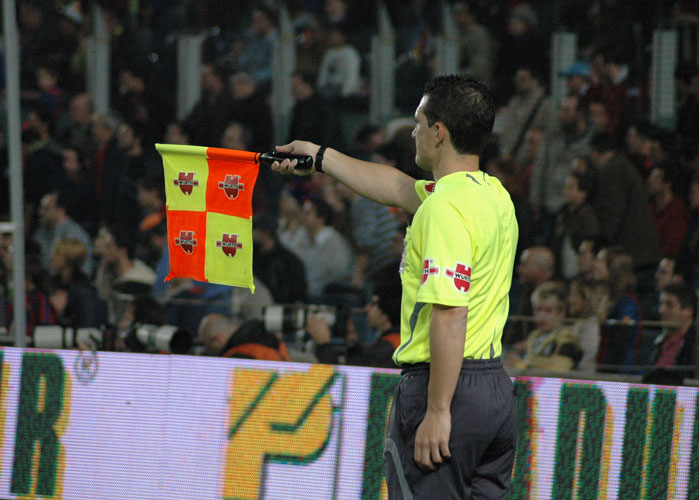


How the rule works in practice
Referees and assistant referees must judge several factors simultaneously: the exact moment the ball is played by a team-mate, the relative positions of players, and whether the player in an offside position becomes involved in play. The offence is judged at the instant the ball is played, not when it is received. If an offside offence occurs, play is restarted with an indirect free kick to the defending team from the place where the offence took place.
What counts as involvement in active play
- Playing or touching the ball after it is played by a team-mate.
- Interfering with an opponent, for example by obstructing a goalkeeper’s line of sight, blocking movement, or making a challenge for the ball.
- Gaining an advantage from being in that position, such as receiving the ball from a rebound off the goalpost, crossbar or an opponent.
A player who is in an offside position but not involved in active play is considered to be passive and should not be penalised.
Common exceptions and special cases
There are clear situations in which a player cannot be penalised for offside. A player is not offside if they are in their own half at the moment the ball is played. Additionally, no offside offence is called when a player receives the ball directly from certain restarts: goal kicks, throw-ins and corner kicks. Other nuanced scenarios arise when the ball is deliberately played by an opponent or when the ball takes an unexpected deflection—these can alter whether an offside offence is judged to have occurred.
History, interpretation and modern developments
The offside concept has existed since the early codification of association football and has evolved through successive clarifications by the sport's law-making body, the IFAB. Interpretations have shifted from a strict positional restriction to a focus on involvement in play and fair competition. In recent years, video review systems have been introduced to help officials make marginal calls. Video assistant referees (VAR) and emerging semi-automated tracking technologies aim to identify the exact moment of the pass and the relative positions of players, reducing human error but sometimes increasing debate over very small margins.
Practical examples and controversies
In everyday play, offside decisions shape tactics: defenders use a high line to catch attackers offside, while attackers time runs to stay level with the second-last defender. Controversy often arises from fast, split-second passes and tight margins where the attacker’s shoulder or toe may be fractionally ahead of a defender. Critics point to subjective judgements such as what constitutes "interfering with an opponent," while proponents of technology argue for clearer, reproducible decisions. Match officials, including the assistant referee, remain responsible for applying the rule on the field, with video review intended to assist but not to replace on-field judgment.
Questions and answers
Q: What is the offside rule in football?
A: The offside rule is a rule in football that punishes the team with the ball for committing an offence by taking an indirect free kick.
Q: Why is the offside rule a much-discussed rule?
A: The offside rule is a much-discussed rule because it is quite complicated and involves a set of provisions that is difficult to understand.
Q: Why is it difficult for the referees to make offside calls?
A: It's difficult for referees to make offside calls because they need to watch the ball, the player with the ball, and the attacker seeking to receive the ball at the same time.
Q: Is it true that the ball must be played forward for an offside offence to be committed?
A: No, it's a common misconception that the ball must be played forward for an offside offence to be committed.
Q: How is an offside offence determined?
A: An offside offence is determined by the position of the player relative to the last two opponents, the ball, and the opponents goal line, rather than the direction of the ball.
Q: When is an attacker in an offside position?
A: An attacker is in an offside position when they are closer to the opponent's goal line than both the ball and the second-last opponent when it is played by their teammate.
Q: Are there any exceptions to the offside rule?
A: Yes, there are exceptions to the offside rule, but the text doesn't specify what they are.
Related articles
Author
AlegsaOnline.com Offside rule (association football) Leandro Alegsa
URL: https://en.alegsaonline.com/art/72064