
Oboe: construction, sound, history, repertoire and variants
A concise encyclopedia overview of the oboe — its design, double-reed sound production, historical development, common uses in orchestras and chamber music, and related instruments.
Overview
The oboe is a soprano-pitched woodwind instrument played with a double reed. It belongs to the family of woodwinds and is played by blowing air through two tied reeds so that they vibrate together and set the air column in motion. Its conical bore gives the oboe a penetrating, bright and reedy tone that distinguishes it from the clarinet, which has a cylindrical bore and a different timbre; both instruments may look similar to the casual observer but produce very different sounds — see clarinet for comparison.
Image gallery
5 Images

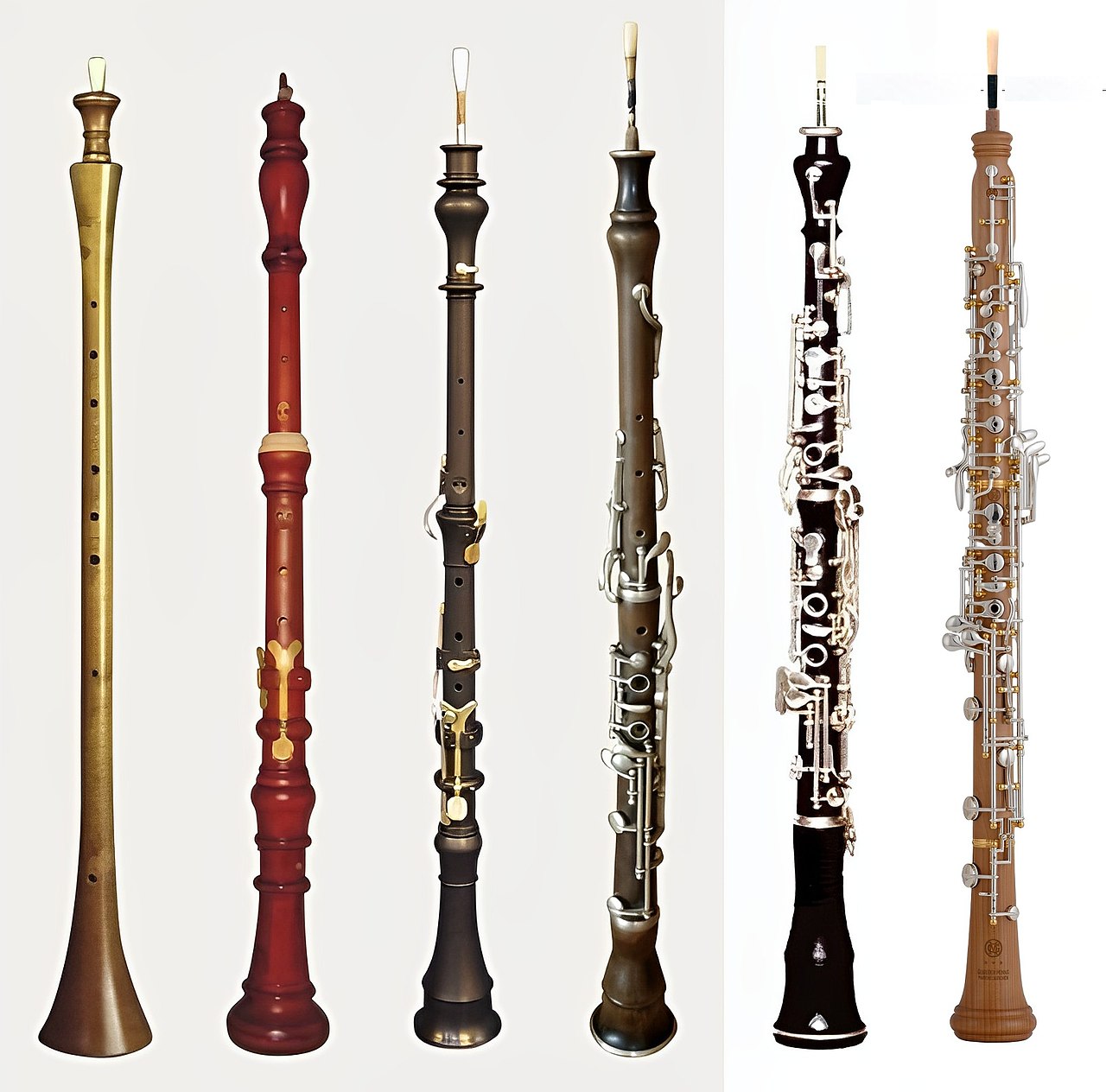


Construction and sound production
Modern oboes are usually made in several sections: the bell, lower joint, upper joint (or top joint), and the reed assembly. Keys and tone holes along the instrument allow the player to change pitch by opening and closing holes while using finger and key combinations. The double reed sits at the narrow end and is crucial to tone and response; small changes in reed shape, cane, or setup have a large effect on sound, tuning and playing comfort. The principal oboist commonly sounds the orchestral tuning note A so the rest of the ensemble can tune to a stable pitch.
History and development
The oboe evolved from earlier shawm-type instruments. Its ancestor, the shawm, was common in medieval and Renaissance music. During the Baroque era the instrument was refined into a more versatile form and gained keys and improved fingerings; this period saw widespread use in ensembles and solo repertoire, as indicated by the instrument's prominence in Baroque works. Composers such as Bach and Handel used it in orchestral contexts, while Italian composers like Vivaldi wrote several concertos for oboe. Over ensuing centuries further mechanical refinements increased technical facility and chromatic accuracy.
Repertoire, role and notable composers
The oboe features in orchestras, chamber ensembles and as a solo instrument. A typical symphony orchestra often includes two oboes and may add a third; a cor anglais or English horn is commonly present as a lower-voiced relative. Composers from different eras wrote for the oboe: Classical and Romantic examples include Mozart and Weber (Weber), later Romantic and early 20th-century composers such as Richard Strauss and 20th-century figures like Francis Poulenc and Ralph Vaughan Williams expanded its solo repertoire. Gustav Holst famously used an extended-range bass instrument in The Planets (Gustav Holst).
Variants and related instruments
- Cor anglais (English horn) — a transposing instrument sounding a fifth lower than the oboe; frequently used for mellow, plaintive solos (cor anglais).
- Oboe d'amore — an instrument pitched between the oboe and English horn, with a more lyrical timbre.
- Bass oboe — sounds an octave below the oboe; rare but used for special colour, as in Holst and a few other orchestral scores.
- Historical variants — baroque oboes and shawms differ in keywork and bore; the instrument's design changed considerably from the 17th to the 20th century.
Technique, maintenance and notable facts
Playing the oboe demands refined breath control, embouchure stability and careful reed work. Oboists often make, adjust or at least select reeds to suit repertoire and pitch conditions. The instrument requires regular maintenance to keep pads, corks and keys functioning correctly. The English name derives from the French hautbois, literally "high wood"; historically the oboe's distinctive timbre has made it a favored vehicle for lyrical solos and expressive melodic lines.
For further reading on performance practice, construction details and instrument care, consult introductory texts, instrument makers' guides and orchestral reference works — or follow specialized resources and conservatory materials linked by topic summaries such as orchestra references, reed-making guides and historical studies. Additional contextual pages include studies of the instrument's acoustic behaviour, its role in chamber music (chamber music), and databases of concertos and works for oboe (concertos, Vivaldi, Bach).
See also composer- and repertoire-focused entries for further examples and listening suggestions — composers mentioned above and others provide a useful starting point for exploring the oboe's varied sonorities and historical development (Weber, Richard Strauss, Poulenc).
Questions and answers
Q: What is an oboe?
A: An oboe is a woodwind instrument with a double reed. It has a conical body and produces sound when air is blown through the double reed at the upper end of the instrument, causing the two reeds to vibrate together.
Q: Who plays an oboe?
A: A person who plays an oboe is called an oboist.
Q: How many oboes are typically in an orchestra?
A: Typically, there are two or three oboes in an orchestra. Occasionally, there may also be a cor anglais which sounds a fifth lower than the oboe and very rarely, there may be a bass oboe which sounds one octave below the regular oboe.
Q: What composers wrote music for solo performances on the Oboe?
A: Composers who wrote music for solo performances on the Oboe include Mozart, Weber, Richard Strauss, Vaughan Williams and Francis Poulenc.
Q: What does "hautbois" mean in French?
A: Hautbois translates to "high wood" in English and refers to its high-pitched sound as a woodwind instrument.
Q: Where did the Oboe come from originally?
A: The Oboe originated from shawm which was popular during medieval and Renaissance times. It became more popular during Baroque period when Bach and Handel used it frequently in their orchestral music as well as Antonio Vivaldi writing concertos for it.
Q: What is it normal for principal Oboists to do before playing in an orchestra?
A: It's normal for principal Oboists to play note A before playing so that other instruments can tune their instruments accordingly.
Related articles
Author
AlegsaOnline.com Oboe: construction, sound, history, repertoire and variants Leandro Alegsa
URL: https://en.alegsaonline.com/art/71791