
Obock Region (Djibouti)
Obock Region is a sparsely populated, coastal administrative region in northern Djibouti with strategic Red Sea and Gulf of Aden frontage, desert landscapes, salt flats, and a largely Afar pastoral population.
Overview
The Obock Region occupies the far north of Djibouti and is centered on the port town of Obock, the region's administrative seat. It is one of the country's least densely populated areas and combines coastal lowlands, arid plains and rugged highlands. Its position along two major waterways gives it strategic and ecological significance despite a relatively small population.
Image gallery
3 Images

Geography and borders
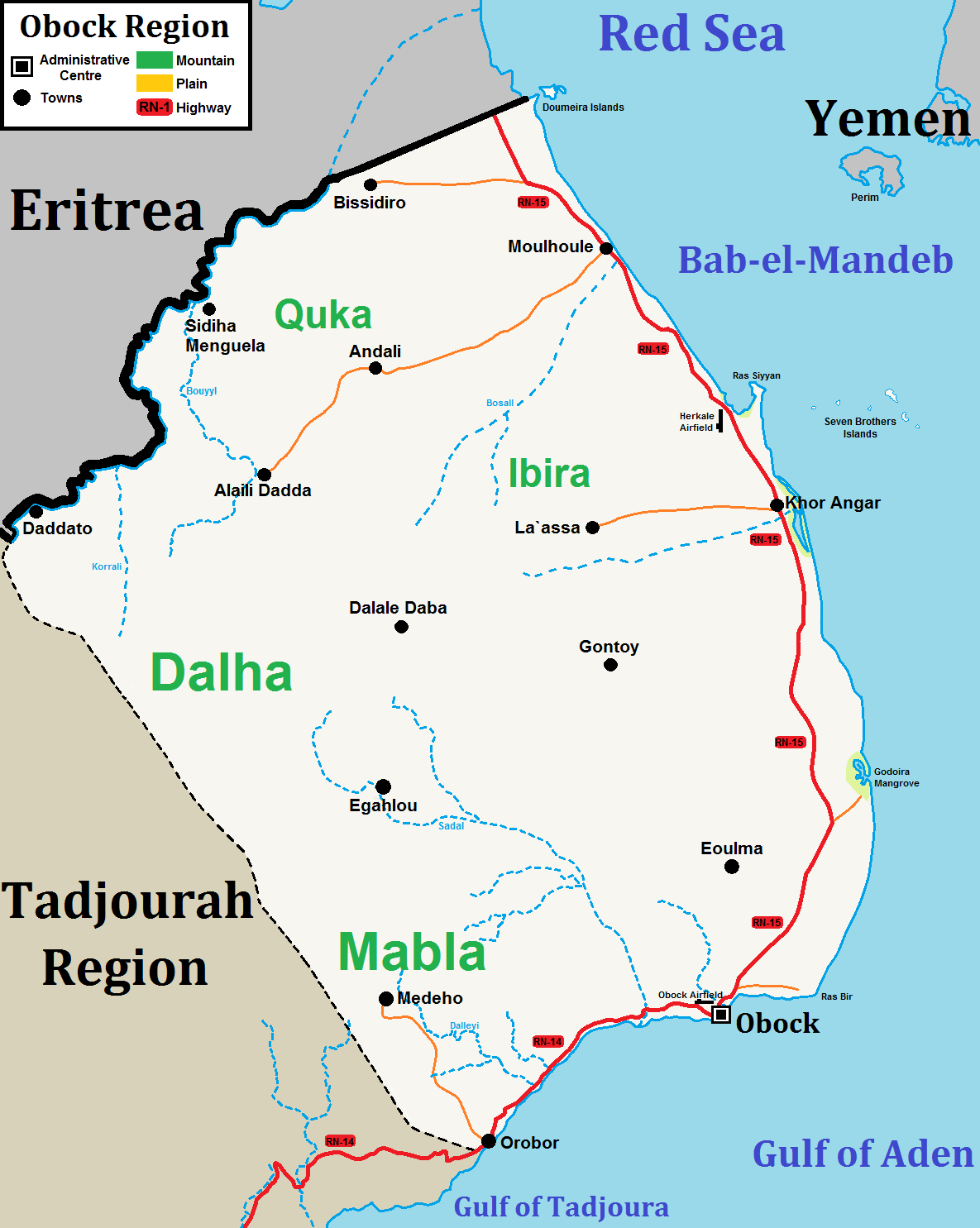
Obock is bounded to the north by Eritrea and to the southwest by the Tadjourah Region. To the east it faces both the Red Sea and the Gulf of Aden, placing its coastline near important international shipping routes. Inland terrain includes volcanic plateaus, seasonal wadis and wide salt flats (sabkhas); several salt-lakes lie along the road toward Tadjourah and are visible from the main tracks linking settlements.
History and human geography
The area has long been inhabited by Afar pastoral communities and has shared in the broader historical currents of the Horn of Africa, including trade across the Red Sea and 19th‑ and 20th‑century colonial presence. Obock town itself served as an early European foothold in the region before other ports grew in importance. Traditional livelihoods—herding, small‑scale trade and fishing—remain central to life in the region.
Economy, environment and biodiversity
Economic activity in Obock is modest: pastoralism, artisanal fishing and salt extraction from coastal flats are the main livelihoods. Marine areas off the coast host coral reefs and diverse fish assemblages, making the coastal zone ecologically valuable. The climate is arid and hot, with rare, irregular rainfall; vegetation is sparse but includes drought‑adapted shrubs and grasses important for grazing.
Towns, transport and services
Besides Obock town, notable settlements include Khôr ‘Angar, Alaili Dadda` and Medeho. Road links are limited and often unpaved; travel between coastal villages and inland wells relies on a network of tracks. Public services such as health and education are concentrated in the regional capital, with smaller clinics and schools serving outlying communities.
Notable facts and contemporary importance
The Obock Region's coastal location near the Bab el‑Mandeb strait and international shipping lanes gives it strategic importance beyond its size. Its salt flats and traditional grazing lands illustrate the adaptation of local communities to an arid environment. For further regional context and administrative details see entries on Djibouti, Obock, neighboring Eritrea, the Tadjourah Region and the adjoining seas (Red Sea, Gulf of Aden).
Questions and answers
Q: Where is the Obock Region located?
A: The Obock Region is located in northern Djibouti.
Q: What is the name of the administrative centre of the Obock Region?
A: The name of the administrative centre of the Obock Region is Obock.
Q: What are the other towns located in the Obock Region?
A: The other towns located in the Obock Region are Khôr ‘Angar, Alaili Dadda`, and Medeho.
Q: What is the Obock Region bordered by?
A: The Obock Region is bordered by Eritrea to the north, the Tadjourah Region to the southwest, and the Red Sea and Gulf of Aden to the east.
Q: What can be found on the road to Tadjoura in the Obock Region?
A: Several salt-lakes can be found on the road to Tadjoura in the Obock Region.
Q: Is the Obock Region located in southern Djibouti?
A: No, the Obock Region is not located in southern Djibouti, but in northern Djibouti.
Q: What bodies of water surround the Obock Region?
A: The Red Sea and Gulf of Aden surround the Obock Region.
Related articles
Author
AlegsaOnline.com Obock Region (Djibouti) Leandro Alegsa
URL: https://en.alegsaonline.com/art/71790
Sources
- presidence.dj : "Djibouti Population"
- google.com : Google Maps
- books.google.com : I Promise to Be Good: The Letters of Arthur Rimbaud