
Numerical weather prediction
Numerical weather prediction (NWP) uses mathematical models, observations and computing to forecast the atmosphere. Covers principles, models, data assimilation, ensembles, limitations and applications.
Overview
Numerical weather prediction (NWP) is the process of forecasting the state of the atmosphere by using mathematical models implemented on computers. Observations from satellites, radar, weather stations, aircraft and other networks define the initial state. The governing physical laws are then used to evolve that state forward in time, producing forecasts used by the public, transport sectors and emergency services. Operational forecasting centers combine data, models and computing to deliver routine weather forecasts and specialized products.
Image gallery
8 Images



Core components
An NWP system integrates multiple interdependent parts:
- Observations and data assimilation: raw measurements are quality-controlled and blended into a dynamically consistent initial condition using statistical and physical techniques.
- Mathematical models: the atmosphere is represented on a numerical grid or basis and its behavior described by equations; many implementations are referred to as computer models.
- Numerical solvers: continuous governing equations are approximated and advanced in time using numerical methods applied numerically.
- Parameterizations: simplified schemes represent processes too small or complex to resolve directly, such as convection, cloud microphysics and surface exchanges.
- Post-processing and delivery: raw model fields are converted into human-readable products, warnings and visualizations for users.
Equations and numerical methods
At the heart of NWP are conservation laws for mass, momentum and energy that treat meteorological quantities as functions of space and time. These are typically expressed as systems of partial differential equations. Variables such as pressure, pressure, temperature and the wind are modeled as fields that evolve by these equations. Practical implementations discretize the domain and use schemes such as finite differences, finite volumes, finite elements or spectral methods to step solutions forward while controlling numerical error.
Data assimilation and observations
Data assimilation merges diverse observations with a prior model state to produce the best available initial condition. Techniques range from variational methods to ensemble-based filters. Effective assimilation reduces initial errors that can grow rapidly over time and limits forecast uncertainty.
Model types and resolution
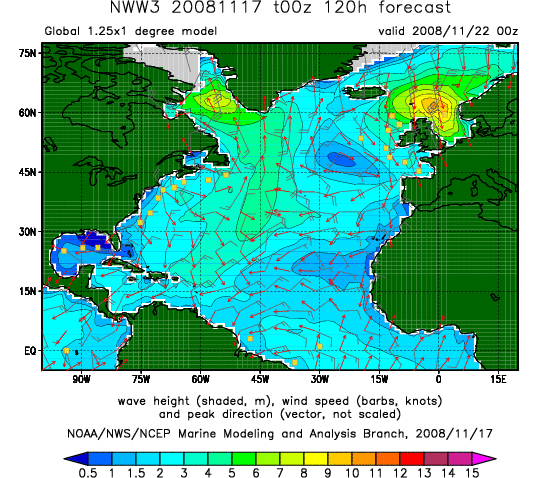
Models vary by scope and resolution. Global models cover the entire planet with coarser grid spacing and provide long-range guidance; regional and convection-permitting models use finer grids to resolve local storms and terrain effects. Higher resolution improves detail but increases computational cost and the need for accurate parameterizations.
Ensembles, uncertainty and verification
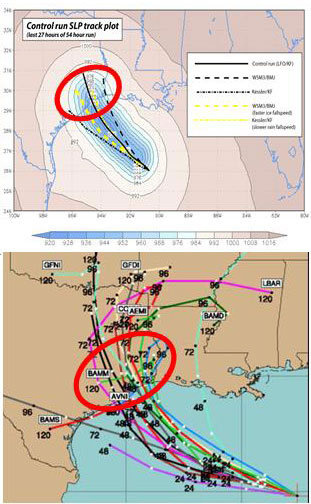
Because the atmosphere is chaotic, small uncertainties in the initial state and model formulation grow with time. Ensemble forecasting runs many members with perturbed initial conditions or model configurations to estimate forecast probability and confidence. Forecast skill is evaluated with verification metrics against observations and reanalyses, guiding model development and operational use.
Applications and computing
NWP underpins daily forecasts, severe-weather warnings, aviation, marine and agricultural services, and supports emergency planning for storms and heat waves. Running large operational suites requires substantial computing power and software infrastructure; many centers rely on high-performance and parallel systems such as supercomputers to produce timely results.
History and challenges
Work on mathematical forecasting dates back to early theoretical efforts; practical computerized forecasts appeared in the mid-20th century as electronic computers became available. Ongoing challenges include incomplete observations, model approximations, representing small-scale processes, and communicating probabilistic information to users. Research continues on improved physics, coupling with the ocean and land surface, and better assimilation methods.
Further reading and resources
Introductory material explains the basic equations and numerical techniques. Technical libraries and educational portals provide model code, tutorials and datasets for study; see repositories on numerical methods and modeling as well as operational forecast portals. For targeted topics consult resources on mathematical functions used in modeling, datasets describing wind and surface fields, and reference material on atmospheric thermodynamics and temperature and pressure. Many training pages discuss how equations are cast as partial differential equations and solved numerically. Additional computational and model documentation is available from institutional collections and community projects that publish code and benchmarks at designated portals and archives for models and datasets.
For practical exploration, students and researchers can access archived model output, tutorials and verification tools via national and international research centers and data services that host learning materials and operational model output links. These resources aid understanding of how modern NWP systems combine observations, theory and computation to produce actionable forecasts.
Key institutional and educational collections provide overviews, operational updates and technical notes; consult those sources to follow advances in data assimilation, ensemble design and high-resolution modeling that continue to expand the capabilities of numerical weather prediction.
Questions and answers
Q: What is numerical weather prediction?
A: Numerical weather prediction is the way weather forecasts are made using computer models of the atmosphere.
Q: How do these models describe current weather conditions?
A: These models describe current weather conditions using equations that take into account parameters such as pressure, temperature, wind direction and speed.
Q: How are these equations solved?
A: These equations are solved numerically using a dynamic system of partial differential equations.
Q: What programming language are these equations implemented with?
A: Most of these equations are implemented using FORTRAN.
Q: Why are supercomputers used to solve these equations?
A: Supercomputers are used because the number of calculations is huge and they need to be finished quickly.
Q: What physical parameters are taken into account when modelling the weather?
A: Physical parameters such as pressure, temperature, wind direction and speed are taken into account when modelling the weather.
Q: Can this modelling accurately predict the weather?
A: While the modelling is not always completely accurate, it serves as a useful tool for predicting weather patterns in the future.
Related articles
Author
AlegsaOnline.com Numerical weather prediction Leandro Alegsa
URL: https://en.alegsaonline.com/art/71438