
Nucleosome
A nucleosome is the basic repeating unit of chromatin: DNA wrapped around histone proteins that compacts chromosomes and helps regulate gene activity, replication and repair.
Overview
A nucleosome is the fundamental structural unit of eukaryotic chromatin. It consists of a segment of DNA wound around a core of histone proteins to form a compact particle. Repeating nucleosomes arrayed along the DNA produce the fibrous material known as chromatin, which in turn organizes into higher-order structures that make up chromosomes.
Image gallery
9 Images




Structure and components
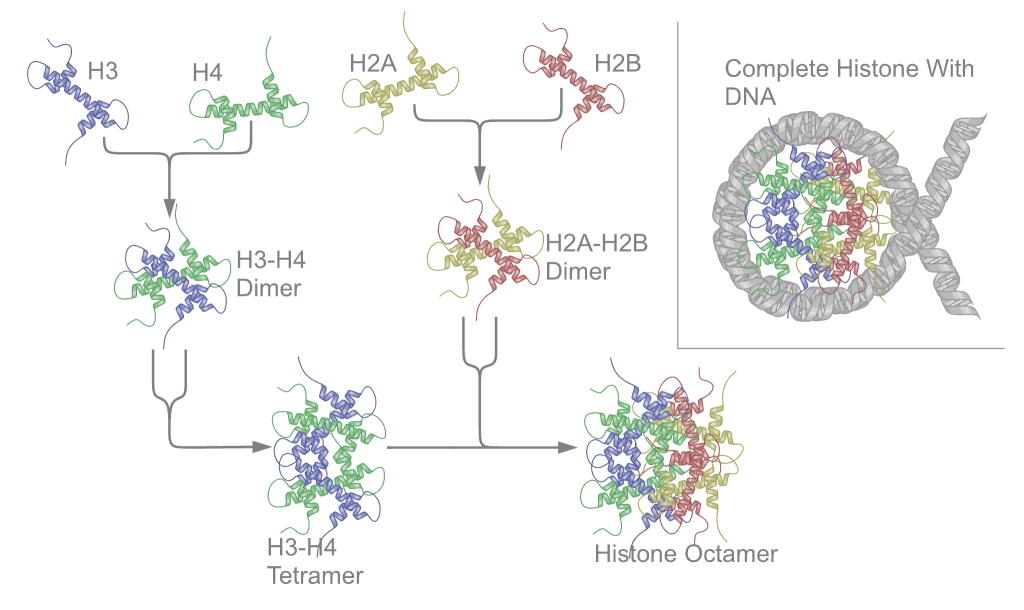
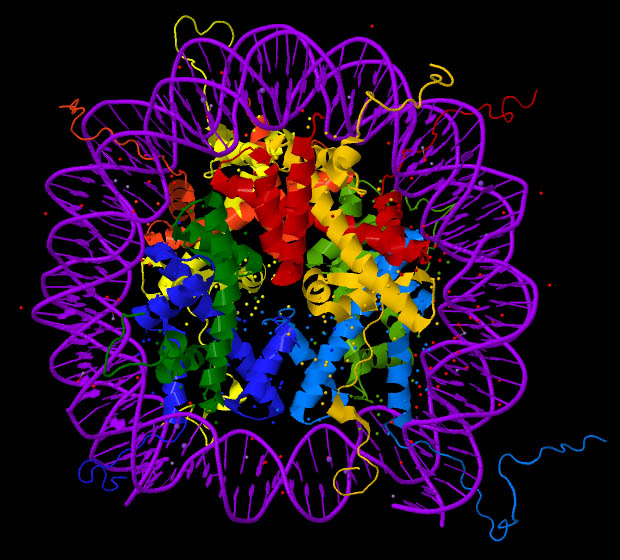
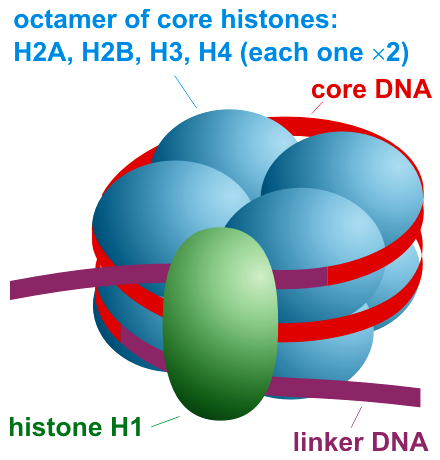
Each core nucleosome typically contains an octamer of histone proteins — two copies each of H2A, H2B, H3 and H4 — around which about 147 base pairs of DNA are wrapped in roughly two turns. A stretch of unwrapped "linker" DNA connects adjacent nucleosomes. An additional, more loosely bound linker histone (often called H1) can associate with the entry and exit of the DNA to form a chromatosome and influence folding into higher-order fibers.
Organization and dynamics
Nucleosomes are not fixed beads but dynamic structures: their position along DNA, spacing, and composition can change. Specialized remodeling complexes slide, eject or restructure nucleosomes to alter DNA accessibility. Chemical modifications of histone tails — such as acetylation, methylation and phosphorylation — affect how tightly DNA is held and serve as signals for other proteins, forming a molecular layer of regulation often called the histone code.
Functions and biological importance
By compacting DNA, nucleosomes allow long genomes to fit inside the nucleus while still permitting regulated access to the genetic code. They play central roles in controlling transcription, replication and DNA repair. Changes in nucleosome positioning and histone modifications contribute to developmental programs and to cellular responses; misregulation is implicated in disease, including cancer and developmental disorders.
History and study
The concept of repeating chromatin subunits emerged from biochemical and electron microscopy studies in the mid‑20th century, with the modern nucleosome model refined through biochemical experiments and later by high‑resolution structural techniques. Contemporary research uses genomics, structural biology and live-cell imaging to map nucleosome organization and dynamics across genomes.
Notable distinctions and further reading
- Core nucleosome vs chromatosome: the chromatosome includes the linker histone that stabilizes entry/exit DNA.
- Positioning and post‑translational modifications define regulatory states important in epigenetics.
- For introductory summaries see general resources on histone proteins and chromatin, and on how nucleosomes influence cell division processes.
Readers can follow basic topics such as histone variants and remodeling complexes to learn how different nucleosome forms influence function; introductory materials about the protein components and chromatin organization are helpful starting points for students and researchers alike.
Questions and answers
Q: What are nucleosomes?
A: Nucleosomes are the building blocks that make up chromosomes. They consist of a segment of DNA wound around a histone protein core.
Q: What is chromatin?
A: Chromatin is a substance that consists of DNA and a protein.
Q: What happens to chromatin to form nucleosomes?
A: Chromatin is packed up to form nucleosomes.
Q: What are the three things that packages of nucleosomes do?
A: The packages of nucleosomes do three things: they function in cell division, they wrap up the very long DNA in a shorter package, and they regulate the gene action in cells.
Q: What is the function of chromosomes in cell division?
A: The function of chromosomes in cell division is to ensure the equal distribution of genetic material between daughter cells.
Q: What is the role of histone proteins in nucleosomes?
A: Histone proteins act as a core around which a segment of DNA is wound to form a nucleosome.
Q: What is the role of proteins in regulating gene action in cells?
A: Proteins play a role in regulating gene action in cells by helping to control the expression of genes.
Related articles
Author
AlegsaOnline.com Nucleosome Leandro Alegsa
URL: https://en.alegsaonline.com/art/71387
Sources
- ncbi.nlm.nih.gov : Molecular biology of the cell
- sciencemag.org : "Spheroid chromatin units (v bodies)"
- pubmed.ncbi.nlm.nih.gov : 4128918
- nature.com : nature.com
- sciencemag.org : "Chromatin structure: a repeating unit of histones and DNA"
- pubmed.ncbi.nlm.nih.gov : 4825889
- ncbi.nlm.nih.gov : "Predicting nucleosome positions on the DNA: combining intrinsic sequence preferences and remodeler activities"
- doi.org : 10.1093/nar/gkp610
- pubmed.ncbi.nlm.nih.gov : 19625488
- ncbi.nlm.nih.gov : "Acetylation and methylation of histones and their possible role in the regulation of RNA synthesis"
- doi.org : 10.1073/pnas.51.5.786
- pubmed.ncbi.nlm.nih.gov : 14172992
- doi.org : 10.1038/nature01411