
Nuclear fallout: causes, characteristics, history, and protection
Nuclear fallout is radioactive material deposited after a nuclear detonation or reactor release. This article covers formation, types, health effects, notable incidents, measurement and protective measures against contamination.
Overview
Nuclear fallout is the radioactive material that descends from the atmosphere after a nuclear detonation or the accidental release of radioactive material from a reactor or facility. Fallout consists of fission products, unconsumed fissile material, and other substances rendered radioactive by neutron activation. These particles and vapors are carried in a plume and later deposit on the ground, water and surfaces as particulate matter or condensed aerosols. For basic information on radiation and its effects see general references on ionizing radiation and on the physical processes of an airborne release such as a nuclear explosion.
Image gallery
10 Images





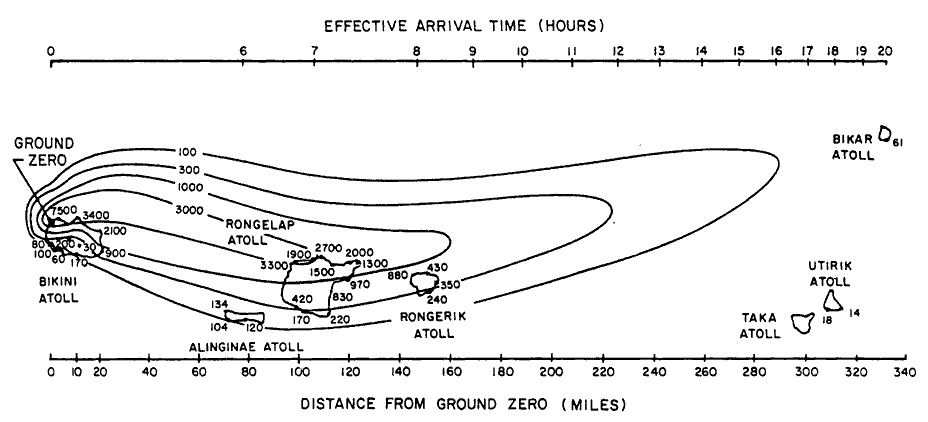
Formation and dispersion
When a nuclear device detonates or a reactor core is breached, extremely hot gases and particulate products are injected into the atmosphere. Some material rises to high altitudes and can travel long distances; other, coarser material falls out close to the source. In addition, neutrons produced in a detonation or released during damage can activate surrounding materials, adding to the inventory of radioactive contaminants. The composition of fallout therefore varies with the type of event, the materials present, and meteorological conditions. Radioactive decay of the mixture governs how the hazard changes over time; for discussion of decay processes see technical sources on radioactive decay.
Types and patterns
- Local (early) fallout: heavier particles descend within hours to days and create intense contamination near the release site.
- Distal (delayed or global) fallout: fine particles and gases spread in the upper atmosphere and deposit after days to years far from the source, sometimes distributed widely across continents.
- Activation products: materials that were not originally radioactive but have become so through neutron exposure.
Health effects and exposure pathways
Fallout produces external exposure from gamma and beta radiation emitted by contaminated surfaces and ground, and internal exposure when radioactive particles are inhaled, ingested in food or water, or enter wounds. Acute high-level exposures can cause radiation sickness, while lower-level or protracted exposures increase lifetime cancer risk and can affect developing tissues and reproductive organs. Protective guidance, monitoring and dose assessment are routinely developed by radiation-protection authorities; see emergency guidance and standards at official guidance.
Measurement, monitoring and units
Environmental and personal monitoring uses instruments and laboratory analysis to measure activity (commonly given in becquerels) and dose (expressed in sieverts or grays for absorbed energy). Programs sample air, rain, soil, milk and foodstuffs to track deposition and to estimate doses to people. Rapid field surveys guide immediate decisions such as evacuation or sheltering, while laboratory assays provide isotope-specific data needed for long-term planning. International and national networks share data and can provide alerts; see monitoring program resources and technical reviews at monitoring references.
Notable incidents and historical context
Fallout has occurred from atmospheric nuclear weapons testing, wartime detonations, and major reactor accidents. Decades of atmospheric testing dispersed fission products globally and were a major reason for international test ban agreements. The 1986 Chernobyl reactor accident released large quantities of radioactive material that contaminated areas of Chernobyl region and required evacuation and long-term exclusion zones; measurable deposition affected parts of Ukraine, Belarus and Russia. The 2011 Fukushima Daiichi accident also produced local and regional contamination and prompted food and water restrictions and remediation efforts. Fallout and cross-border measurements were detected in distant regions such as Scandinavia and across Europe during several historic releases.
Protection, mitigation and long-term management
Immediate protective principles are time, distance and shielding: minimize time in contaminated areas, increase distance from depositional zones, and use sheltering or structural shield to reduce external exposure. Practical emergency actions include evacuation, sheltering-in-place, decontamination of people and property, control of food and water supplies, and administration of medical countermeasures where appropriate. Long-term responses may involve land-use restrictions, soil removal or containment, fixation treatments, and prolonged health surveillance. Preparedness, public communication and international cooperation improve the ability to detect, predict and respond to fallout events; authoritative materials and planning tools are available through radiation safety organizations and civil-protection agencies at resources like radiation basics, explosion mechanics and dedicated decay and dosimetry overviews.
Environmental and social consequences
Large-scale fallout can lead to long-term contamination of ecosystems, disruption of agriculture and food chains, and socioeconomic impacts including population displacement, land abandonment and costly remediation and monitoring programs. The scale and persistence of such consequences depend on the isotopes released, geographic and climatic conditions, and the resources devoted to response and recovery.
Further reading and resources
- Technical and emergency guidance from national and international radiation-protection authorities: see reviews and advisories at regional reports.
- Historical summaries of weapons testing and accident case studies are provided in many scientific and governmental publications; general overviews and monitoring data can be found through consolidated portals and surveillance networks at surveillance pages and incident archives.
- Educational materials on mitigation and dose reduction are distributed by civil-protection agencies and health organizations; introductory material is available at public health resources and specialist summaries at technical collections.
For immediate concerns about possible contamination or for guidance during an event, consult local authorities and designated emergency information channels and follow official instructions found in preparedness plans and authoritative guidance sources such as those indexed at international guidance.
Questions and answers
Q: What exactly is fallout?
A: Fallout refers to the residual radiation hazard that is left over after a nuclear explosion.
Q: Why is it called "fallout"?
A: The name "fallout" comes from the fact that radioactive material from the explosion "falls out" of the atmosphere and settles on the ground below.
Q: What causes the creation of fission products?
A: All nuclear explosions result in the creation of fission products, which are the broken, radioactive atoms that result from the fission reaction.
Q: What other materials can become radioactive during a nuclear explosion?
A: Neutrons from the explosion can also cause nearby materials to become radioactive.
Q: Was radioactive fallout only caused by nuclear weapons?
A: No, there was also radioactive fallout after the Chernobyl disaster, which was caused by a malfunctioning nuclear power station.
Q: What area was affected by the radioactive fallout from the Chernobyl disaster?
A: The radioactive fallout from the Chernobyl disaster caused serious contamination over an area including Ukraine, Belarus, Russia, Scandinavia, and parts of Europe.
Q: What happened to people living within 30 kilometres of the Chernobyl power plant?
A: All people living within a 30-kilometre radius of the Chernobyl power plant were forced to move because of the radioactive fallout. Many villages and towns in the area were abandoned.
Related articles
Author
AlegsaOnline.com Nuclear fallout: causes, characteristics, history, and protection Leandro Alegsa
URL: https://en.alegsaonline.com/art/71355
Sources
- world-nuclear.org : "Chernobyl | Chernobyl Accident | Chernobyl Disaster"