
NSDAP 25-Point Program: Origin, Content, and Historical Significance
The 25-point program was the founding political manifesto of the National Socialist German Workers' Party (NSDAP), drafted in 1920. It set out the movement's aims and influenced its subsequent ideology and policies.
Overview
The 25-point program was the founding political platform of the National Socialist German Workers' Party, presented in 1920. It was drawn up primarily by Anton Drexler and revised and promoted by Adolf Hitler as the party coalesced into a national movement. The program condensed the party's goals into a concise list intended to outline who could belong to the movement and what it sought to achieve. It functioned both as recruitment material and as a public statement of principles during the party's early years.
Image gallery
2 Images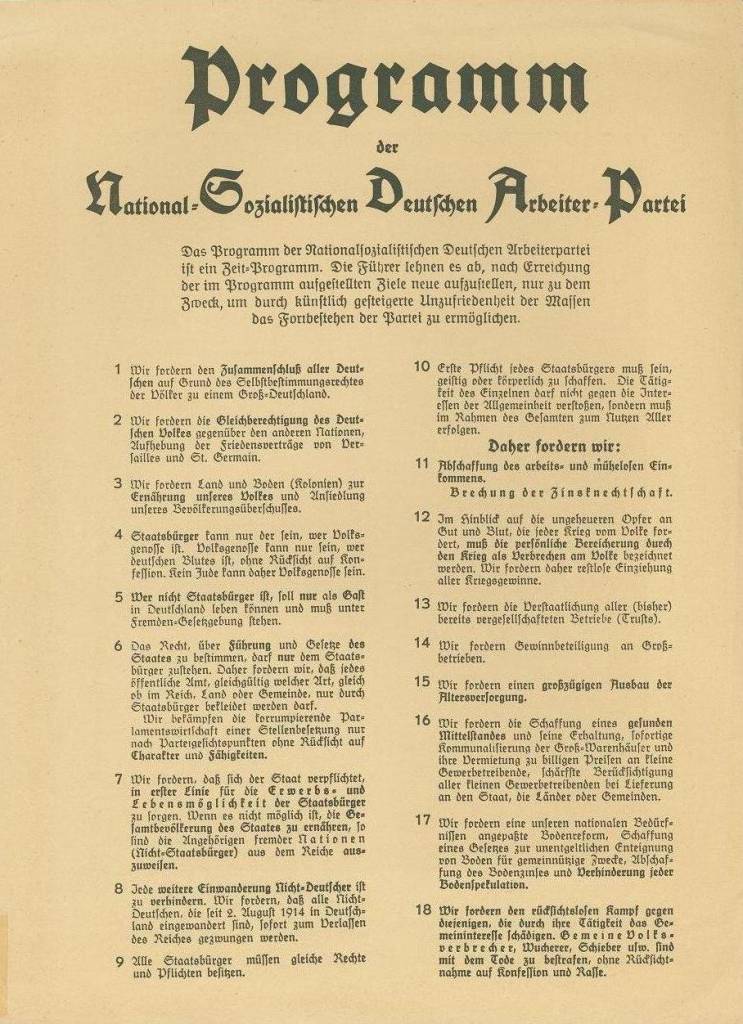

Core themes and content
The document combined several strands of political messaging—nationalist, populist and social-economic—framed within a sharply exclusionary racial outlook. Its major themes included strong German nationalism, revocation or revision of postwar settlements perceived as unjust, a demand for greater rights for ethnic Germans, and social measures presented as benefiting the ‘people’. The program also contained explicit provisions that excluded Jews from the definition of the political community, and it called for measures affecting property, industry and the distribution of wealth.
Typical points and emphases
- Citizenship and belonging defined in ethnic terms, excluding groups identified as foreign or undesirable.
- Territorial revisionism and rejection of the post-World War I treaties and war-guilt clauses.
- State intervention in the economy, including demands for the nationalization or control of large trusts, and social welfare promises for certain social classes.
- Strictures on immigration and naturalization, especially directed against Jews, which reflected and institutionalized an explicitly antisemitic policy orientation.
Origin and development
The program emerged in the chaotic aftermath of World War I, amid political instability and economic distress in Germany. Publicized at a party convention, it helped turn a fringe association into an organized political force by offering a compact, easily communicated agenda. Adolf Hitler later discussed the program's role in shaping and recruiting for the movement in his autobiographical and political writing; the document remained a reference point for the party even as priorities and rhetoric evolved under Hitler's leadership.
Impact and historical significance
As a manifesto, the 25-point program played an important role in clarifying and broadcasting the NSDAP's aims. It served as propaganda to attract diverse constituencies—nationalists, veterans, unemployed workers and others—by combining promises of national revival with social and economic proposals. Importantly, the program's exclusionary and racist clauses provided an ideological basis that later informed discriminatory and violent policies enacted by the movement after it gained power. The program is therefore studied as an early blueprint that illuminates the party's intentions and priorities.
Legacy and interpretation
Historians examine the 25-point platform both as a political tool of early National Socialism and as a revealing historical document. Some of its economic and social-sounding elements were used tactically to broaden appeal; other provisions—particularly those dealing with race and belonging—were central to the movement's identity and had catastrophic consequences when translated into state policy. For contemporary readers the program remains a primary source for understanding the movement's formation and the ideological groundwork that preceded later developments under the NSDAP. For further context on how the program was presented and commented upon by its leaders, see references in Mein Kampf.
Researchers and readers should treat the document as both propaganda and policy statement: it illuminated aims, attracted followers, and foreshadowed the radical policies that would follow once the movement attained state power. The program's role in history is thus inseparable from the broader study of extremism, propaganda and state-driven discrimination in twentieth-century Europe.
Questions and answers
Q: What is the NSDAP 25 points manifesto?
A: The NSDAP 25 points manifesto is a 25-point plan written by Anton Drexler and edited and supported by Adolf Hitler for the National Socialist German Workers' Party (NSDAP), Nazi Party, when it was founded in 1920.
Q: Who wrote and supported the NSDAP 25 points manifesto?
A: Anton Drexler wrote the NSDAP 25 points manifesto and it was edited and supported by Adolf Hitler.
Q: When was the NSDAP 25 points manifesto written?
A: The NSDAP 25 points manifesto was written in 1920.
Q: What was the purpose of the NSDAP 25 points manifesto?
A: The purpose of the NSDAP 25 points manifesto was to give a rough picture of the movement's aims and recruit for the National Socialist German Workers' Party.
Q: Where was the explanation of the purpose of the 25 points found?
A: The explanation of the purpose of the 25 points was found in the fifth chapter of the second volume of Mein Kampf.
Q: How many guiding principles are there in the NSDAP 25 points manifesto?
A: There are twenty-five guiding principles in the NSDAP 25 points manifesto.
Q: What is the NSDAP 25 points manifesto in a sense?
A: In a sense, the NSDAP 25 points manifesto is a political creed that recruits for the movement and is suited to unite and weld together those who have been recruited.
Related articles
Author
AlegsaOnline.com NSDAP 25-Point Program: Origin, Content, and Historical Significance Leandro Alegsa
URL: https://en.alegsaonline.com/art/71321
Sources
- hitler.org : "Programme of the NSDAP"