
Northern goshawk (Accipiter gentilis): identification, behavior, and conservation
A comprehensive overview of the northern goshawk (Accipiter gentilis): appearance, range, behavior, history in falconry, and conservation status across Europe, Eurasia and North America.
Overview
The northern goshawk (Accipiter gentilis) is a large, powerful bird of prey in the family Accipitridae. It is commonly called the goshawk and is considered one of the archetypal "true hawks" in the genus Accipiter, which also contains several smaller forest-dwelling hawk species (other Accipiter species). The species has a broad Holarctic distribution, occurring across much of Europe, western and northern Eurasia and large parts of North America. Its scientific name reflects its identity: Accipiter is Latin for "hawk".
Image gallery
10 Images
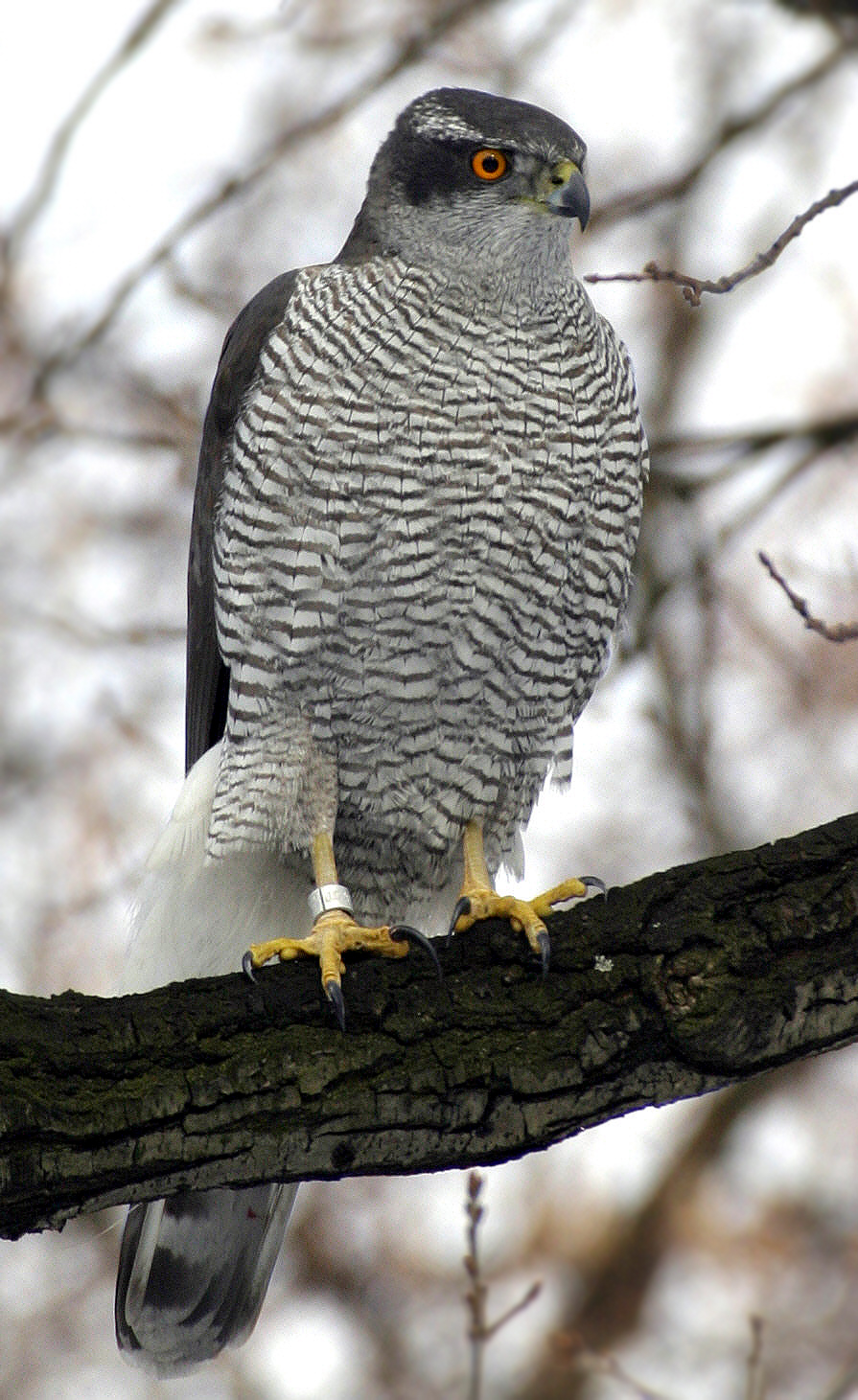


Identification and physical characteristics
Northern goshawks are medium-large raptors with a robust body, long tail and broad, rounded wings adapted for agile flight through dense woodland. Adults typically show slate-grey to dark brown upperparts and a pale, finely barred underside. A bold white eyebrow stripe is a characteristic facial feature. There is marked sexual dimorphism: females are noticeably larger than males and can be up to one-third heavier. Juveniles differ in having browner upperparts and streaked, rather than finely barred, underparts.
Distribution, habitat and movements
The goshawk favors mature forests with a mix of closed canopy and open hunting spaces. It occupies coniferous, mixed and deciduous woodlands and can be found from lowland forests to boreal zones and montane woodlands. Many populations are resident year-round, while individuals from the coldest parts of the range may move south or to lower elevations in winter. In North America, migratory goshawks are sometimes observed following mountain ridgelines during fall migration.
Behavior, diet and hunting
Goshawks are stealthy, sit-and-wait predators that rely on surprise and rapid, maneuverable pursuit through trees to capture prey. Their diet is diverse and includes medium-sized birds (such as grouse and corvids) and mammals (hares, squirrels and other rodents). They are capable of taking sizeable prey relative to their own weight and use powerful talons to subdue captures. Pairs maintain territories and hunt over a combination of closed forest and adjacent openings.
Reproduction and lifespan
Pairs are typically monogamous within a season and often maintain territories year after year. Nests are bulky constructions of sticks placed high in mature trees and are reused and refurbished across seasons. Clutch sizes commonly range from a few eggs to half a dozen, with incubation and nestling care shared by both adults. Lifespan in the wild varies but many birds live several years; survival is highest in well-protected habitats.
History with people and conservation
The goshawk has long been associated with falconry: in medieval Europe trained goshawks were prized by the nobility (falconry in the Middle Ages). Historically, persecution, habitat loss and pesticide impacts reduced numbers in parts of its range, though many populations have recovered where forested landscapes persist and protective measures exist. Current conservation issues include habitat fragmentation, illegal shooting in some regions and sensitivity to timber management that removes mature nesting trees.
Distinguishing facts and comparisons
- The goshawk is larger and more robust than similar forest hawks such as the Cooper's hawk and has a faster, more powerful flight at low altitude.
- Only a few raptors, for example the golden eagle, approach or exceed the goshawk in overall Holarctic range.
- Its name comes from Old English roots often rendered as "goose-hawk," reflecting historic perception of its strength.
For additional general information about taxonomy, identification and regional status, consult reputable field guides and species accounts available through ornithological organizations and conservation groups (species overview, family context, related Accipiter species, genus details, European range, Eurasian records, North American status, nomenclature, falconry heritage).
Notable observation: migratory behavior is variable and influenced by local climate and prey availability; some populations are largely sedentary while others undertake seasonal movements. Field identification benefits from attention to size, silhouette, facial pattern and habitat.
Questions and answers
Q: What is the northern goshawk?
A: The northern goshawk is a medium-large raptor in the family Accipitridae.
Q: Why is the northern goshawk called the goshawk?
A: The northern goshawk is spoken of as the goshawk because it has a wide range over most of Europe, Eurasia and North America, and its scientific name in Latin is Accipiter, which means "hawk".
Q: What is the range of the northern goshawk?
A: The northern goshawk has a wide range over most of Europe, Eurasia and North America, probably only the golden eagle has a wider range.
Q: How is the northern goshawk classified?
A: The northern goshawk is classified as a "true hawk".
Q: Who were only permitted to fly goshawks for falconry in the Middle Ages?
A: In the Middle Ages, only the nobility were permitted to fly goshawks for falconry.
Q: Is the northern goshawk a resident or migratory bird?
A: The northern goshawk is mainly a resident bird, but those from colder regions migrate south for the winter.
Q: When are migratory goshawks often seen migrating south in North America?
A: Migratory goshawks are often seen migrating south along mountain ridge tops at nearly any time of the fall, depending on latitude, in North America.
Related articles
Author
AlegsaOnline.com Northern goshawk (Accipiter gentilis): identification, behavior, and conservation Leandro Alegsa
URL: https://en.alegsaonline.com/art/71021
Sources
- iucnredlist.org : "Accipiter gentilis"
- avis.indianbiodiversity.org : "Astur gentilis schvedowi AVIS-IBIS"