
North American Plate
A comprehensive overview of the North American tectonic plate: extent, boundaries, internal structure, geological history, and its significance to earthquakes and landscape evolution.
Overview: The North American Plate is a major tectonic plate that carries the bulk of the North American continent and adjacent oceanic crust. It is the Earth's second-largest plate by area, roughly 76,000,000 km2, and interacts with the Pacific Plate, Eurasian Plate, African Plate and others along a complex set of boundaries. The term tectonic plate refers to one of the rigid slabs that make up the planet's outer shell.
Image gallery
1 Image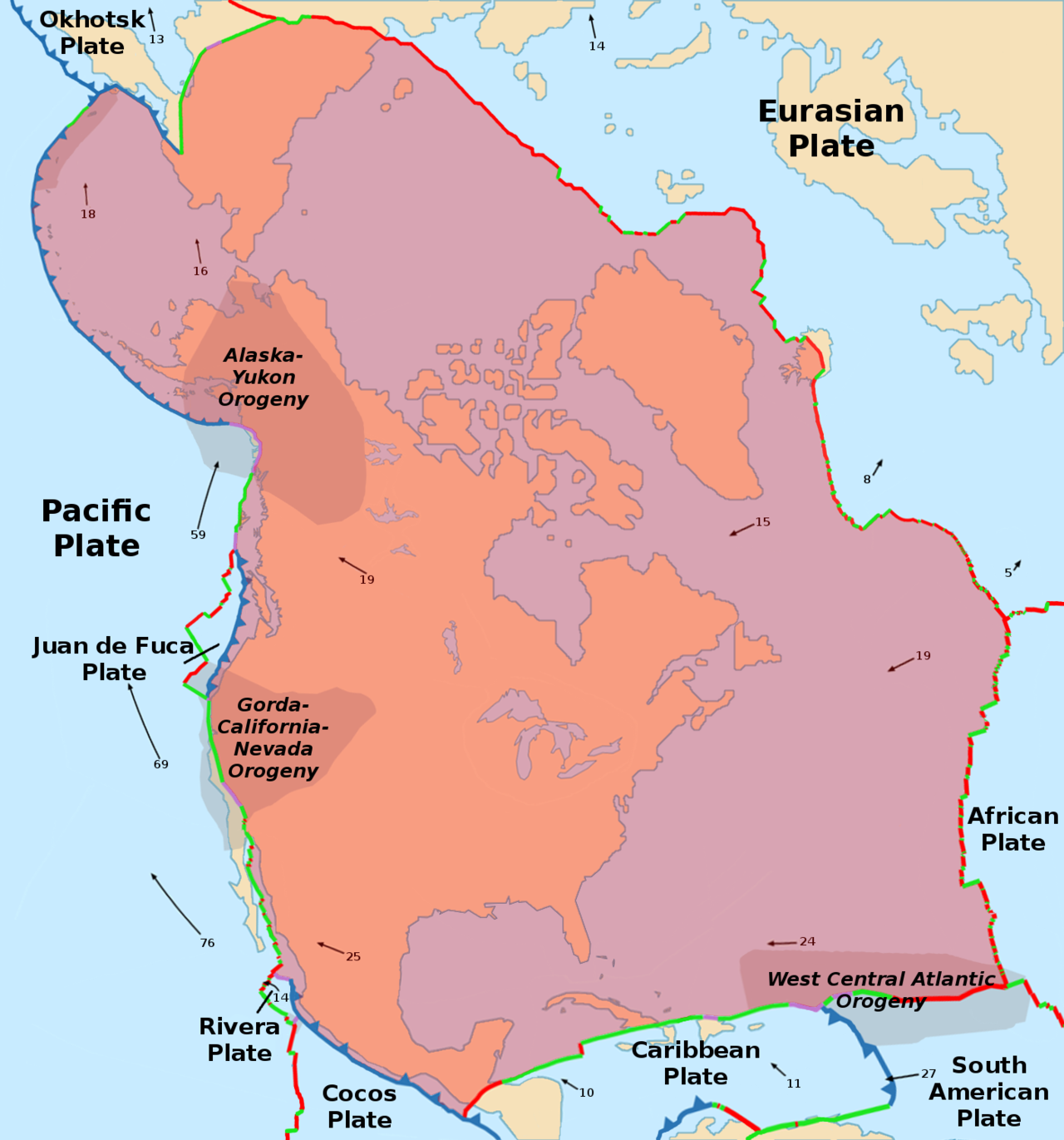
Geographic extent
The plate encompasses most of continental North America, and also carries a number of island and offshore regions: Greenland, parts of the Caribbean such as Cuba and the Bahamas, extreme northeastern sections of Asia (Siberia fringe), and stretches that include portions of Iceland and some islands in the Azores. Its eastern margin reaches the Mid-Atlantic Ridge, a divergent boundary where new oceanic crust forms.
Boundaries and neighbors
On the west the plate abuts the Pacific Plate and other smaller plates, with active transform faults and subduction zones that produce earthquakes and volcanism. To the far northwest it reaches toward the Chersky Range in eastern Siberia, marking a complex transition to the Eurasian and adjacent plates (Chersky Range). Boundaries can be divergent, convergent or transform, and are not limited to coastlines: they cut through oceans and sometimes across continents.
Internal structure and components
The North American Plate includes both continental and oceanic crust: broad expanses of granitic continental crust and narrower regions of basaltic oceanic crust (continental crust, oceanic crust). The ancient, stable heart of the plate is a granitic craton, often referred to in North America as the Canadian Shield or Laurentian craton; cratons are old, thick lithosphere fragments (granitic, craton). Around the edges of this craton are numerous terranes: smaller blocks of crust that have been accreted or sutured to the margin over hundreds of millions of years (terrane).
Geological history and development
The plate's present outline is the result of long-term processes including seafloor spreading, collision, continental rifting and accretion of terranes. Over geological time the margin has grown outward as island arcs and microcontinents collided and stuck to the craton. Divergent motion along the Mid-Atlantic Ridge gradually separates the North American Plate from the Eurasian and African plates, while interactions at western margins continue to reshape mountain ranges and basins.
Significance and examples of activity
Because it comprises both stable interior regions and active margins, the plate illustrates a wide range of tectonic behavior. Stable cratonic interiors experience little deformation, whereas margins host earthquakes, volcanic arcs and mountain building. Examples include the seismic and volcanic activity related to the Pacific margin, and the slow seafloor spreading at the Mid-Atlantic Ridge. These processes influence topography, resource distribution (minerals and hydrocarbons), and natural hazards.
- Major neighbors and features: tectonic plate concept, Mid-Atlantic Ridge, Chersky Range.
- Terranes and craton: craton, granitic shield, accreted terranes.
- Included regions and islands: North America, Greenland, Cuba, Bahamas, extreme NE Asia, Iceland, Azores.
- Crust types: continental crust, oceanic crust.
For further technical descriptions and maps consult detailed geologic and geophysical resources: introductory treatments of plate tectonics and region-specific studies expand on how the North American Plate has evolved and how it continues to influence surface processes and hazards across the hemisphere.
Questions and answers
Q: What is the North American plate?
A: The North American plate is a large tectonic plate that covers most of North America, Greenland, Cuba, the Bahamas, parts of Iceland and the Azores, and extreme northeastern Asia.
Q: What is the area of the North American plate?
A: The area of the North American plate is 76,000,000 km2 (29,000,000 sq mi).
Q: What is the position of the North American plate in relation to other tectonic plates?
A: The North American plate is the Earth's second-largest tectonic plate, behind the Pacific Plate, which borders it to the west.
Q: What kinds of crust does the North American plate include?
A: The North American plate includes both continental and oceanic crust.
Q: What is the interior of the North American plate's landmass composed of?
A: The interior of the North American plate's landmass is an extensive granitic craton.
Q: What are the fragments of crustal material called that are stuck on to the craton over a long span of time?
A: The fragments of crustal material are called terranes.
Q: What is much of North America west of the Rocky Mountains composed of?
A: Much of North America west of the Rocky Mountains is composed of terranes that are stuck on (accreted) to the craton over a long span of time.
Related articles
Author
AlegsaOnline.com North American Plate Leandro Alegsa
URL: https://en.alegsaonline.com/art/70811