
North American P-51 Mustang: design, history, and legacy
Long-range American fighter of WWII, the P-51 Mustang combined a laminar-flow wing and Merlin power to escort bombers, excel in multiple roles, and remain iconic in postwar aviation and air racing.
Overview
The North American P-51 Mustang is a single-seat, single-engine fighter that became one of the most influential combat aircraft of World War II. Conceived and built by North American Aviation, the Mustang entered service with Allied air forces and—after fitting with a more capable powerplant—proved ideally suited to long-range escort missions over Europe and the Pacific. Its combination of range, speed and maneuverability allowed it to protect strategic bombing raids and to take on air superiority and ground-attack tasks.
Image gallery
10 Images




Design and key characteristics
From the beginning the Mustang emphasized aerodynamic efficiency. Its laminar-flow wing reduced drag at high speed, and a streamlined fuselage helped deliver notable performance for a single-engine fighter of its era. Early models used an Allison V-1710 engine that gave good low-altitude power but limited high-altitude capability. Later production received a Packard-built license version of the Rolls-Royce Merlin engine, improving performance above roughly 15,000 feet and transforming the Mustang into a true high-altitude escort fighter.
Distinctive features include the ventral radiator installation that benefited from the Meredith effect to recoup some cooling drag, and the P-51D's clear, 'bubble' canopy which greatly improved pilot visibility compared with earlier framed canopies. Typical armament for many wartime Mustangs consisted of multiple .50-caliber machine guns mounted in the wings; later adaptations and field modifications allowed for bombs and rockets for fighter-bomber missions.
Development, variants and technical evolution
Development began under a rapid prewar contract to provide fighters to Allied air forces. The type progressed through a series of versions during the war: early production and Allison-powered variants were followed by the Merlin-powered P-51B/C series and the widely produced P-51D. A late-war, lighter P-51H aimed at higher speed and improved climb was produced in smaller numbers. Modifications across variants included changes to the canopy, armament layout, internal fuel capacity and engine installation to balance range, performance and pilot protection.
Operational use and impact
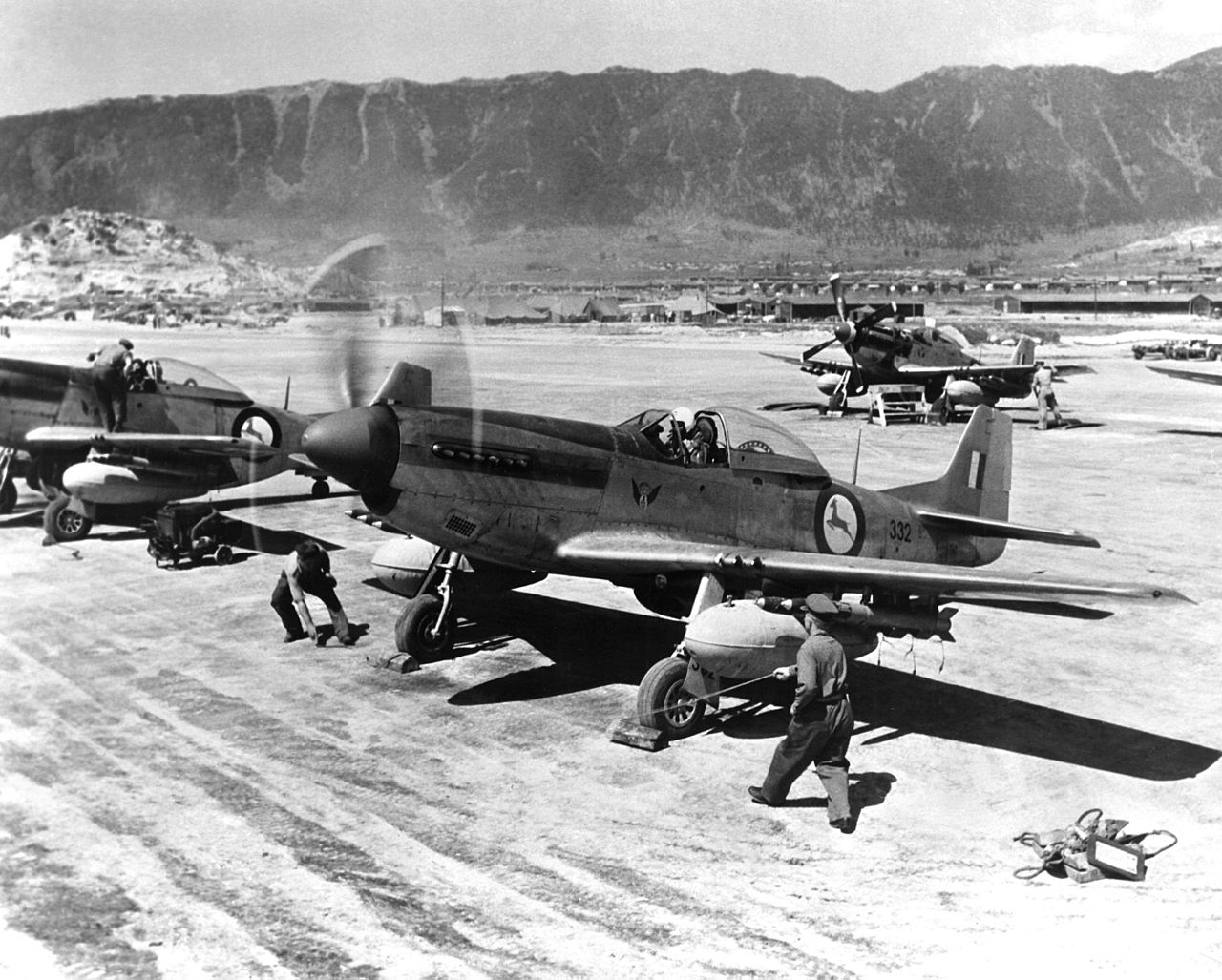
Once fitted with the Merlin engine and equipped with external fuel tanks for extended range, the Mustang was widely used to escort USAAF heavy bombers on deep-penetration missions into occupied Europe, where it reduced bomber losses and contested Luftwaffe fighters at long ranges. It saw service in multiple theaters and roles: air superiority, bomber escort, strafing and ground attack. After World War II the Mustang remained in service with many air forces around the world and was adapted as a fighter-bomber in the early stages of the Korean War.
Postwar legacy and cultural significance
Beyond military service, the Mustang has enjoyed a long postwar career. Surplus aircraft were operated by smaller air arms, used in civilian roles, and restored by museums and collectors. The Mustang's combination of sleek lines and strong performance made it a popular choice in air racing circuits, where veteran examples continue to compete. Its presence in memorials, museums and airshows helps preserve the aircraft's technological and historical significance for new generations.
Variants and notable facts
- P-51A – early production with Allison engine, limited high-altitude capability.
- P-51B/C – introduction of the Packard-built Merlin engine, extended-range roles.
- P-51D – most numerous wartime model, with bubble canopy and improved armament layout.
- P-51H – late-war lightweight high-performance version.
- Operational note: addition of drop tanks and Merlin power were decisive in converting the Mustang from a local defender into a long-range escort.
For further reading and resources on production history, technical specifications and surviving aircraft, consult in-depth references and dedicated collections that document the Mustang's development and enduring influence on military aviation. See also materials related to North American's wartime production and the Merlin engine development at related historical sources.
Questions and answers
Q: What is the North American P-51 Mustang?
A: The North American P-51 Mustang is an American fighter made by North American Aviation during World War II.
Q: How many versions of the Mustang were built?
A: There were 5 versions of the Mustang built - P-51A, P-51B, P-51C, P-51D, and P-51H.
Q: What is the difference between the Packard-built version of the Rolls-Royce Merlin engine and the Allison engine used in the P-51A?
A: The Packard-built version of the Rolls-Royce Merlin engine featured a more advanced supercharger, allowing much better performance above 15,000 feet when compared to the Allison.
Q: What is the "bubble" canopy featured in the P-51D version?
A: The "bubble" canopy in the P-51D version is an unobstructed canopy by metal supports.
Q: Was the P-51 Mustang used in any other wars besides World War II?
A: Yes, the P-51 Mustang was also used in the Korean War as a dive bomber.
Q: Were there any Central American air forces that used the P-51 Mustangs?
A: Yes, the P-51 Mustang was used by many Central American air forces until the 1970s.
Q: What are P-51 Mustangs often used for today?
A: Today, P-51 Mustangs are often used in air races.
Related articles
Author
AlegsaOnline.com North American P-51 Mustang: design, history, and legacy Leandro Alegsa
URL: https://en.alegsaonline.com/art/70810
Sources
- books.google.com : "Mustang Aces of the Ninth & Fifteenth Air Forces & the RAF"
- militaryhistory.about.com : "World War II: North American P-51 Mustang".
- nationalmuseum.af.mil : "North American P-51D Mustang" · web.archive.org