
Nordfriesland (district, Schleswig-Holstein, Germany)
Nordfriesland is Germany's northernmost district in Schleswig-Holstein, noted for the Wadden Sea, North Frisian Islands and Halligen, marsh and dike landscapes, Frisian culture, tourism and conservation.
Overview
Nordfriesland is the northernmost district of Germany, located in the federal state of Schleswig-Holstein. The district seat is Husum. The territory combines low-lying coastal mainland with tidal flats, salt marshes and a chain of islands and islets in the North Sea. Much of the coastal area forms part of the Schleswig-Holstein Wadden Sea National Park, an internationally important intertidal ecosystem.
Image gallery
4 Images


Geography and landscape
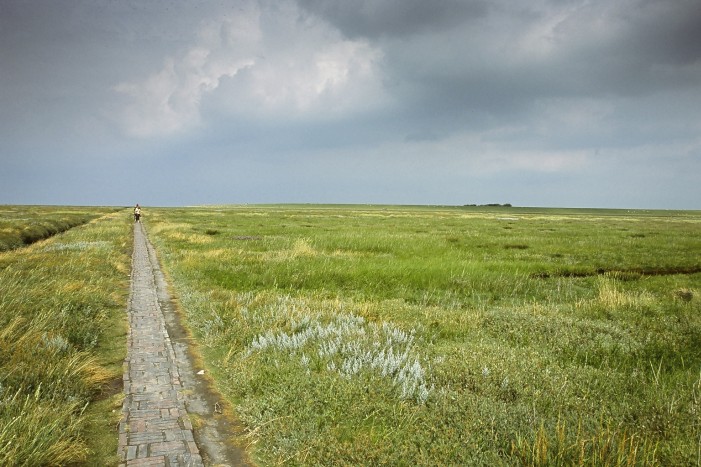
The mainland consists of marshes (Marsch), geest ridges and reclaimed polders protected by extensive dike systems. The Eiderstedt peninsula marks the district's southern shore where the River Eider flows into the sea. The region is shaped by tides, storm surges and long traditions of land reclamation and coastal defence. In several villages raised dwelling mounds—known as Warften or terps—attest to historic settlement patterns adapted to occasional inundation.
Islands and Halligen
Nordfriesland includes the North Frisian Islands and the distinctive Halligen, small unprotected islets that are regularly flooded except for dwellings placed on artificial mounds. Larger islands such as Sylt, Föhr, Amrum, Pellworm and Nordstrand are important for tourism and local culture. Sylt is connected to the mainland by a rail causeway; other islands are reached by ferry or causeway. The Halligen are notable for their unique way of life and landscape, with houses and churches often standing on the mounds to withstand storm tides.
History and culture
The area has a long Frisian presence and shows a blend of Frisian, Danish and German influences. North Frisian language varieties survive in several locales, alongside Low German dialects and standard German. Maritime traditions, seafaring and coastal agriculture have shaped local customs, architecture and festivals. Historic towns and villages reflect the interaction between human settlement and the dynamic coastal environment.
Economy, nature conservation and tourism
Nordfriesland's economy is diverse: tourism and recreation on beaches and islands are major income sources, while agriculture (especially dairy and cattle), fishing and small-scale industries remain important. Renewable energy, particularly wind power, has become more prominent. Conservation of the Wadden Sea and protected areas aims to preserve habitats for migratory birds, seals and intertidal species. Sustainable tourism practices, guided mudflat hiking, birdwatching and marine education are typical activities that balance visitor use with nature protection.
Transport and administration
Connections to and between islands vary: rail, ferries and causeways link the archipelago to the mainland. The district is administered within the state structure of Schleswig-Holstein and cooperates with neighbouring districts and national park authorities on coastal management, emergency response to storm surges and regional planning.
Note: For administrative details, up-to-date travel information and conservation rules consult official regional sources and visitor centres maintained by local authorities and the national park administration.
Questions and answers
Q: Where is Nordfriesland located?
A: Nordfriesland is located in the northernmost part of Germany.
Q: What state is Nordfriesland a part of?
A: Nordfriesland is a part of the state of Schleswig-Holstein.
Q: What is the entire coastal region of Nordfriesland a part of?
A: The entire coastal region of Nordfriesland is a part of the Schleswig-Holstein Wadden Sea National Park.
Q: What is the name of the peninsula in the south of Nordfriesland?
A: The name of the peninsula in the south of Nordfriesland is Eiderstedt.
Q: Does the River Eider join the sea in Nordfriesland?
A: Yes, the River Eider joins the sea in the Eiderstedt peninsula of Nordfriesland.
Q: How many large islands are there in the Nordfriesland district?
A: There are five large islands (Sylt, Föhr, Amrum, Pellworm, and Nordstrand) in the Nordfriesland district.
Q: What is the name of the smaller islets in the Nordfriesland district?
A: The smaller islets in the Nordfriesland district are known as Halligen and there are ten of them.
Related articles
Author
AlegsaOnline.com Nordfriesland (district, Schleswig-Holstein, Germany) Leandro Alegsa
URL: https://en.alegsaonline.com/art/70675
Sources
- statistik-nord.de : "Statistikamt Nord – Bevölkerung der Gemeinden in Schleswig-Holstein 4. Quartal 2016] (XLS-file)"
- commons.wikimedia.org : Nordfriesland
- tools.wmflabs.org : 54°35′N 9°00′E / 54.58°N 9.0°E / 54.58; 9.0