
Atrax: the Sydney funnel-web spiders — overview, venom, and distinctions
Atrax is a small genus of robust Australian funnel-web spiders noted for potent venom, burrow-based funnel webs, and medical significance. This article covers biology, behavior, distribution, and first-aid considerations.
Atrax is a genus of mygalomorph spiders native to eastern Australia, most famously associated with the Sydney region. Members of this genus are among the best known of the group commonly called funnel-web spiders. They are medium-to-large, stout-bodied spiders that build silk-lined burrows with a characteristic funnel-shaped entrance where they wait to ambush prey.
Image gallery
1 Image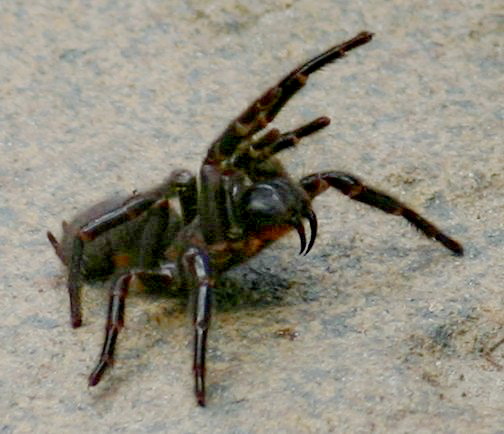
Taxonomy and identification
Atrax belongs to the infraorder Mygalomorphae, the lineage that includes tarantulas and their relatives. These spiders have downward-pointing fangs and robust chelicerae. Key field characters include a glossy carapace, strong legs adapted for digging, and the silk funnel that leads to a sheltered retreat. See dedicated resources for images and keys: Atrax genus overview and mygalomorph spider characteristics.
Behavior and habitat
Individuals live in burrows, often under logs, rocks or at the base of trees, and line the entrance with silk to form a funnel. They are sit-and-wait predators that detect vibrations on the silk and emerge to capture insects and other small animals. Males are more likely to wander in warm months while seeking mates, which increases the chance of human encounters. Their territorial nature can include threat displays and defensive charges toward perceived threats before biting. For behavior descriptions see funnel-web spider behavior.
Venom and medical importance
Atrax species possess potent venom that affects the nervous system. The venom contains peptide toxins that can cause serious symptoms in humans and other mammals. Historically, bites from some funnel-web species resulted in severe illness and fatalities prior to the availability of specific antivenom. Since the development and clinical use of antivenom, outcomes after hospital treatment have improved markedly. For medical guidance and historical context consult venom and antivenom information.
Safety, first aid and public health
Because of their potential medical significance, suspected bites from Atrax or related funnel-web spiders are treated as medical emergencies. First aid recommendations commonly advised by health authorities include applying a pressure immobilization bandage and keeping the patient still while arranging rapid transfer to a medical facility; anyone bitten should seek immediate professional care. Public health information and treatment protocols are available from regional health services: Sydney-area health guidance and Australian medical advice.
Distinctions and similar spiders
Not all spiders called "funnel-web" are close relatives of Atrax. Several often-seen garden spiders build funnel-shaped webs (for example from other families) but belong to a different evolutionary group and are generally harmless to people. The true funnel-webs (family Atracidae and related genera) differ in anatomy, behaviour and venom potency from these lookalikes. For taxonomic distinctions see funnel-web vs. funnel-shaped web spiders.
Because Atrax is a small genus with a restricted geographic range, accurate identification is important both for ecological study and for clinical reasons. Museum keys, specialist literature and regional spider guides remain the best sources for reliable identification. Researchers and members of the public should rely on experts when handling or attempting to identify potentially dangerous spiders.
- Overview: burrow-dwelling, funnel-shaped silk retreats.
- Danger: potent neurotoxic venom; antivenom available.
- Confusion: many nonvenomous spiders also build funnel-shaped webs.
- Action: treat suspected bites as emergencies and seek medical care.
Questions and answers
Q: What is Atrax?
A: Atrax is a genus of spiders known for their strong venom and aggressive behavior.
Q: How do Atrax spiders defend their territory?
A: Atrax spiders chase off attackers who may scare them by making a threat display, and then they will bite.
Q: What is the fastest death caused by an Atrax spider bite?
A: The fastest death recorded occurred in 1927, when a young boy died within fifteen minutes of being bitten.
Q: How many deaths were recorded before antivenom was invented for Atrax spider bites?
A: Thirteen deaths were recorded in the fifty years before antivenom was invented for Atrax spider bites.
Q: Why are Atrax spiders sometimes called Sydney Funnel Web spiders?
A: Atrax spiders are sometimes called Sydney Funnel Web spiders because they come from around that part of Australia.
Q: How many groups of spiders are there under the heading "spiders" (Aranae)?
A: There are three main groups of spiders under the heading "spiders" (Aranae).
Q: Which group of spiders includes Atrax spiders?
A: Atrax spiders belong to the third group of spiders, which includes tarantulas and a few other kinds of spiders.
Related articles
Author
AlegsaOnline.com Atrax: the Sydney funnel-web spiders — overview, venom, and distinctions Leandro Alegsa
URL: https://en.alegsaonline.com/art/7065