
Atomic radius
Overview of atomic radius: definitions, how it is measured, periodic trends, historical notes, and why atomic size matters in chemistry and materials science.
Overview
The atomic radius is a measure of the size of an atom, commonly described as the distance from the nucleus to the region in which the probability of finding electrons is significant. Because electrons form a diffuse cloud rather than a hard boundary, no single value uniquely defines an atom's size; instead, several operational definitions are used depending on context and measurement method. The concept helps explain bond lengths, packing in solids, and many chemical trends.
Image gallery
2 Images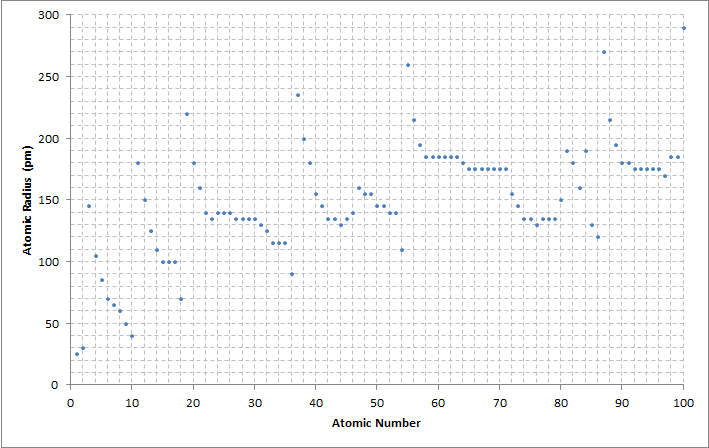

Definitions and common types
Different practical definitions of atomic radius are used in chemistry and physics. Each captures a different aspect of atomic size and is measured or inferred in different ways:
- Covalent radius: half the distance between nuclei in a homonuclear bond, often obtained from molecular or crystallographic data. See a general overview: covalent radius notes.
- Van der Waals radius: half the distance between nonbonded atoms in adjacent molecules; useful for understanding molecular packing and steric effects. Background: van der Waals radius resources.
- Metallic radius: half the distance between nearest-neighbour atoms in a metallic lattice.
- Ionic radius: an effective size assigned to ions in crystals; it depends on coordination number and the oxidation state of the ion.
How it is measured
Atomic radii are not measured directly as single-atom boundaries but are inferred from experimental and computational methods. Common approaches include X-ray and neutron crystallography to obtain interatomic distances in solids, spectroscopic measurements of gas-phase species, and quantum mechanical calculations that estimate electron density contours. For summaries of experimental techniques and modern datasets, consult: measurement methods.
Periodic trends and causes
Across the periodic table, atomic size follows well-established trends. Moving down a group increases radius because each period adds an electron shell, placing outer electrons on average farther from the nucleus. Moving left to right across a period, radii generally decrease: protons are added to the nucleus while electrons populate the same principal shells, so the effective nuclear charge felt by valence electrons increases and pulls them closer. These trends are modulated by shielding (inner electrons partially offset nuclear attraction), electron-electron repulsion, and specific effects such as the lanthanide contraction, which slightly reduces expected sizes among elements following the lanthanides.
Importance, examples, and notable facts
Atomic radius is central to understanding chemical bonding, reactivity, and material properties. Smaller atoms tend to form shorter, stronger bonds and can have higher ionization energies, while larger atoms are often more polarizable and chemically soft. Differences in ionic radii explain crystal structures and solubility; van der Waals radii help predict steric hindrance in organic chemistry. For further context and comparative tables, see: comparative tables and guides.
History and context
The idea of atomic size evolved as atomic theory and experimental techniques developed. Early qualitative notions of atomic size gave way to quantitative estimates with the advent of X-ray crystallography and more precise spectroscopic methods in the 20th century. Since then, improvements in computational quantum chemistry have provided consistent frameworks to compare and interpret different radius definitions. Because the term is operational rather than absolute, careful specification of which radius is meant is important in scientific communication.
Questions and answers
Q: What is atomic radius?
A: Atomic radius is the distance between the nucleus and the edge of the electron cloud.
Q: Why is it hard to define atomic radius?
A: It is because it is impossible to know where all of the electrons are at a given time.
Q: How does atomic radius vary when you move down a group in the periodic table?
A: Atomic radius tends to increase as you move down a group because the number of electrons is greater, and so the radius of the circle of electrons in the element is bigger.
Q: Why does atomic radius tend to decrease as you move to the right across a period?
A: Atomic radius tends to decrease due to the shielding effect.
Q: What is the shielding effect?
A: The shielding effect is the ability of inner electrons to partially shield outer electrons from the attraction of the positively charged atomic nucleus.
Q: Which direction does atomic radius tend to increase in the periodic table?
A: Atomic radius tends to increase as you move down a group in the periodic table.
Q: Which direction does atomic radius tend to decrease in the periodic table?
A: Atomic radius tends to decrease as you move to the right across a period in the periodic table.
Related articles
Author
AlegsaOnline.com Atomic radius Leandro Alegsa
URL: https://en.alegsaonline.com/art/7055