
Noctiluca scintillans — the bioluminescent sea sparkle
A concise overview of Noctiluca scintillans, a free‑living dinoflagellate known for bright bioluminescent displays, heterotrophic feeding, symbioses with phytoplankton, and episodic coastal blooms.
Noctiluca scintillans, commonly called the sea sparkle, is a single‑celled marine organism classified among the dinoflagellates. It is a free‑living protist that frequently produces striking blue‑white flashes of bioluminescence when water is disturbed. Researchers and mariners have long noted its capacity to make waves and wakes glow, a phenomenon often described as the "sea sparkle" or, on a very large scale, a milky sea effect. For basic classification and taxonomy see dinoflagellate and the entry for protist.
Image gallery
4 Images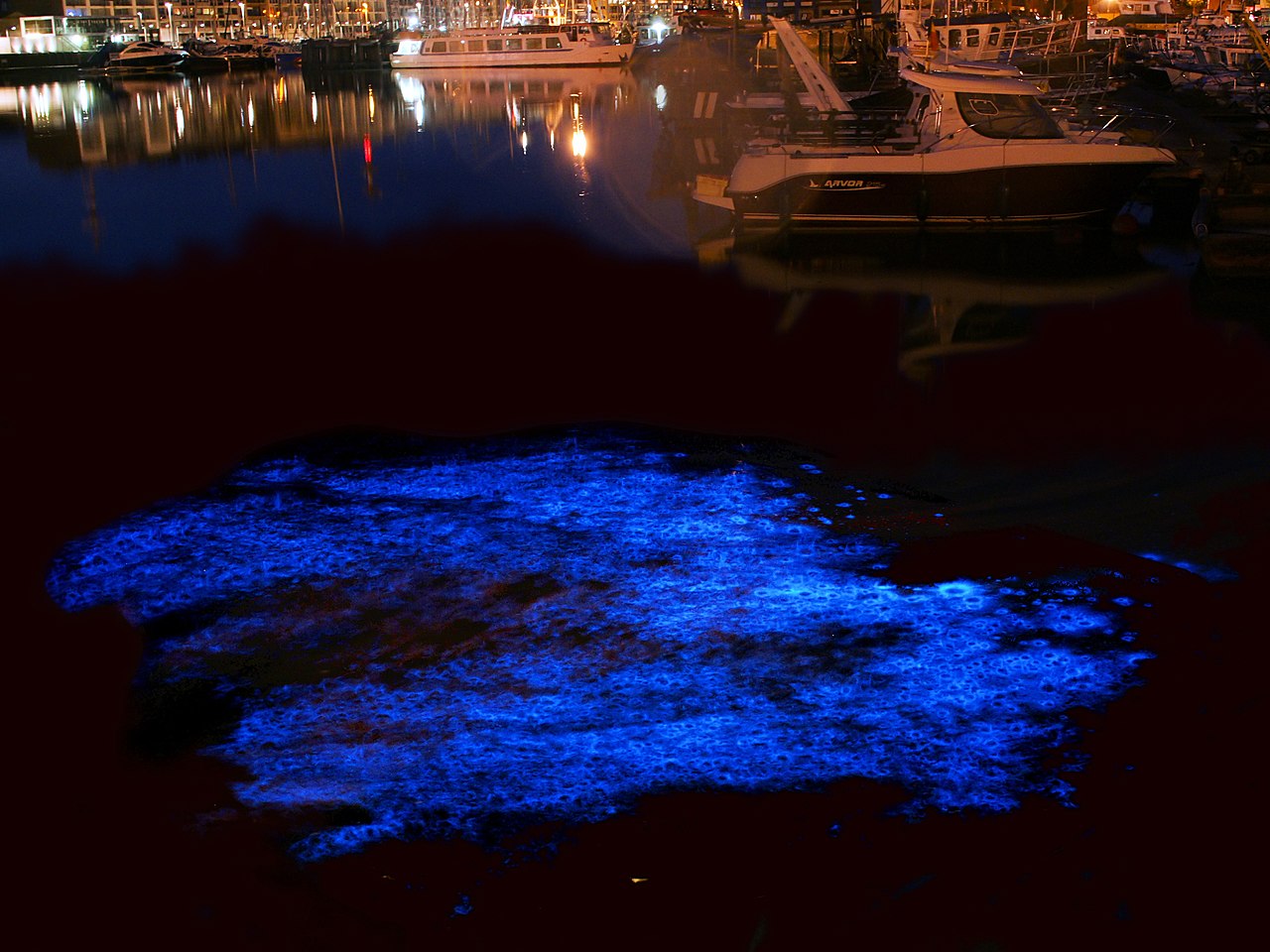


Structure and bioluminescence
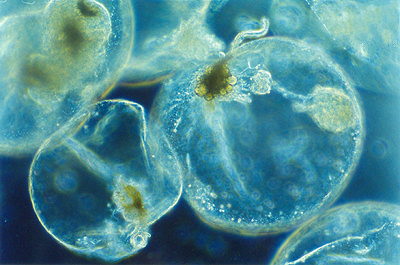
Noctiluca cells are relatively large for single‑celled plankton and contain distinctive organelles that produce light. The bioluminescence arises in the cytoplasm through a luciferin–luciferase chemical reaction housed in thousands of spherical bodies called scintillons. These scintillons are visible under microscopy and are responsible for the cell's rapid photon emission when mechanically or chemically stimulated. The reaction occurs within the cytoplasm and is calcium‑sensitive; populations that do not glow lack scintillons entirely, a trait documented in some nonluminescent members of the Noctiluca group. The luminous response has made N. scintillans a model organism for studying marine bioluminescence and cellular signaling.
Feeding, symbiosis and nutrition
Unlike many dinoflagellates that rely on photosynthesis, Noctiluca scintillans is mainly heterotrophic and engulfs its food by phagocytosis. It consumes a wide range of prey including small plankton, chain‑forming diatoms, other dinoflagellates, fish eggs and marine bacteria. Observations indicate that certain diatoms, notably genera such as Thalassiosira, are frequently eaten and can also survive temporarily inside vacuoles. At the same time, some populations harbor photosynthetic microalgae as endosymbionts: tiny phytoplankton retained in internal compartments perform photosynthesis and supply organic carbon to the host. These symbionts are often located within membrane‑bound vacuoles and may persist across host generations, producing a greenish form of Noctiluca that relies less on active feeding.
Distribution, blooms and ecological role
Noctiluca scintillans occurs in many coastal and shelf waters worldwide and is especially noticeable when it forms dense aggregations or blooms. Blooms can change surface coloration (sometimes called red tides when pigments are abundant) and produce spectacular nighttime luminescence. While N. scintillans is not generally considered highly toxic, dense blooms can alter food‑web dynamics, smother planktonic communities, and contribute to localized oxygen depletion as cells respire and decompose. These ecological effects may impact fisheries, aquaculture and water quality, so monitoring of Noctiluca events is a component of coastal management in affected regions.
History of observation and scientific importance
Sailors and coastal communities have recorded glowing seas for centuries; modern scientific study of Noctiluca began with microscopic and chemical investigations into bioluminescence. The species has been important for understanding how single cells generate light, how luciferin and luciferase systems work, and how symbioses between heterotrophic hosts and photosynthetic symbionts evolve. Because it combines conspicuous behavior, a straightforward cellular origin of light, and a flexible nutritional strategy, N. scintillans continues to be used in physiological, ecological and molecular research.
Notable characteristics and distinctions
- Bioluminescence: Light production via scintillons and a luciferin–luciferase reaction makes the organism conspicuous at night — see bioluminescence.
- Heterotrophy with optional symbionts: Primarily feeds by engulfing prey (heterotroph) but may host photosynthetic partners.
- Diet breadth: Eats a variety of organisms including plankton, diatoms and bacteria, and may ingest fish eggs.
- Cell biology: Light produced in the cytoplasm within scintillons (scintillons) and non‑glowing strains lack these organelles.
- Symbiotic compartments: Photosynthetic endosymbionts occupy vacuoles and carry out photosynthesis for the host.
- Taxonomy and references: For general classification consult material on dinoflagellates and related protists.
Noctiluca scintillans remains both an object of public fascination and a subject of active research. Its glowing displays are a vivid reminder of the chemical and ecological complexity of microscopic life in the oceans.
Questions and answers
Q: What is Noctiluca scintillans?
A: Noctiluca scintillans is a free-living marine-dwelling species of dinoflagellate that shows bioluminescence when disturbed.
Q: How does Noctiluca scintillans produce bioluminescence?
A: Noctiluca scintillans produces bioluminescence in the cytoplasm through a luciferin-luciferase reaction in thousands of spherical organelles called scintillons.
Q: What is the milky seas effect?
A: The milky seas effect is produced when Noctiluca scintillans is disturbed and the bioluminescent reaction in its cytoplasm creates a milky appearance on the surface of the sea.
Q: What does Noctiluca scintillans eat?
A: Noctiluca scintillans is a heterotroph that engulfs its food through phagocytosis. It eats plankton, diatoms, other dinoflagellates, fish eggs, and bacteria. Its favourite food source is the diatom Thalassiosira.
Q: Do all species in the Noctiluca genus have scintillons?
A: No, nonluminescent populations in the genus Noctiluca lack scintillons.
Q: Does Noctiluca scintillans photosynthesize?
A: No, Noctiluca scintillans is a heterotroph and does not photosynthesize.
Q: Do symbiotic organisms live inside Noctiluca scintillans?
A: Yes, Noctiluca scintillans takes in tiny phytoplankton that live as endosymbionts and do photosynthesis for their larger host. Diatoms are often found in the vacuoles of Noctiluca.
Related articles
Author
AlegsaOnline.com Noctiluca scintillans — the bioluminescent sea sparkle Leandro Alegsa
URL: https://en.alegsaonline.com/art/70524
Sources
- britannica.com : "Iimage of the "Sea Sparkle" from 'Britannica Online Encyclopedia'"