
Atmel AVR microcontrollers: overview, architecture, and uses
Overview of the Atmel AVR family: RISC, Harvard architecture, on‑chip flash, register file, main variants (tinyAVR, megaAVR, XMEGA), history and common applications including Arduino.
The AVR series is a family of microcontrollers originally developed by Atmel in the mid‑1990s and now maintained by Microchip Technology. Designed as a compact, efficient 8‑bit RISC platform, AVR devices brought inexpensive on‑chip reprogrammable flash memory and a streamlined instruction set to embedded designers. Their combination of low cost, modest power consumption and an accessible development ecosystem made AVRs especially popular in hobbyist, educational and industrial applications.
Image gallery
10 Images

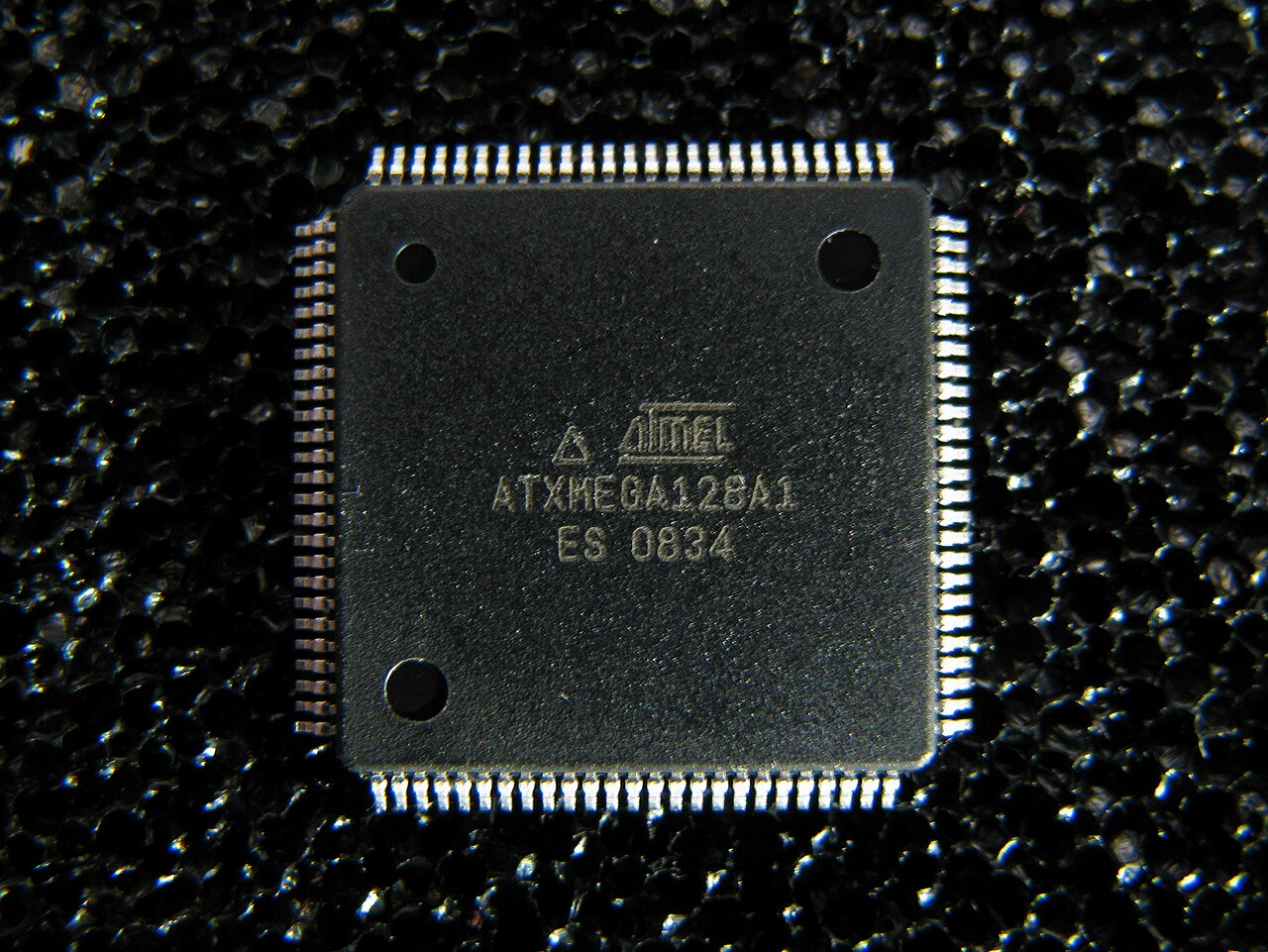
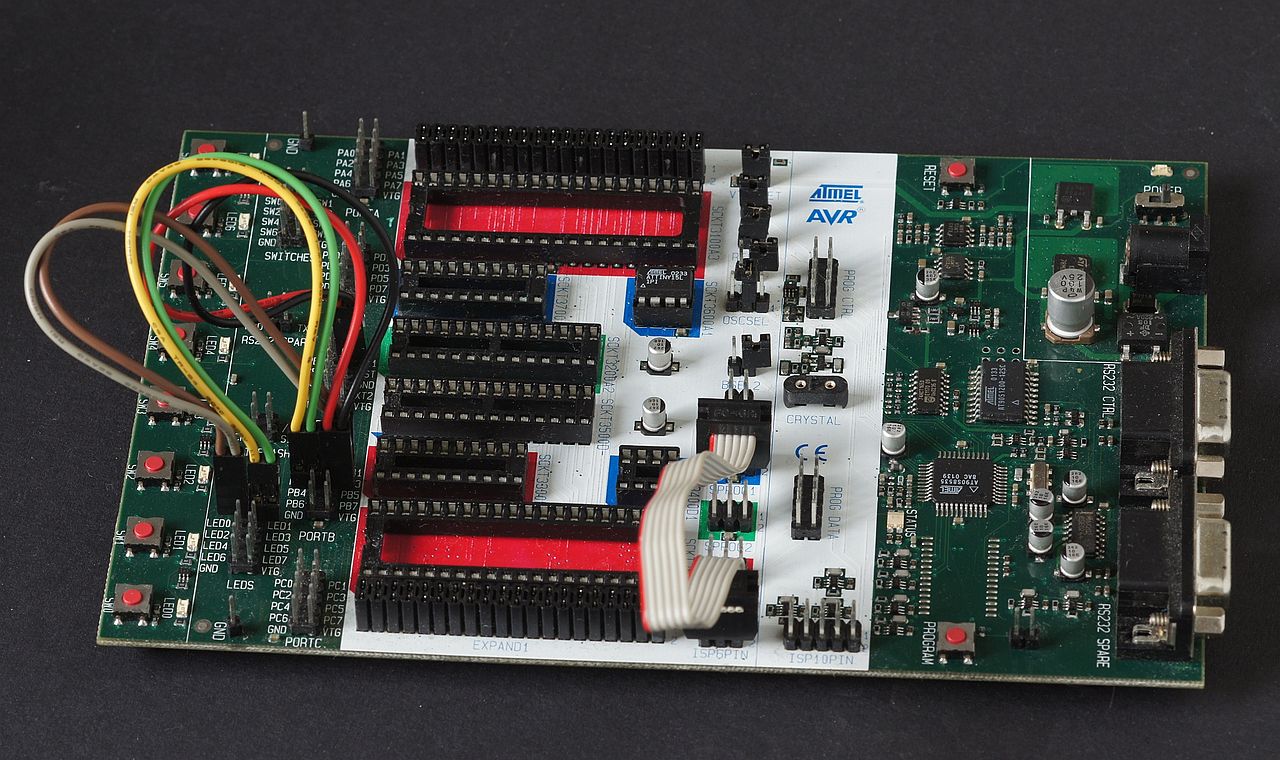


Architecture and key characteristics
AVR cores implement a load/store, reduced instruction set architecture with a true Harvard architecture, meaning program and data memories are physically separate. Most classical AVRs are 8‑bit processors with a 32×8‑bit general purpose register file directly connected to the arithmetic logic unit (ALU). This register layout allows two registers to be read and an operation performed in a single clock cycle for many instructions, improving per‑clock throughput compared with older designs.
A defining feature when AVRs first appeared was the use of on‑chip flash memory for program storage, which allowed quick in‑system reprogramming rather than relying on one‑time programmable ROM or removable memory such as EPROM and nonvolatile bytewise options like EEPROM. The adoption of on‑chip flash simplified development cycles and reduced production costs for many small embedded systems.
Families, variants and ecosystem
AVR product lines include tinyAVR (very small packages and limited peripherals), megaAVR (feature‑rich mainstream 8‑bit parts), and XMEGA (higher performance and enhanced peripherals). Atmel also developed a separate 32‑bit line called AVR32; however, the widely used classic AVRs remain 8‑bit. A notable member of the family, the ATmega328P, gained broad recognition after being used as the microcontroller on the Arduino Uno board, which helped drive the AVR into education and maker communities.
- Common on‑chip peripherals: timers/counters, ADCs, USART/SPI/I2C interfaces, PWM, and brown‑out/reset logic.
- Programming and toolchain: support in open toolchains such as avr‑gcc and avrdude, and vendor tools like Atmel/Microchip Studio.
- Programming methods: in‑system programming (ISP), bootloader-based updates, and debugWIRE or JTAG on some parts.
History, name and comparisons
Introduced in 1996, the AVR architecture arrived at a time when many microcontrollers used either mask ROM, EPROM or EEPROM for code storage and typically executed multi‑cycle machine operations. Compared with contemporaries such as the Intel MCS‑51 (8051) family, which often required many clock cycles per instruction, the AVR’s streamlined pipeline and single‑cycle execution for most instructions offered significantly higher instruction throughput per clock in many cases. Popular explanations of the name "AVR" include references to the original designers' names and to marketing expansions such as "Advanced/RISC"; the precise origin has been described differently in various sources, so accounts vary.
Applications and notable facts
AVR microcontrollers are widely used in small appliances, sensor nodes, hobby projects, educational kits and industrial controllers. Their balance of simplicity and capability makes them a frequent choice for battery‑powered devices and for designs that require straightforward I/O, timing and serial communications without the complexity of higher‑end processors. The active community around AVR hardware and software contributes libraries, bootloaders and documentation that keep these devices accessible to newcomers and professionals alike.
For further reading about the architectural model, memory types, and embedded toolchains, see resources on the Harvard architecture, on‑chip flash, EPROM and EEPROM. The AVR family remains a clear example of how focused architectural choices—register‑oriented design, separate program/data memory and integrated flash—can make microcontrollers easier to program and faster per clock for typical control tasks.
Questions and answers
Q: When was the AVR microcontroller architecture developed?
A: The AVR microcontroller architecture was developed in 1996 by Atmel.
Q: What architecture is the AVR microcontroller based on?
A: The AVR microcontroller is based on the Harvard microcontroller architecture.
Q: What sets the AVR microcontroller apart from other microcontrollers at the time of its development?
A: The AVR microcontroller uses on-chip flash memory for program storage, as opposed to one-time programmable ROM, EPROM, or EEPROM used by other microcontrollers at the time.
Q: What is the commonly believed meaning of the abbreviation AVR?
A: Many people believe that AVR stands for Alf (Egil Bogen) and Vegard (Wollan)'s Risc processor.
Q: What architecture did the AVR microcontroller replace?
A: The AVR microcontroller replaced the older MCS-51 architecture.
Q: How many clock cycles does one machine cycle of MCS-51 take?
A: One machine cycle of MCS-51 takes 12 clock cycles.
Q: What is the advantage of AVR microcontrollers over MCS-51 in terms of performance per clock cycle?
A: Performance per clock cycle is 12 times higher with AVR microcontrollers.
Related articles
Author
AlegsaOnline.com Atmel AVR microcontrollers: overview, architecture, and uses Leandro Alegsa
URL: https://en.alegsaonline.com/art/7028
Sources
- cse.unsw.edu.au : UNSW School of Computer Science and Engineering - General AVR Info