
Nine-banded armadillo (Dasypus novemcinctus)
A medium-sized armored mammal native to the Americas, known for its bony carapace, insectivorous diet, burrowing habits and the unusual reproduction that often produces identical quadruplets.
The nine-banded armadillo (Dasypus novemcinctus), often called the nine-banded or long-nosed armadillo, is a distinctive mammal of the Americas. It is named for the overlapping bony bands on its carapace that give it a segmented, armor-like appearance. Native to South and Central America, the species expanded its range northward through the 19th and 20th centuries and is now well established in parts of the southern United States.
Image gallery
7 Images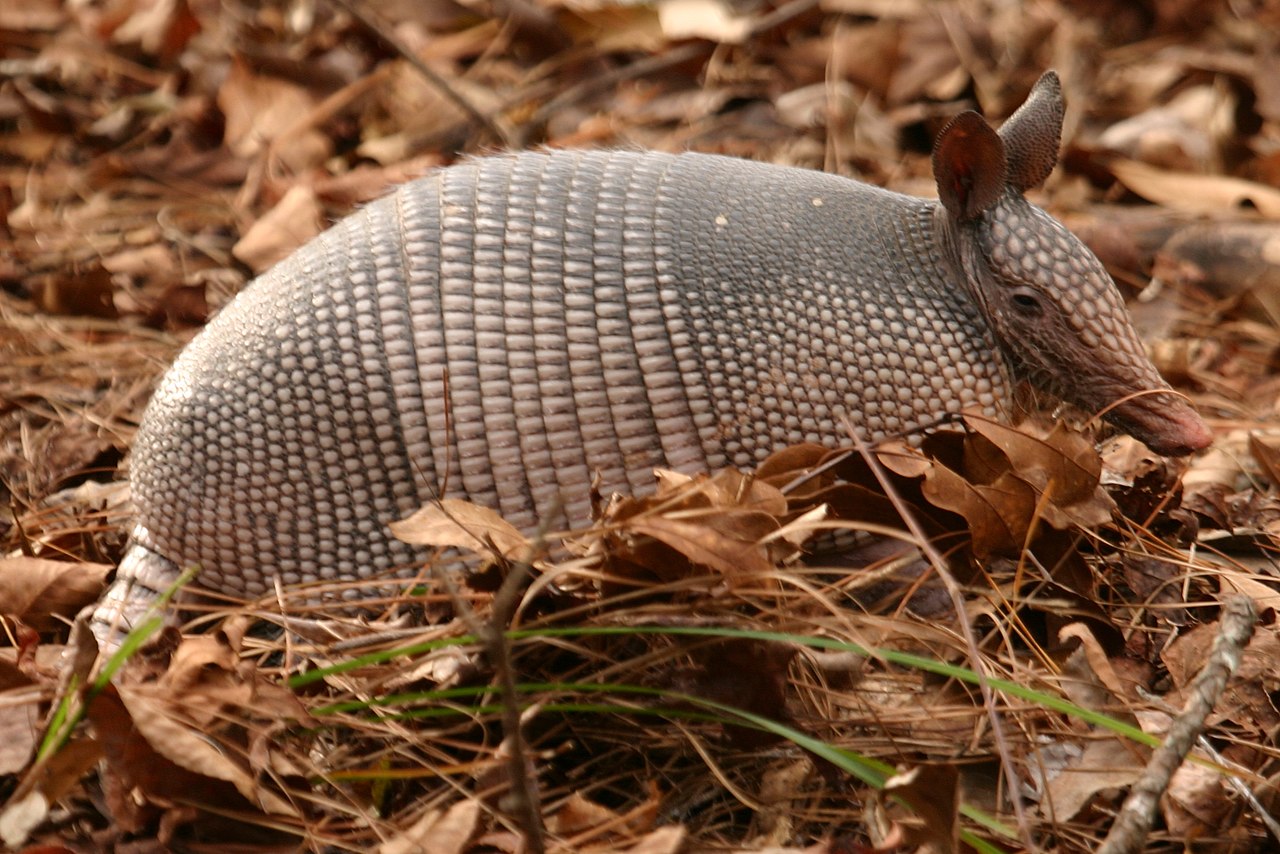


Physical characteristics
Armadillos have a leathery shell formed from bony scutes arranged in plates that protect the back and sides while allowing limited flexibility. The nine-banded armadillo has a long, tapered snout, small eyes, and large, shovel-like forefeet with strong claws for digging. It is a medium-sized mammal with a low, robust body and a long tail. When startled this species can leap straight up — commonly 3–4 feet (91–122 cm) — a behavior that can make them vulnerable to vehicle collisions.
Diet and behavior
Primarily insectivorous, the nine-banded armadillo feeds on ants, termites and a variety of other small invertebrates, which it locates by scent and uncovers with powerful digging. Its behavior is largely solitary and crepuscular to nocturnal, and it constructs shallow burrows for resting and rearing young. Foraging helps aerate soil and control insect populations, making the armadillo an important ecological participant in many habitats.
Reproduction and life history
One remarkable trait of this species is polyembryony: a single fertilized egg typically divides to produce four genetically identical offspring, so litters of identical quadruplets are common. Females care for the young in burrows until they are independent. Armadillos reach maturity over a period of months to years and face predation from larger carnivores and humans.
Human interactions and conservation
The nine-banded armadillo adapts well to a variety of environments, from grasslands and scrub to forest edges, and in many places its populations are stable. It is frequently encountered by people, sometimes causing conflicts when it damages lawns or gardens or when struck by vehicles due to its jumping response. The species can also carry the bacterium that causes leprosy, which has prompted public-health attention in some regions.
Further information
Questions and answers
Q: What is the scientific name for the nine-banded armadillo?
A: The scientific name for the nine-banded armadillo is Dasypus novemcinctus.
Q: What is the common name for the nine-banded armadillo?
A: The common name for the nine-banded armadillo is either the nine-banded armadillo or the nine-banded, long-nosed armadillo.
Q: What type of animal is the nine-banded armadillo?
A: The nine-banded armadillo is a species of armadillo.
Q: What type of food does the nine-banded armadillo eat?
A: The nine-banded armadillo is an insectivorous animal, and their diet consists mostly of ants, termites, and other small invertebrates.
Q: Can the nine-banded armadillo jump?
A: Yes, the nine-banded armadillo can jump up to 3-4 feet in the air when scared.
Q: What is the average size of the nine-banded armadillo?
A: The average size of the nine-banded armadillo is approximately 2-3 feet in length, weighing anywhere from 6-15 pounds.
Q: Is the nine-banded armadillo a common species?
A: Yes, the nine-banded armadillo is a common species found in North, Central, and South America.
Related articles
Author
AlegsaOnline.com Nine-banded armadillo (Dasypus novemcinctus) Leandro Alegsa
URL: https://en.alegsaonline.com/art/70257
Sources
- commons.wikimedia.org : Dasypus novemcinctus
- species.wikimedia.org : Dasypus novemcinctus
- iucnredlist.org : "Dasypus novemcinctus"
- loc.gov : "How high can a nine-banded armadillo jump?"
- msu.edu : Armadillo expansion
- ncwildlife.org : Public Hearings applying to 2010-2011 Fishing, Hunting and Trapping Seasons
- whiteville.com : "New regulations feature armored possums"
- msu.edu : "Armadillo Observation"
- buzzle.com : "Texas State Animal - Nine-banded Armadillo"
- nhptv.org : "Nine-Banded Armadillo - Dasypus novemcinctus - NatureWorks"
- britannica.com : "polyembryony (biology) -- Britannica Online Encyclopedia"
- edis.ifas.ufl.edu : "The Nine-banded Armadillo (Dasypus novemcinctus)"
- valdosta.edu : "Polyembryony in Armadillos"
- links.jstor.org : "Polyembryony in the Armadillo: genetic or physiological?"
- books.google.com.au : Mammalogy: adaptation, diversity, ecology