
Nimravidae: extinct feliform carnivores and "false" saber-toothed mammals
Nimravidae were an extinct family of feliform carnivores, often called false saber-toothed cats. They lived from the Eocene to the Miocene across North America, Europe and Asia and show notable convergent evolution.
Overview
The Nimravidae were an extinct family often described as cat-like predators within the order Carnivora. Traditionally placed in the suborder Feliformia, nimravids are commonly referred to as "false saber-toothed cats" because some evolved elongated canine teeth similar to those of true saber-toothed felids. They are classified as a distinct family of prehistoric mammals and are part of the broader story of carnivore evolution.
Image gallery
10 Images




Physical characteristics
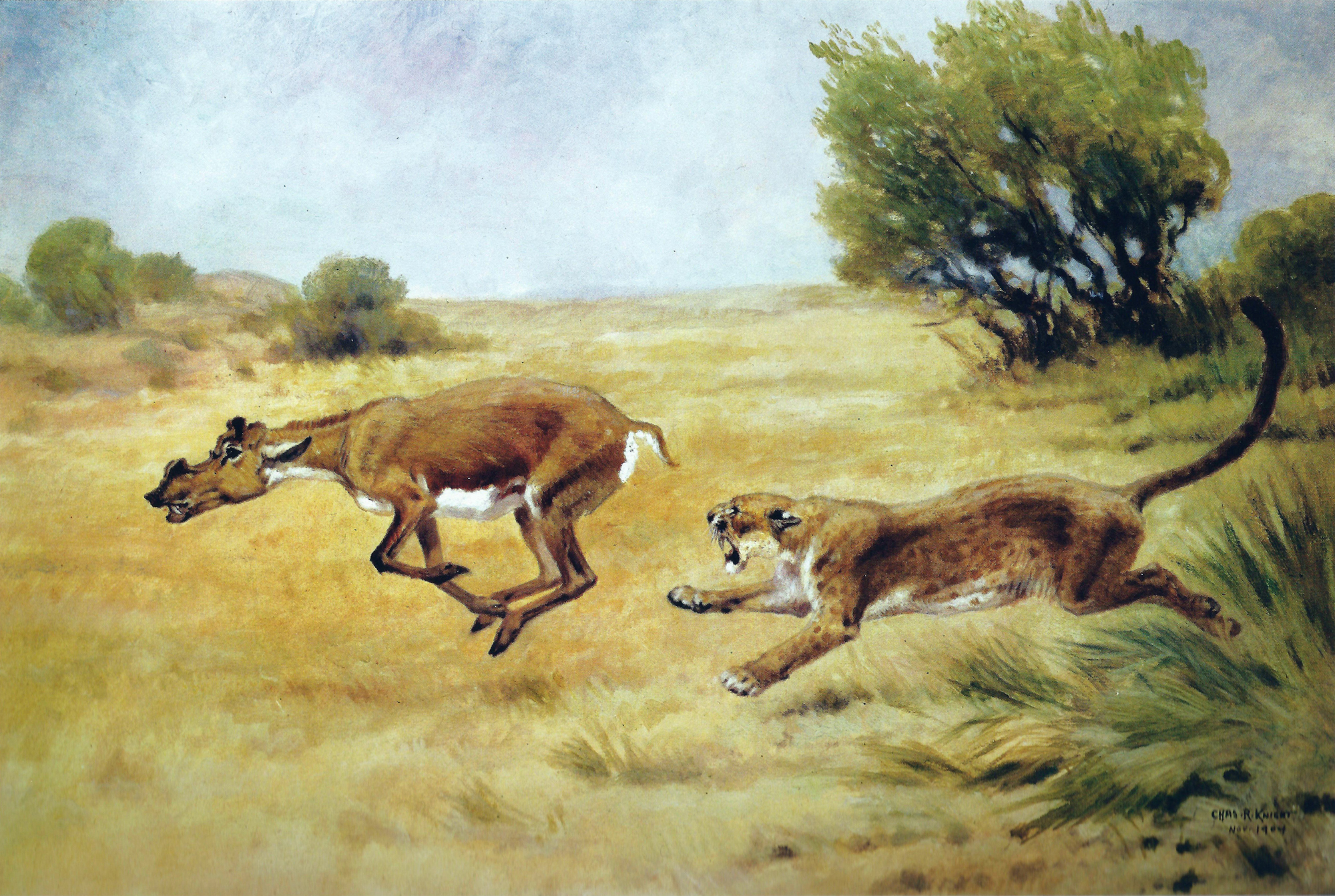
Nimravids displayed a range of body shapes but shared a generally muscular, low-slung, catlike build with relatively short legs and tails compared with many modern cats. Skull and tooth morphology varied widely across the group: some species had moderately sized canines and retained slicing carnassials, while others developed very long, laterally compressed upper canines and associated skull specializations. A handful of genera show bony flanges or ridges on the lower jaw that may have supported and protected long canines in life.
- Size: from small, fox-sized forms to larger, panther-sized predators.
- Limbs: robust forelimbs adapted for grappling prey.
- Skull and teeth: from generalized carnassials to extreme sabertooth specializations.
Dentition and convergent evolution
Among nimravids, several lineages evolved enlarged canines independently of true saber-toothed felids such as Smilodon. This is a classic example of convergent, or parallel, evolution: different carnivore groups adapted similar killing tools in response to comparable ecological pressures. Unlike felids, nimravids belonged to a separate branch of feliforms and show a mosaic of primitive and derived dental traits.
Taxonomy and evolutionary history
Fossils assigned to Nimravidae are known from strata spanning the late Eocene through the Miocene, with many accounts placing their main range roughly between 42 and 20 million years ago. Molecular and fossil-based analyses suggest the lineages that led to nimravids and to true cats (felids) separated from a common ancestor earlier in the Paleogene, perhaps around 50 million years ago according to some studies. Well-known genera include Nimravus, Hoplophoneus, Dinictis, and Eusmilus, though naming and relationships are subjects of ongoing research.
Distribution, ecology, and fossil record
Nimravid fossils have been recovered from North America, Europe and Asia, indicating a broad Holarctic distribution. Their habitats ranged from woodlands to open plains, and their adaptations suggest they were primarily ambush predators that fed on contemporary ungulates and other vertebrates. The fossil record preserves skulls, jaws and limb bones that allow reconstruction of hunting styles and bite mechanics, though details vary between taxa.
Extinction and significance
By the middle to late Miocene nimravids declined and ultimately disappeared from the fossil record. Causes likely include climatic change, habitat shifts, and competition with other carnivores, including evolving felids and other carnivoran groups. Paleontologists study nimravids because they illuminate how similar ecological roles can be filled by unrelated lineages and because their diversity helps reconstruct Cenozoic predator communities. For further reading and specimen images see curated databases and museum collections referenced by specialists (cat-like reconstructions and mammal overviews).
Note: classification of some close relatives (for example some taxa sometimes placed in Barbourofelidae) remains debated; ongoing work in paleontology and molecular studies continues to refine relationships within early feliform carnivores.
Questions and answers
Q: What is the Nimravidae?
A: The Nimravidae is an extinct family in the Carnivora.
Q: What type of mammal is the Nimravidae?
A: The Nimravidae is a type of cat-like mammal in the suborder Feliformia.
Q: Where did the Nimravidae live?
A: The Nimravidae lived in North America, Europe, and Asia.
Q: When did the Nimravidae live?
A: The Nimravidae lived from the Eocene through the Miocene epochs, 42–20 million years ago.
Q: How long did the Nimravidae last?
A: The Nimravidae lasted for about 22 million years.
Q: Are nimravids closely related to the sabre-toothed cats of genus Smilodon?
A: No, although some nimravids physically resembled the sabre-toothed cats of genus Smilodon, they were not closely related, but evolved a similar form through parallel evolution.
Q: When did the ancestors of nimravids and felids diverge from their common ancestor?
A: The ancestors of nimravids and felids diverged from their common ancestor about 50 mya.
Related articles
Author
AlegsaOnline.com Nimravidae: extinct feliform carnivores and "false" saber-toothed mammals Leandro Alegsa
URL: https://en.alegsaonline.com/art/70238
Sources
- paleodb.org : PaleoBiology Database: Nimravidae, basic info