
Nihon Odai Ichiran (Table of the Rulers of Japan)
A 17th‑century Japanese chronological table of emperors compiled by the Hayashi school and later translated into French by Isaac Titsingh; a landmark source for premodern Japanese regnal history.
Overview
Nihon Odai Ichiran (日本王代一覧, often romanized Nihon Ōdai Ichiran) is a compact chronological register of Japan's emperors compiled in the early Edo period. Presented as a series of short entries and tables, it lists sovereigns in succession with traditional reign dates and brief notes about important events during each reign. The work was designed to provide a readable, authoritative reference to the imperial sequence for scholars and officials.
Image gallery
2 Images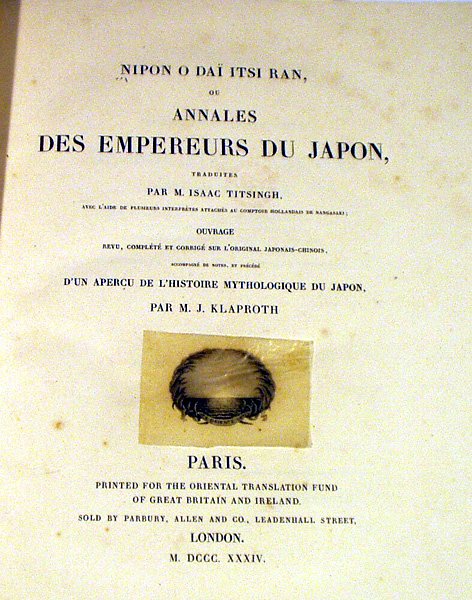

Authorship and Compilation
The chronicle is associated with the Hayashi scholarly family, a prominent line of Neo‑Confucian scholars who served as advisers to the Tokugawa shogunate. It was compiled in the 17th century to synthesize earlier classical chronicles and official records into a concise regnal list. The Hayashi school emphasized moral and political instruction, and works they produced often aimed to organize history in a form useful for government and education.
Contents and Format
The book arranges emperors in a tabular or annalistic format: name of the sovereign, traditional accession and death years, era names (nengō) used during the reign, and one‑line summaries of notable incidents. Early entries for the mythic era are brief and legendary in tone, while entries for later, historically documented rulers are more specific. Because it relies on classical sources — including chronicles such as the Kojiki and Nihon Shoki and on court records — the work mixes legendary tradition with documentary material in the way typical of premodern Japanese historiography.
Translation and European Reception
In the early 19th century Isaac Titsingh, a Dutch East India Company official and collector of Japanese manuscripts, prepared a translation of the chronicle. His French edition, published posthumously in 1834 as Annales des empereurs du Japon, was one of the earliest substantial introductions of Japanese historical material to European readers. For scholars and diplomats of the opening‑Japan era, Titsingh's work provided a usable regnal framework and stimulated further interest in Japan's recorded past.
Significance and Limitations
Nihon Odai Ichiran remains useful as a historical reference and as an example of Edo‑period historical compilation. It influenced both Japanese official knowledge of the imperial past and early Western accounts of Japan. Modern historians, however, treat its early lists cautiously: the oldest imperial reigns are drawn from mythic chronicles and lack independent archaeological confirmation. For later periods, where independent records and inscriptions exist, its entries are more reliable but still benefit from cross‑checking with contemporary primary sources.
Key Features and Uses
- Compact chronological arrangement of emperors and reigns.
- Blend of legendary material and documentary records typical of Edo historiography.
- Source for 19th‑century European studies of Japan after Titsingh's translation.
- Still referenced for regnal lists, ceremonial dates, and the study of how Japanese scholars organized history in the Tokugawa period.
Questions and answers
Q: What is Nihon Odai Ichiran?
A: Nihon Odai Ichiran is a Japanese book that chronicles the reigns of Japanese emperors before the 19th century.
Q: When was Nihon Odai Ichiran written?
A: Nihon Odai Ichiran was written in the 17th century.
Q: Who translated Nihon Odai Ichiran into French?
A: Nihon Odai Ichiran was translated into French by a Dutchman named Isaac Titsingh.
Q: When was the French translation of Nihon Odai Ichiran published?
A: The French translation of Nihon Odai Ichiran was published in 1834.
Q: What is the significance of the French translation of Nihon Odai Ichiran?
A: The French translation of Nihon Odai Ichiran was one of very few books about Japan of the time.
Q: What does Nihon Odai Ichiran cover?
A: Nihon Odai Ichiran covers the reigns of the Japanese emperors before the 19th century.
Q: What is the meaning of the title "Nihon Odai Ichiran"?
A: "Nihon Odai Ichiran" means "Table of the rulers of Japan" in Japanese.
Related articles
Author
AlegsaOnline.com Nihon Odai Ichiran (Table of the Rulers of Japan) Leandro Alegsa
URL: https://en.alegsaonline.com/art/70165
Sources
- books.google.com : The American Cyclopaedia: a Popular Dictionary of General Knowledge,
- books.google.com : Dictionnaire des orientalistes de langue française, p. 542