
Nigersaurus — the short-necked, ground-feeding sauropod
Nigersaurus is a small, mid-Cretaceous diplodocoid sauropod from what is now Niger, known for its broad, tooth-filled muzzle, rapid tooth replacement and adaptations for low‑level browsing.
Overview
Nigersaurus is a genus of diplodocoid sauropod that lived during the middle Cretaceous in what is today the Republic of Niger. Compared with classic long‑necked giants, Nigersaurus was relatively small and light for a sauropod, with an unusually short neck and a highly modified skull that marks it as a specialized feeder rather than a typical high‑browsing giant. It is recognized as a distinct genus within the group related to Diplodocus-like forms (diplodocoids), but it shows important differences from its relatives.
Image gallery
10 Images
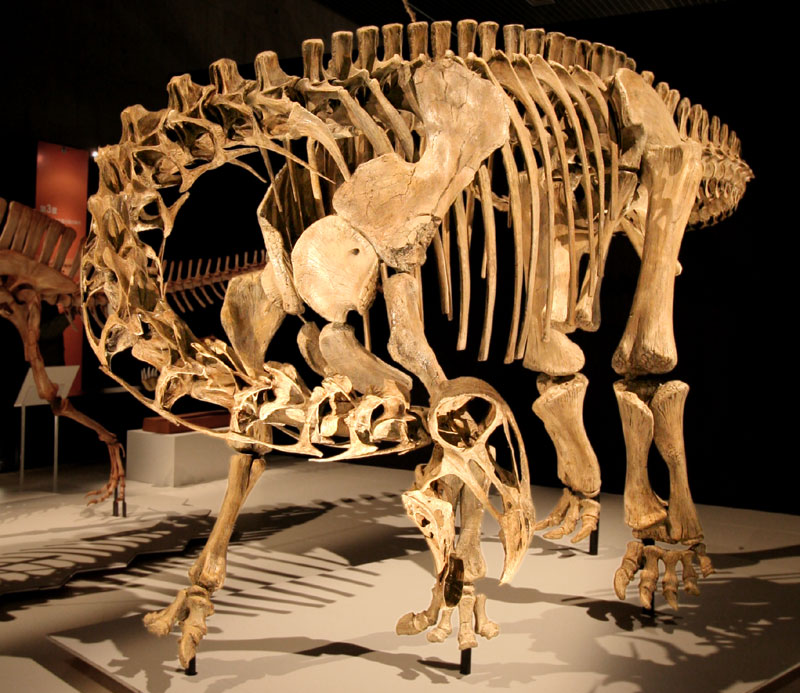


Anatomy and distinguishing features
The skull of Nigersaurus is one of its most striking attributes. It is lightweight, with many openings and delicate bones, and it supports a broad, straight muzzle that carried more than five hundred small, replaceable teeth clustered at the front of the jaws. The teeth and jaw arrangement suggest a feeding mechanism unlike that of most other sauropods: the dental battery was used to crop vegetation close to the ground, and the jaws may have been sheathed by a horny covering similar to a keratinous beak. Internally, the skeleton shows extensive pneumatic cavities—air sacs that reduced mass—while the limbs remained robust to support the body, estimated at roughly the mass of a modern elephant.
Feeding, senses and posture
Evidence from the teeth, jaw shape and wear patterns indicates Nigersaurus was primarily a low‑level browser. Its teeth were replaced at a rapid pace—paleontologists have estimated frequent turnover compared with many other dinosaurs—which would have been useful for processing abrasive, soft plant material. Proposed food items include ferns, horsetails and early flowering plants; paleobotanical studies point to abundant ground‑cover flora such as ferns and horsetails. The olfactory region of the braincase appears small, suggesting smell was not a dominant sense, while debate continues over whether the head was habitually held facing downward to graze or could be lifted more horizontally like other sauropods.
Discovery and scientific history
Fossils of the animal now called Nigersaurus were first reported in the 1970s from Cretaceous deposits in Niger, but material sufficient to define the genus was not described until later fieldwork recovered more complete remains. The named specimens provided the first clear view of its unique skull and dental arrangement, prompting reexamination of diplodocoid diversity and feeding ecology during the Cretaceous. Paleontologists placed Nigersaurus within the broad sauropod clade (sauropoda) and refined its relationships among mid‑Cretaceous herbivores.
Ecology, habitat and associations
Nigersaurus inhabited a riparian environment—floodplains and river margins—where the vegetation favored low, soft plants and the water system supported diverse vertebrate communities. Fossils from the same formations show that it shared its landscape with other large herbivores, predatory theropods and various crocodylian relatives (crocodylomorphs). Its remains are relatively common in some deposits, making it an important taxon for reconstructing mid‑Cretaceous ecosystems in northern Africa (Cretaceous environments).
Notable facts and significance
- Nigersaurus possessed a highly specialized, broad muzzle with a dense battery of front‑facing teeth concentrated at the jaw tips, unlike the peg‑like dentition of many other sauropods.
- Rapid tooth replacement and delicate cranial bones are interpreted as adaptations for continuous cropping of abrasive, low vegetation.
- Its lightweight, air‑filled vertebrae and robust limbs illustrate a balance between mass reduction and load bearing typical of many sauropods.
- Finds of Nigersaurus help illuminate faunal turnover and niche partitioning among large herbivores in African mid‑Cretaceous ecosystems.
Researchers continue to study Nigersaurus specimens to refine its posture, feeding mechanics and life appearance; reconstructions and new analyses frequently update our understanding of how this unusual sauropod lived amid the river systems of Cretaceous Africa.
Further reading and specimen data are available through museum and specialist publications; for general context see regional paleontology resources and taxonomic reviews (skull anatomy, riparian settings).
Questions and answers
Q: What is Nigersaurus?
A: Nigersaurus is a genus of Diplodocus-like sauropod dinosaur that lived in the middle of the Cretaceous period in what is now the Republic of Niger.
Q: How was its skull different from Diplodocus?
A: Its skull had many fenestrae (openings) and thin bones, and it had a wide muzzle filled with more than 500 teeth. The jaws were wider than the skull, and its teeth were placed far to the front.
Q: How long was Nigersaurus?
A: Nigersaurus was 9 meters (30 feet) long, which is small for a sauropod.
Q: What did it weigh?
A: It weighed around 4 tonnes, comparable to a modern elephant. Its skeleton was filled with air sacs, which lightened the weight.
Q: What type of habitat did it live in?
A: It lived in a riparian habitat (near rivers).
Q: What kind of plants did it eat?
A: It probably ate soft plants such as ferns, horsetails, and angiosperms.
Q: Who else shared its habitat?
A: It shared its habitat with other large herbivores, as well as large theropods and crocodylomorphs.
Related articles
Author
AlegsaOnline.com Nigersaurus — the short-necked, ground-feeding sauropod Leandro Alegsa
URL: https://en.alegsaonline.com/art/70117
Sources
- plosone.org : plosone.org/article/info:doi/10.1371/journal.pone.0001230
- sciencemag.org : sciencemag.org/content/286/5443/1342