
Atlantic City, New Jersey: resort history, boardwalk, casinos and transport
Atlantic City is a coastal resort city on Absecon Island in New Jersey known for its historic boardwalk, casinos, conventions, and role as the inspiration for the original Monopoly locations.
Overview
Atlantic City is a coastal city located on Absecon Island in New Jersey, United States. Long known as a seaside resort and entertainment center, it grew from a modest shore town into an internationally recognized destination for leisure, conventions and gaming. The city was incorporated as a municipality in 1854 after a rail connection facilitated travel from nearby Philadelphia, and it later became famous for its wooden boardwalk, amusement piers and beachfront hotels.
Image gallery
10 Images


Characteristics and landmarks
Atlantic City’s most iconic feature is its boardwalk, a long wooden promenade that runs along the oceanfront and gives access to casinos, shops, arcades and family attractions. The city’s skyline and oceanfront concentrate large hotel-casino complexes, conference facilities and performance venues. Many cultural references link Atlantic City to popular culture: it served as the inspiration for several property names in the original Monopoly board and for numerous films, songs and novels.
History and development
Growth accelerated in the 19th century after rail service made the shore reachable for urban residents. The boardwalk and beachfront amusements developed to serve seasonal visitors, and by the early 20th century the city hosted large pageants, exhibitions and conventions. In the late 20th century, legalized casino gaming transformed the local economy, prompting new construction and year-round tourism. Economic fortunes have fluctuated since then as competition, changing travel habits and regional development influenced the city’s business mix.
Uses, economy and events
Atlantic City’s economy blends hospitality, entertainment, retail and convention activities. Casinos and resort hotels remain major employers and draw attendees for conferences and concerts. The city also stages seasonal festivals, sporting events and cultural programs that bring visitors beyond gaming. Historically the city hosted national events and pageants, helping to sustain a reputation as a major East Coast entertainment center.
Transportation and access
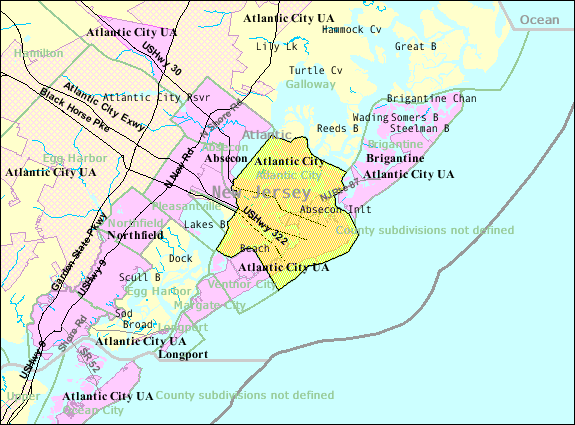
- The principal roadways that lead into the city include the Black Horse Pike/Harding Highway (US 322/40), the White Horse Pike (US 30) and the Atlantic City Expressway.
- Rail connections established in the 19th century remain important: service from Philadelphia helped create the city’s early tourism market and continues to shape commuter and visitor routes.
- By road, Atlantic City is roughly 132 miles south of New York City and about 55 miles southeast of Philadelphia, depending on route.
Demographics and region
According to the 2010 Census, the city had a population of 39,558. The wider Atlantic City– Hammonton metropolitan area counted several hundred thousand residents in the same count, reflecting the region that depends on the city for jobs and visitor services.
Notable facts and distinctions
Visitors often identify Atlantic City with its boardwalk, casinos and beachfront attractions, but it also functions as a regional convention hub and cultural center. Its association with gaming and entertainment, and its appearance in popular games and media, have secured a prominent place in American leisure history. For more general information about the city and travel resources, official and tourism websites provide detailed, up-to-date guidance on gambling and resort offerings.
Questions and answers
Q: When did Atlantic City become a city?
A: Atlantic City officially became a city in 1854 when it was connected to Philadelphia by a new railroad.
Q: What is Atlantic City known for?
A: Atlantic City is known internationally as a resort city for gambling, conventions, and leisure.
Q: What board game was inspired by Atlantic City?
A: The original version of the board game Monopoly was inspired by Atlantic City.
Q: Where is Atlantic City located?
A: Atlantic City is located on Absecon Island on the coast of the Atlantic Ocean in New Jersey, United States.
Q: What was the population of Atlantic City according to the 2010 United States Census?
A: According to the 2010 United States Census, the population of Atlantic City was 39,558.
Q: How many people were living in the Atlantic City–Hammonton Metropolitan Statistical Area according to the 2010 Census?
A: According to the 2010 Census, there were 274,549 people living in the Atlantic City–Hammonton Metropolitan Statistical Area.
Q: What are the road routes into Atlantic City?
A: The three road routes into Atlantic City are the Black Horse Pike/Harding Highway (US 322/40), White Horse Pike (US 30), and the Atlantic City Expressway.
Related articles
Author
AlegsaOnline.com Atlantic City, New Jersey: resort history, boardwalk, casinos and transport Leandro Alegsa
URL: https://en.alegsaonline.com/art/6982
Sources
- nj.gov : 2012 New Jersey Mayors Directory
- cityofatlanticcity.org : Administration
- census.gov : Gazetteer of New Jersey Places
- geonames.usgs.gov : U.S. Geological Survey Geographic Names Information System: Atlantic City
- factfinder2.census.gov : DP-1 - Profile of General Population and Housing Characteristics: 2010 for Atlantic City city, Atlantic County, New Jersey
- lwd.dol.state.nj.us : Table DP-1. Profile of General Demographic Characteristics: 2010 for Atlantic City city
- factfinder2.census.gov : GCT-PH1 Population, Housing Units, Area, and Density: 2010 - State -- County Subdivision from the 2010 Census Summary File 1 for New Jersey
- tools.usps.com : Look Up a ZIP Code for Atlantic City,NJ
- factfinder.census.gov : "American FactFinder"
- mcdc2.missouri.edu : A Cure for the Common Codes: New Jersey
- geonames.usgs.gov : "US Board on Geographic Names"
- factfinder2.census.gov : DP-1 - Profile of General Population and Housing Characteristics: 2010 for Atlantic City-Hammonton, NJ Metro Area; New Jersey
- cityofatlanticcity.org : Maps & Directions