
Nephthys — Egyptian goddess of protection, mourning, and the dead
Nephthys, sister of Isis and wife of Set, is an ancient Egyptian goddess associated with protection, funerary rites, mourning, and resurrection in the Osiris cycle.
Overview
Nephthys (Egyptian Nebet-hut, "Lady of the House") is an ancient Egyptian goddess commonly associated with protection, mourning, and the realm of the dead. Often paired with her sister Isis, Nephthys appears throughout Egyptian religion as a complementary figure who assists in funerary rites, supports the rebirth of the deceased, and acts as a guardian of the king and the tomb.
Image gallery
6 Images


Names, epithets and iconography
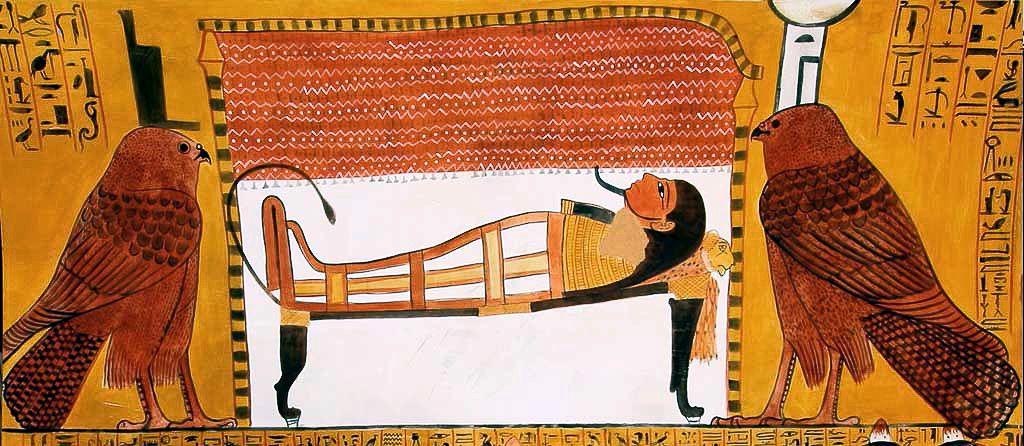
Her Egyptian name means "lady of the house" and she carries several epithets, among them "The Excellent Goddess." In art she is typically shown as a woman bearing on her head the hieroglyphs that spell her name (a basket and a house) or as a kite—a large bird—whose form is linked to nocturnal and funerary symbolism. Nephthys is sometimes depicted with outstretched wings, a motif shared with Isis, that represents protective enfolding of the dead and the living alike.
Mythic roles and relationships
Nephthys is one of the four children of the earth god Geb and the sky goddess Nut and thus sister to Isis, Osiris and Set. In many traditions she is the wife of Set; in others her alliances are more fluid. She occupies a central place in the Osiris cycle: when Osiris is killed, Nephthys assists Isis in locating and embalming his body. Her power is frequently described as magical and restorative—helping to ensure rebirth—and she plays a protective role toward Horus during his infancy in some versions of the myths.
Functions in funerary practice and magic
Nephthys figures prominently in Egyptian funerary texts and rituals. She appears in the Pyramid Texts, Coffin Texts and the Book of the Dead as a guardian and mourner who aids the deceased in the journey to the afterlife. In tomb decoration she is often paired with Isis at the head and foot of sarcophagi, and in later practice she was associated with one of the canopic guardians—the baboon-headed Hapi—who protected the lungs. Because of her protective and occasionally fearsome aspects, she was invoked in spells and amulets intended to ward off enemies and danger.
Cult, worship and development
Nephthys had an established role in temple liturgies and local cults, though she was generally less prominent in popular devotion than her sister Isis. Priesthoods and ritual specialists invoked her in funerary rites and royal ceremonies; some pharaonic inscriptions describe her as a protector of the king, capable of destroying his foes with a formidable, even fiery, force. In the Late Period and through the Ptolemaic era various syncretisms linked Nephthys to other deities, including limited associations with goddesses such as Anuket.
Key attributes and notable facts
- Domains: protection, mourning, funerary rites, nocturnal power.
- Family: sister of Isis, Osiris and Set; in certain traditions mother of Anubis.
- Iconography: woman with the hieroglyphs for her name or a kite/bird; often shown with wings.
- Role in myth: helps resurrect Osiris and protects the infant Horus.
- Funerary role: guardian in tomb texts and protector of canopic jars, often linked with Hapi.
As a figure of both consolation and fierce guardianship, Nephthys embodies the ambivalent power of protection in ancient Egyptian thought: she comforts mourners and ensures rebirth, yet she can also act as a destructive force against threats to the king or the dead. Her presence across funerary art and ritual literature underlines her importance in the Egyptian worldview of death and renewal.
Questions and answers
Q: Who is Nephthys?
A: Nephthys is a goddess with wide power and capacity, referred to as "The Excellent Goddess."
Q: What was Nephthys' role in protecting the king?
A: Nephthys was considered a protector of the king and was able to kill the enemies of the king with her fiery breath.
Q: What was Nephthys' role in the myths of Osiris?
A: Nephthys had a central role in the popular myths of Osiris; it is her magical powers that helped to resurrect his body, as well as to protect and nurture Horus while he is a child.
Q: In which contexts was Nephthys presented as a protector?
A: Nephthys is presented as a protector of the dead and, in other contexts, as protecting the baboon-headed Hapi, one of the 4 canopic jars.
Q: What happened to Nephthys in the Late Period?
A: In the Late Period, Nephthys became linked with the goddess, Anuket.
Q: What were some of Nephthys' other powers?
A: Nephthys had wide power and capacity, and was able to kill the enemies of the king with her fiery breath.
Q: What was Nephthys' title?
A: Nephthys was often referred to as "The Excellent Goddess."
Related articles
Author
AlegsaOnline.com Nephthys — Egyptian goddess of protection, mourning, and the dead Leandro Alegsa
URL: https://en.alegsaonline.com/art/69190