
Atchison, Topeka and Santa Fe Railway (AT&SF)
A major 19th–20th century American railroad that spurred settlement of the Midwest and Southwest; known for freight and passenger service and its 1996 merger into BNSF.
Overview
The Atchison, Topeka and Santa Fe Railway (reporting mark ATSF), commonly called the Santa Fe or AT&SF, was one of the largest railroads in the United States. Chartered in 1859 to link Atchison and Topeka with Santa Fe, the line instead grew into a transcontinental system that served the central and southwestern states. Although its corporate name referenced Santa Fe, the main line bypassed the city because of difficult terrain; a short branch line from Lamy, New Mexico, provided direct rail access to Santa Fe itself.
Image gallery
10 Images


Growth and network
Construction advanced steadily after the company was founded in February 1859. The railroad pushed westward across the plains, reaching the Kansas–Colorado border by 1873 and arriving in Pueblo, Colorado, in 1876. By the 1880s the line extended into New Mexico and reached Albuquerque. Over the late 19th century the Santa Fe continued to develop routes toward the Pacific coast, creating one of the principal north–south and east–west corridors across the American interior.
Business model and regional impact
Beyond operating trains, the railroad actively stimulated traffic for its own lines. Company agents established real estate offices and sold or promoted farmland along new routes to create a steady demand for transportation. This strategy helped populate large areas of the Plains and supported an agricultural economy that contributed substantial revenue. Grain such as wheat and livestock like cattle were regular commodities on Santa Fe trains; cattle drives from Texas brought animals north to markets and shipping points in towns such as Wichita and Dodge City during the 1870s.
Services, culture and technology
The Santa Fe operated both freight and passenger services. Its passenger trains — including long-distance streamliners introduced in the 20th century — became famous for speed, comfort and distinctive styling. The railroad cultivated a strong corporate image and played a role in tourism to the Southwest, promoting destinations and resorts along its routes. Like other U.S. carriers, passenger traffic declined in the mid-20th century; most intercity passenger service was transferred to Amtrak when it began operation in 1971, although the railroad's legacy continued in popular culture and rail preservation.
Merger and legacy
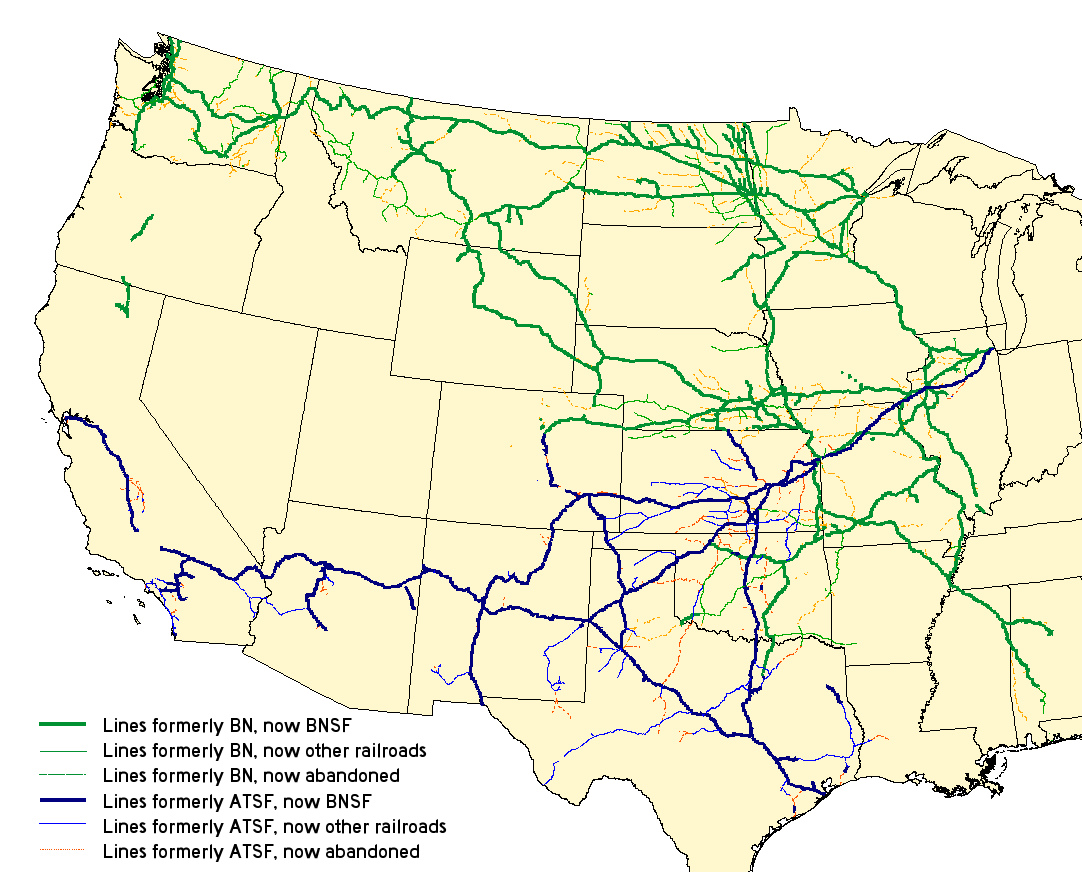
After more than a century as an independent carrier, the Atchison, Topeka and Santa Fe Railway ceased to exist as a separate company on December 31, 1996, when it completed a merger with the Burlington Northern Railroad to form the Burlington Northern and Santa Fe Railway (BNSF). The combined system remains one of North America's largest freight railroads. The AT&SF's influence is visible today in the cities, towns and rail corridors it helped establish, and in preserved equipment and museums that commemorate its history.
Notable facts and distinctions
- Founding purpose: link towns of Atchison, Topeka and the New Mexico capital Santa Fe, though the mainline avoided the latter.
- Engineering choices: mainline routing often reflected geography, avoiding difficult terrain where possible and using branches such as the one from Lamy to reach local centers.
- Economic role: land sales and promotion created freight sources and helped settle large parts of Kansas and neighboring states.
- Regional connections: expansion touched Colorado and important towns including Pueblo and Albuquerque.
- Commodities: staples included wheat and cattle, some of which were driven north from Texas to markets like Wichita.
The story of the Atchison, Topeka and Santa Fe Railway is a central chapter in the wider history of American rail transportation, illustrating how railroads shaped settlement patterns, regional economies and the cultural image of the American West.
Questions and answers
Q: What was the Atchison, Topeka and Santa Fe Railway?
A: The Atchison, Topeka and Santa Fe Railway (reporting mark ATSF) was a large railroad in the United States. It was created in February 1859 to join Atchison and Topeka, Kansas with Santa Fe, New Mexico.
Q: When did the AT&SF reach Albuquerque?
A: The AT&SF reached Albuquerque in 1880.
Q: How did the railroad create demand for its services?
A: To create demand for its services, the railroad set up real estate offices and sold farm land.
Q: Where did much of its revenue come from?
A: Much of its revenue came from wheat grown in Kansas and cattle driven north from Texas to Wichita and Dodge City by September 1872.
Q: Did it ever serve Santa Fe, New Mexico directly?
A: No, it never served Santa Fe directly because the terrain was too rough. A branch line from Lamy reached Santa Fe instead.
Q: When did the AT&SF officially end?
A: The AT&SF officially ended on December 31st 1996 when it merged with Burlington Northern Railroad to form Burlington Northern & Santa Fe Railway.
Q: What year was the AT&SF created? A: The AT&SF was created on February 11th 1859
Tags
Related articles
Author
AlegsaOnline.com Atchison, Topeka and Santa Fe Railway (AT&SF) Leandro Alegsa
URL: https://en.alegsaonline.com/art/6904
Sources
- catskillarchive.com : The Atchison Topeka and Santa Fe
- books.google.com : Santa Fe...Steel Rails through California
- books.google.com : Santa Fe: The Railroad Gateway to the American West, Volume One
- books.google.com : Santa Fe: The Railroad Gateway to the American West, Volume Two
- books.google.com : Trademarks of the Santa Fe Railway and Peripheral Subjects · web.archive.org
- kancoll.org : online
- kancoll.org : online