
Negroland: historic European name for parts of inland West Africa
Negroland (also Nigritia) was an early modern European term for the region south of the Sahara in West Africa, reflecting European knowledge, cartography, and terminology of the time.
Overview
Negroland, sometimes rendered Nigritia in older texts, is a historic European geographic label applied to parts of inland West Africa south of the Sahara Desert. European mapmakers and writers of the early modern and 19th centuries used the term to denote a broad, partly undefined zone of African polities, trade routes and river systems that contrasted with the Sahara, the Maghreb and the coastal zones they more directly controlled or visited.
Image gallery
1 Image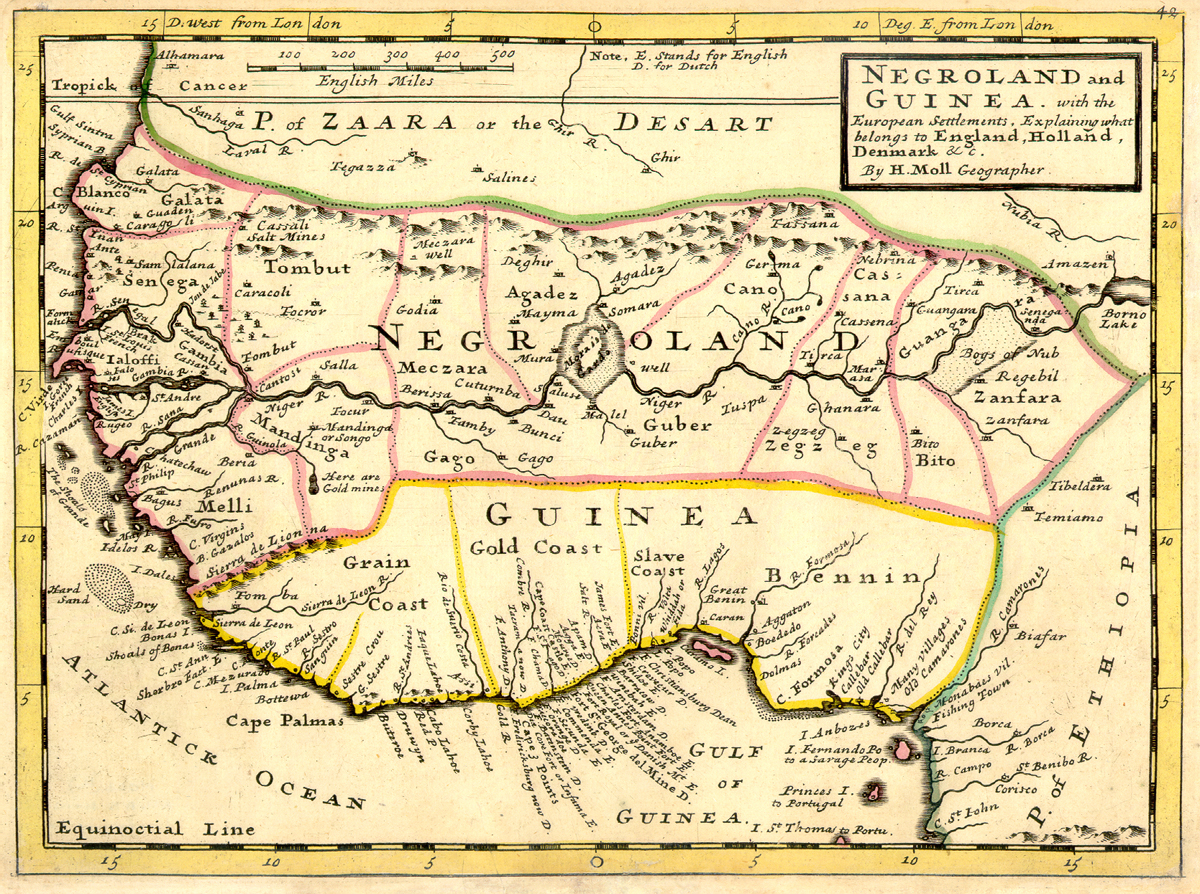
Name and etymology
The English term derives from Latin and Romance-language forms that translate a phrase from Arabic, Bilad al-Sudan, literally "land of the Blacks." This Arabic phrase had long been used by North African and Middle Eastern writers to refer to the strip of territory immediately south of the Sahara. European writers translated or transliterated the idea into their own languages; in English-language atlases of the 17th–19th centuries the labels "Negroland" or "Nigritia" became common. Contemporary readers should note that these terms reflect outdated and racialized categories and are not used in modern geography.
Cartography and contemporary perceptions
Maps that label Negroland typically show the region of the great West African rivers and inland kingdoms rather than precise political boundaries. Early cartographers often had incomplete or secondhand information about river courses and interior geography. For example, some European maps conflated the Senegal, Gambia and Niger river systems, drawing them as a connected network or as branches of one great river. Explorers, traders and missionary accounts gradually corrected these misconceptions during the 19th century as inland surveys and direct observation increased; see contemporaneous maps and descriptions in historic atlases for examples (see maps, see regional descriptions).
Peoples, states and cultures
What Europeans called Negroland encompassed a great diversity of societies: urbanized trading centers, powerful kingdoms, pastoral regions and agricultural communities. Prominent polities and cultural spheres in this broad region included variations of Sahelian states, trans-Saharan trade networks, and populations speaking a variety of languages. European accounts generically labelled inhabitants as "Negroes" or similar terms in period sources; modern scholarship uses precise ethnolinguistic names and nation-states instead (period terminology).
Historical usage and decline
The label fell from scholarly and cartographic favor as African geography was documented in more detail and as the language of race and empire came under critical scrutiny. Nineteenth-century exploration, colonization and the development of modern national borders replaced sweeping regional labels with specific colonial territories and later independent states. Historians and geographers now prefer terms such as West Africa, Sahel or the Sudan region (the latter used in a geographic sense, distinct from the modern state named Sudan). For additional historical context consult older atlases and travel literature (historic narratives).
Significance and cautions
Negroland is primarily of interest to historians of cartography, colonialism and European perceptions of Africa. When encountered in older sources the term is a reminder of how external observers categorized unfamiliar regions and peoples. Modern treatment requires care: the term is outdated, imprecise and rooted in racialized worldviews, so contemporary writing replaces it with accurate regional or cultural names wherever possible.
- See also: regional maps and period atlases (map examples).
- For discussion of language and terminology in Arabic sources see Arab geographic terms.
- For period American or European map usages and labels consult reproductions of 18th–19th century atlases (atlas references, terminology in sources).
Questions and answers
Q: What is Negroland?
A: Negroland, also known as Nigritia, was a region in Africa south of the Sahara.
Q: How explored was the region of Negroland?
A: The region of Negroland was poorly explored by Europeans.
Q: What did Europeans mainly know about the area around Negroland?
A: Europeans mainly knew about the area around the coast surrounding Negroland.
Q: What is the meaning of the term "Bilad al-Sudan"?
A: The term "Bilad al-Sudan" translates to "land of the Blacks".
Q: What did Europeans of the time believe about the rivers in Negroland?
A: Europeans of the time believed that the rivers Senegal, Gambia, and Niger were in the same river system, one river that divided before flowing into the ocean.
Q: When was the area approximately described as "Nigritia" on an American map?
A: The area was approximately described as "Nigritia" on an American map published by Fielding Lucus Jr. in 1823.
Q: What were the inhabitants of Nigritia called?
A: The inhabitants of Nigritia were called Negroes.
Related articles
Author
AlegsaOnline.com Negroland: historic European name for parts of inland West Africa Leandro Alegsa
URL: https://en.alegsaonline.com/art/69033
Sources
- economist.com : "A world apart - Elite black America"
- books.google.com : "The Negroland of the Arabs Examined and Explained"
- davidrumsey.com : "A General Atlas Containing Distinct Maps Of all the Known Countries in the World, Constructed from the Latest Authority. Written and Engraved by Jos. Perkins, Philadelphia. Baltimore"