
Nefertiti: Queen of the Amarna Era and Icon of Ancient Egypt
Nefertiti (c.1370–c.1330 BCE) was the Great Royal Wife of Akhenaten, a central figure in the Amarna religious reforms and a powerful, visually iconic queen whose life and possible rule remain debated.
Overview
Nefertiti was the Great Royal Wife of the Egyptian pharaoh Akhenaten during the late 18th Dynasty (commonly dated c.1370–c.1330 BCE). Her name is often translated as "the beautiful (or perfect) woman has come." She is one of the best known figures of the Amarna period, a brief era when the royal court promoted the sun disk Aten and moved the capital to Akhetaten (modern Amarna). Nefertiti appears frequently in contemporary art and inscriptions and is remembered both for her public role and for the striking images that survive.
Image gallery
10 Images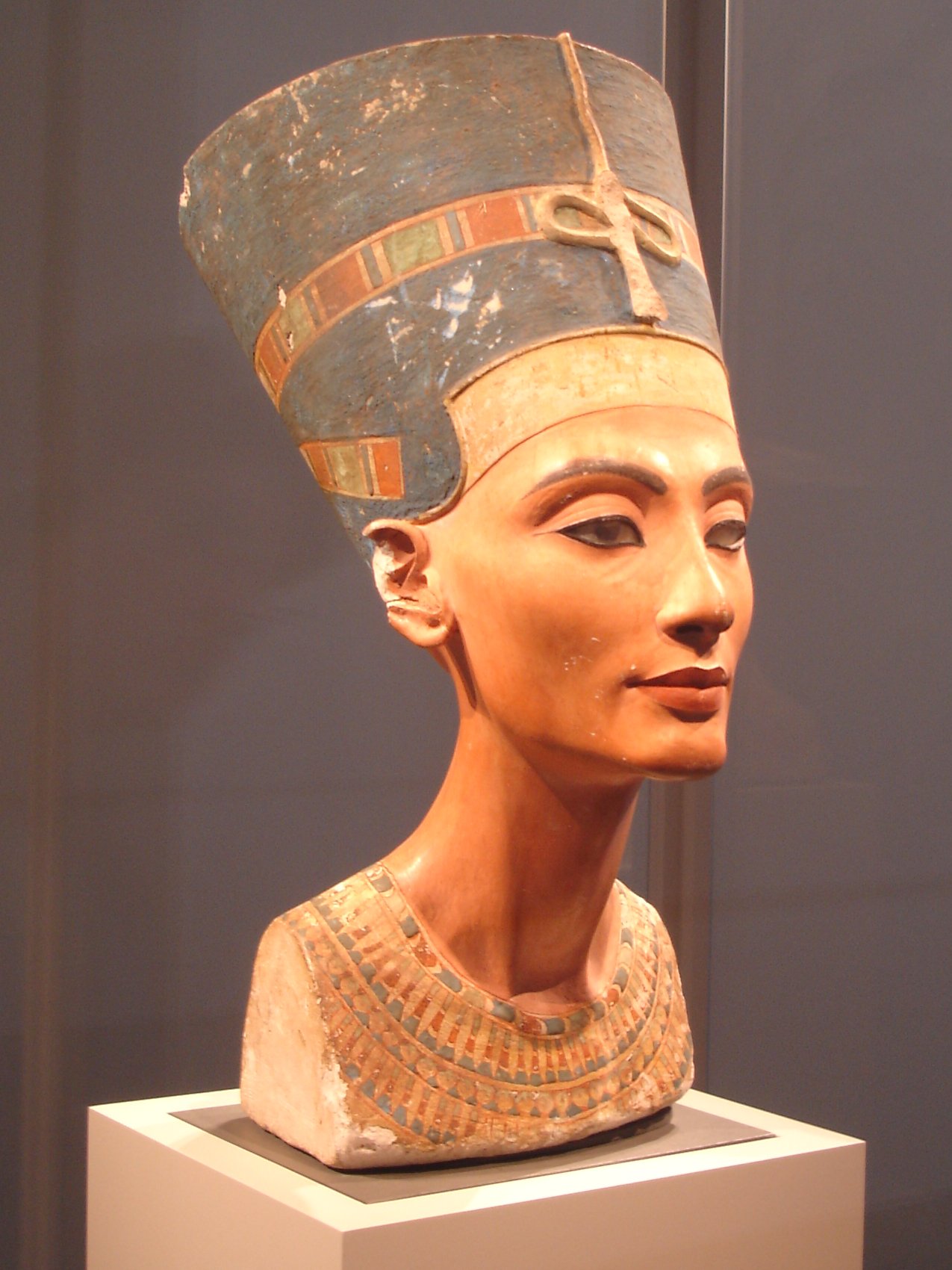


Life and role at court
Contemporary reliefs and painted scenes show Nefertiti participating in religious rituals, sometimes holding ritual objects or presenting offerings with the pharaoh. Amarna art often depicts the royal couple in intimate, informal poses and occasionally gives Nefertiti artistic parity with the king, an unusual emphasis in Egyptian royal imagery. The tall, flat-topped blue crown depicted in many portraits has become closely associated with her identity.
Origins and family
Details of Nefertiti's parentage remain uncertain. Ancient inscriptions provide incomplete information and Egyptologists have proposed various hypotheses, but no consensus on her origins exists. She bore several daughters who are named in surviving records and was connected by marriage to the royal family; she has also been described as a stepmother or mother-in-law to the young Tutankhamun in later succession sequences.
Possible rule and succession debates
After Akhenaten's disappearance from the historical record, a short and puzzling sequence of rulers followed. Some scholars identify a female ruler who adopted kingly titulary and link that figure to Nefertiti under the name Neferneferuaten. Others propose different identities for the ephemeral rulers of this period, including a short reign attributed to Smenkhkare or to one of Akhenaten's daughters. The evidence is fragmentary and interpretations vary; the question of whether Nefertiti served as a pharaoh in her own right is still debated.
Archaeology and famous images
Nefertiti's image survives in painted reliefs, small sculptures, and a renowned painted limestone bust discovered in 1912 in an Amarna sculptor's workshop. That portrait, notable for its realism and refined modeling, has contributed greatly to her modern fame. The findspot and artistic quality link her closely to the distinctive Amarna style, which emphasized naturalistic features and new compositional conventions in royal art.
Tomb and later history
No tomb can be identified with certainty as Nefertiti's. Various candidate burials and hypotheses have been proposed, including possibilities in Amarna and in the later royal valley at Thebes, but none has achieved broad agreement. Her fate after the end of the Amarna court remains obscure in the surviving record.
Legacy and cultural significance
Nefertiti is significant for studies of the Amarna reforms, for understandings of royal women in ancient Egypt, and for the history of Egyptian art. She has become a symbol in modern culture as well as a subject of scholarly inquiry. For further context on the period and its rulers, see general treatments of ancient Egypt and specialized studies on Akhenaten and the Amarna era. Interpretations continue to evolve as researchers reassess inscriptions, art, and archaeological evidence.
- Name meaning: commonly given as "the beautiful (or perfect) woman has come."
- Artistic prominence: central figure of Amarna artistic innovations and realism.
- Contested succession: possible identification with a short-lived pharaonic name remains debated by Egyptologists.
Questions and answers
Q: Who was Nefertiti?
A: Nefertiti was the Great Royal Wife of the Egyptian Pharaoh Akhenaten and one of the most powerful queens in Ancient Egypt.
Q: When did Nefertiti live?
A: Nefertiti lived around 1370 BC to 1330 BC.
Q: Did Nefertiti have any relation to other pharaohs?
A: Nefertiti was the mother-in-law and may have been stepmother of the Pharaoh Tutankhamun.
Q: After her husband died, did Nefertiti rule as pharaoh?
A: It is possible that Nefertiti ruled as pharaoh under the name Neferneferuaten, but some archaeologists do not think so.
Q: What does Nefertiti's name mean in English?
A: In English, Nefertiti's name means "the beautiful (or perfect) woman has come".
Q: Was Nefertiti's reign significant?
A: Yes, Nefertiti was one of the most powerful queens in Ancient Egypt and left a significant impact on history.
Q: How was Nefertiti's name pronounced at the time?
A: At the time, Nefertiti's name was pronounced something like *nafratiːta.
Related articles
Author
AlegsaOnline.com Nefertiti: Queen of the Amarna Era and Icon of Ancient Egypt Leandro Alegsa
URL: https://en.alegsaonline.com/art/69012
Sources
- crystalinks.com : "Nefertiti – Beautiful and Powerful Queen of Ancient Egypt"
- ancient.eu : "Nefertiti"
- manchester.ac.uk : "Nefertiti was no pharaoh, says renowned Egyptologist"
- britannica.com : "Nefertiti"