
Nature versus nurture: understanding the causes of human differences
An overview of the nature versus nurture debate: definitions, history, evidence, modern views on gene–environment interaction, research methods, examples, and common misconceptions.
The phrase nature versus nurture frames a longstanding question about why individuals differ: how much of our behaviour, abilities, and appearance comes from inherited biology and how much from life experiences? In scientific usage, nature refers to genetic, developmental and physiological influences, while nurture covers family, culture, learning, and other environmental effects. Understanding their interplay helps clarify topics from health and education to social policy.
Image gallery
2 Images
Key concepts
Several technical ideas are central to the discussion. In population genetics and behavioural science researchers estimate heritability, a statistical measure that describes the proportion of variation in a population attributable to genetic differences. A trait may have contributions from genetic predispositions and from experiences that shape behaviour. Importantly, heritability is not an indicator of immutability: a highly heritable trait can still be altered by environmental change.
Historical development
The contrast between inherited endowments and upbringing has deep roots. Writers such as Shakespeare and educators like Richard Mulcaster noted the roles of nature and training long before modern science. The expression itself gained popularity after the Victorian polymath Francis Galton used it in the context of social and biological questions; Galton was influenced by Charles Darwin and the ideas set out in On the Origin of Species. Philosophers such as John Locke argued for learning from experience—the so‑called tabula rasa or blank slate viewpoint—while others stressed heredity and the shaping role of the environment. Critics have long argued that the simple "versus" framing misrepresents a more interactive reality.
Methods and evidence
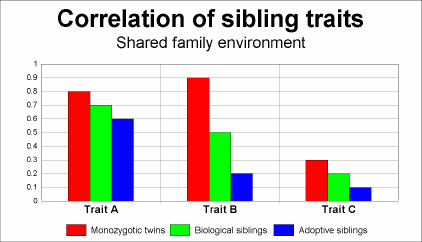
Empirical work uses multiple approaches: twin and adoption studies, family and pedigree analyses, and modern molecular tools such as genome‑wide association studies. These methods aim to separate genetic resemblance from shared environments and to detect interactions where genes moderate environmental effects or vice versa. Discussions in the public debate often simplify these findings; specialists emphasize the limits of each method and the need for careful interpretation.
Modern perspectives and mechanisms
Contemporary biology and psychology stress dynamic interactions. Concepts such as gene–environment interaction, epigenetics, and developmental systems thinking show how experience can alter gene expression and how genetic tendencies can shape the environments people select. These views move beyond a binary choice toward a model where development results from continual reciprocal influence.
Examples, significance and common misconceptions
Examples include cognitive skills, personality characteristics, risk for some illnesses, and language acquisition. None of these is determined solely by genes or upbringing. Two common errors are to interpret heritability as destiny and to assume equal contributions from nature and nurture in every case. A cautious account recognizes that the relative influence of genes and environment can vary by trait, by population, and across the life course. For readers wanting background on how people acquire knowledge, historical context and further study, useful starting points include classic sources from the Victorian period and modern reviews of contemporary research.
Summary points
- Nature and nurture are interdependent: development is shaped by both biology and experience.
- Measures like heritability describe populations, not individuals, and have limits.
- Modern work focuses on interactions, plasticity, and mechanisms such as epigenetic change.
- Historical figures—Galton, Locke, and cultural voices like Shakespeare—influenced how the question has been framed.
For deeper technical and historical reading consult accessible summaries in genetics and developmental psychology and follow current research that integrates environment and biology into unified accounts of human variation.
Further links for exploration: population genetics, traits, behaviour, Darwin, On the Origin of Species, heredity, environment, The Tempest, tabula rasa, public debate, Victorian, acquire knowledge, Shakespeare, John Locke, heritability, Francis Galton.
Questions and answers
Q: What is the nature versus nurture debate about?
A: The nature versus nurture debate is about the causes of differences between people. It looks at how much of a person's traits and behavior are due to their inherited genes and biology (nature) or from events or experiences that happen during life (nurture).
Q: Who suggested the phrase 'nature versus nurture'?
A: The phrase 'nature versus nurture' was suggested by the Victorian polymath Francis Galton. He was influenced by Darwin's On the Origin of Species.
Q: How long has this debate been going on for?
A: This debate has been going on since before Shakespeare wrote about it in The Tempest, which was published in 1611. Even before that, English schoolmaster Richard Mulcaster wrote about it in 1582.
Q: Does nature or nurture have more influence over a person's traits and behavior?
A: Both nature and nurture play interacting roles in development, so both have an influence over a person's traits and behavior. Many modern psychologists and anthropologists consider any contrast between them as naive because they see it as an outdated state of knowledge.
Q: Did John Locke believe humans got their 'mind' from nurture?
A: At first sight, John Locke seemed to think humans got their 'mind' from nurture (the tabula rasa or blank slate theory), but he was only concerned with how we acquire knowledge from sense data rather than our overall make-up.
Q: What does heritability mean?
A: Heritability refers to the extent to which something is inherited genetically - this includes traits of behaviour and character.
Q: Does this debate apply only to humans? A: Though the public debate is all about humans, these principles apply to any living thing - plants as well as animals.
Related articles
Author
AlegsaOnline.com Nature versus nurture: understanding the causes of human differences Leandro Alegsa
URL: https://en.alegsaonline.com/art/68795
Sources
- books.google.com : books.google.com/books?id=_uE-bpGo2N4C&pg=PA227&dq=Nature+versus+nurture+galton&lr=&as_dr…
- twinsuk.ac.uk : twinsuk.ac.uk
- doi.org : 10.2307/2840900
- dx.doi.org : 10.1007/BF01067188
- doi.org : 10.1126/science.2218526
- pubmed.ncbi.nlm.nih.gov : 2218526
- doi.org : 10.1111/j.0963-7214.2004.00295.x
- nytimes.com : "After the bell curve"
- dx.doi.org : 10.1073/pnas.96.15.8790
- owlcation.com : "Causes of Aggression: A Psychological Perspective"
- tandfonline.com : "CONCEPT ANALYSIS: AGGRESSION"
- doi.org : 10.1080/01612840490486755
- worldcat.org : 0161-2840