
Natural History Museum (London): collections, history and public role
Major London museum housing extensive biological, geological and mineral collections; a centre for research, conservation and public education on Earth’s natural history.
Overview
The Natural History Museum in London is Britain’s principal museum dedicated to life and earth sciences. Located in South Kensington, the institution combines public galleries, research laboratories and long-term specimen stores. Visitors encounter displays spanning living organisms, fossils and the planet’s rocks and minerals, while scientific staff preserve and study the collections. Practical visitor information and official details are available on the museum’s information page, and local context is provided in general London guides.
Image gallery
10 Images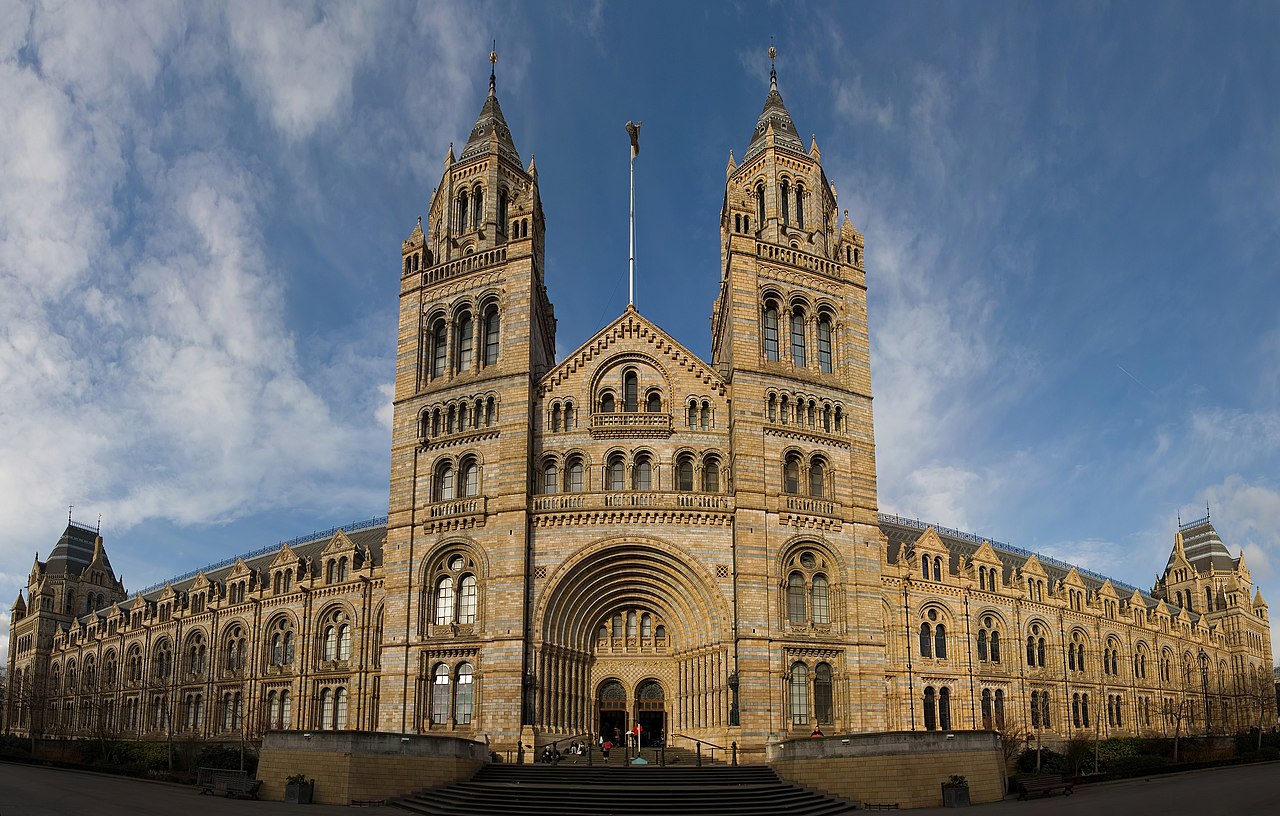



Collections and galleries
The museum holds extensive collections organised to support both public display and specialist research. Major areas include biological specimens (insects, plants, birds and preserved animals), palaeontology (fossils demonstrating the history of life), and geological holdings (rocks, minerals and meteorites). The geological holdings are described further on pages about rock collections and mineral exhibits. Exhibition galleries mix historic specimens with modern interpretation and interactive displays for different ages.
History and architecture
The present landmark building, opened in the late 19th century, was designed by Alfred Waterhouse and is noted for its Romanesque style and terracotta ornamentation. The museum grew from national natural history collections that were previously part of broader state holdings; it became a dedicated centre for natural science display, study and public education. The site stands on Exhibition Road among neighbouring institutions such as the Victoria and Albert Museum and Imperial College London.
Research, the Darwin Centre and conservation
Beyond exhibitions the museum functions as an active research organisation. Scientific staff specialise in taxonomy, systematics, palaeontology, mineralogy and conservation science, and the institution supports studies on biodiversity and environmental change. The Darwin Centre provides laboratory space and public-facing stores for working scientists; further information on these activities is available via the museum’s research and collections pages. The institution also loans specimens to other museums and collaborates with universities and international partners.
Public role, learning and significance
The museum maintains a broad educational mission: general admission is free, and programmes include temporary exhibitions, school resources, family events and citizen science projects. It is widely recognised for the scientific value of its collections and for combining historic architecture with contemporary galleries. Notable displays and outreach initiatives make the museum a leading centre for communicating Earth’s natural history to both specialists and the general public.
Questions and answers
Q: What is the Natural History Museum?
A: The Natural History Museum is a museum in London that is the largest natural history museum in Britain.
Q: What does the NHM include?
A: The NHM includes the nation's main collections of specimens of life, rocks and minerals.
Q: What does the museum staff do?
A: The museum staff at the NHM employs scientific staff, conducts research, stores specimens, and manages the public galleries.
Q: Where is the NHM located?
A: The NHM is located on Exhibition Road in South Kensington, London.
Q: What are the other large institutions on Exhibition Road in South Kensington, London?
A: The other large institutions on Exhibition Road in South Kensington, London are the Science Museum, the Victoria and Albert Museum and Imperial College London.
Q: What kind of research is conducted at the NHM?
A: Research on specimens and other natural history topics is conducted at the NHM.
Q: Why is the NHM notable?
A: The NHM is notable because it is the largest natural history museum in Britain and has extensive collections and staff involved in research.
Related articles
Author
AlegsaOnline.com Natural History Museum (London): collections, history and public role Leandro Alegsa
URL: https://en.alegsaonline.com/art/68766
Sources
- nhm.ac.uk : nhm.ac.uk/our-science.html