
National Museum of Natural History (Smithsonian Institution)
Major Smithsonian natural history museum on the National Mall in Washington, D.C., with more than 500 million specimens, public exhibits (Insect Zoo, IMAX), research programs, and free admission.
Overview
The National Museum of Natural History is a leading natural history museum on the National Mall in Washington, D.C., administered by the Smithsonian Institution. It houses vast scientific collections, public exhibitions and educational programs, and is open to visitors nearly every day of the year with free admission. Over time it has become one of the most visited museums in the United States, drawing millions of visitors annually.
Image gallery
10 Images



Collections
The museum's repositories contain more than half a billion specimens and objects documenting the diversity of life, the history of Earth, and human cultural artifacts. These collections are central to scientific research, conservation, and public interpretation.
- Botanical specimens (plants, seeds, and preserved material)
- Zoological collections (insects, mammals, birds, fishes and other animals)
- Fossils and paleontological material that record ancient life
- Minerals, gems and rocks, including famous gemstones and meteorites
- Anthropological and cultural objects that illuminate human history
Exhibits and notable displays
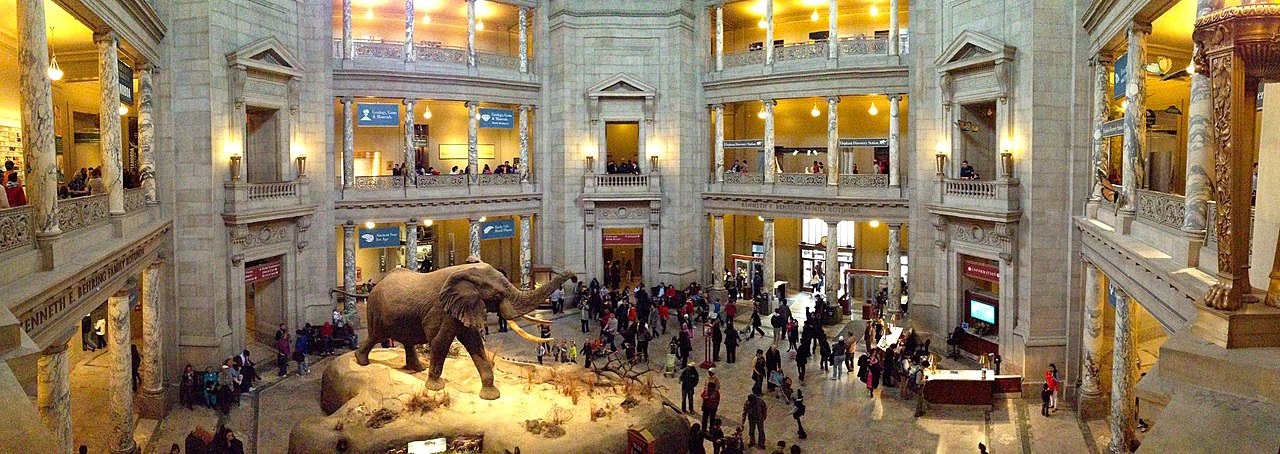
The museum presents a mix of permanent halls and rotating special exhibitions. Permanent galleries explore topics such as paleontology (fossils and the evolution of life), earth sciences (minerals, geology and meteorites), biodiversity, human origins and cultural history. Public highlights often include an Insect Zoo that offers live demonstrations and interactive learning, an on-site theater that has shown large-format films, and a gem and mineral hall that has displayed famous gems. Exhibits are designed for a wide audience, from young children to scholars, and combine specimens with multimedia interpretation.
History and architecture
The institution and its collections grew from 19th- and early 20th-century scientific collecting and the Smithsonian's mission to increase and diffuse knowledge. The main building on the Mall reflects early 20th-century museum design adapted over decades to accommodate expanding collections and contemporary exhibition needs. The museum's spaces have been renovated periodically to improve conservation, research facilities and visitor experience while retaining historic features.
Research, curation and education
Beyond display, the museum is a major research center. Staff scientists, curators and collections managers study taxonomy, ecology, paleontology, geology, anthropology and related fields. Collections serve as primary scientific evidence used in taxonomy, conservation assessments and environmental studies. The museum also organizes educational programs for schools, families and the public, supports graduate research, and collaborates with institutions worldwide to share specimens and expertise.
Visitor information and resources
The museum welcomes millions of visitors each year and offers resources for planning visits, academic research, and online exploration. It is free to enter and open most days; specific hours, accessibility services and current exhibitions are posted by the institution. For more information, online catalogs and outreach programs, consult the following resources:
- Official museum information
- Exhibitions and events
- National Mall visitor guide
- Washington, D.C., visitor resources
- U.S. federal cultural institutions overview
- Smithsonian Institution main page
- Botany collections database
- Zoology collections and research
- Fossil and paleontology resources
- Minerals, gems and geology information
- Rocks and meteorites collections
- Research and scientist profiles
Whether approached as a destination for hands-on learning, a scientific research center, or a guardian of irreplaceable specimens, the National Museum of Natural History plays multiple roles: stewarding global collections, advancing scientific knowledge, and providing public access to the natural world.
Questions and answers
Q: What is the National Museum of Natural History?
A: The National Museum of Natural History is a natural history museum located on the National Mall in Washington, D.C., United States, administered by the Smithsonian Institution.
Q: What kind of collections are displayed in the National Museum of Natural History?
A: The museum's collections include over 500 million specimens of plants, animals, fossils, minerals, rocks, meteorites, and human cultural artifacts.
Q: What is the admission fee to the National Museum of Natural History?
A: Admission to the museum is free.
Q: What is the opening time of the National Museum of Natural History?
A: The museum is open 364 days a year.
Q: Which Smithsonian museum is the most visited?
A: The National Museum of Natural History is the most visited of all the Smithsonian museums.
Q: What is unique about the natural history scientists at the National Museum of Natural History?
A: The museum is home to about 185 professional natural history scientists – the largest group of scientists dedicated to the study of natural and cultural history in the world.
Q: What other attractions are found in the National Museum of Natural History?
A: The main building of the museum includes an "Insect Zoo" and an IMAX theater.
Related articles
Author
AlegsaOnline.com National Museum of Natural History (Smithsonian Institution) Leandro Alegsa
URL: https://en.alegsaonline.com/art/68663
Sources
- newsdesk.si.edu : "Visitor Statistics" · web.archive.org
- usatoday.com : "Smithsonian reports 20% jump in museum visitors"
- mnh.si.edu : National Museum of Natural History official website
- mnh.si.edu : "About the Museum"