
National Assembly (France)
Lower house of the French Parliament under the Fifth Republic, composed of 577 deputies elected from single-member constituencies by a two-round system; meets at the Palais Bourbon in Paris.

The National Assembly (French: Assemblée nationale) is the principal directly elected chamber of the Parliament of France under the Fifth Republic. It is one of two parliamentary houses, the other being the Senate, and plays a central role in making and controlling public policy. The Assembly is the forum in which government ministers answer MPs, where laws are debated and voted, and where confidence in the government can be expressed or withdrawn.
Image gallery
5 Images


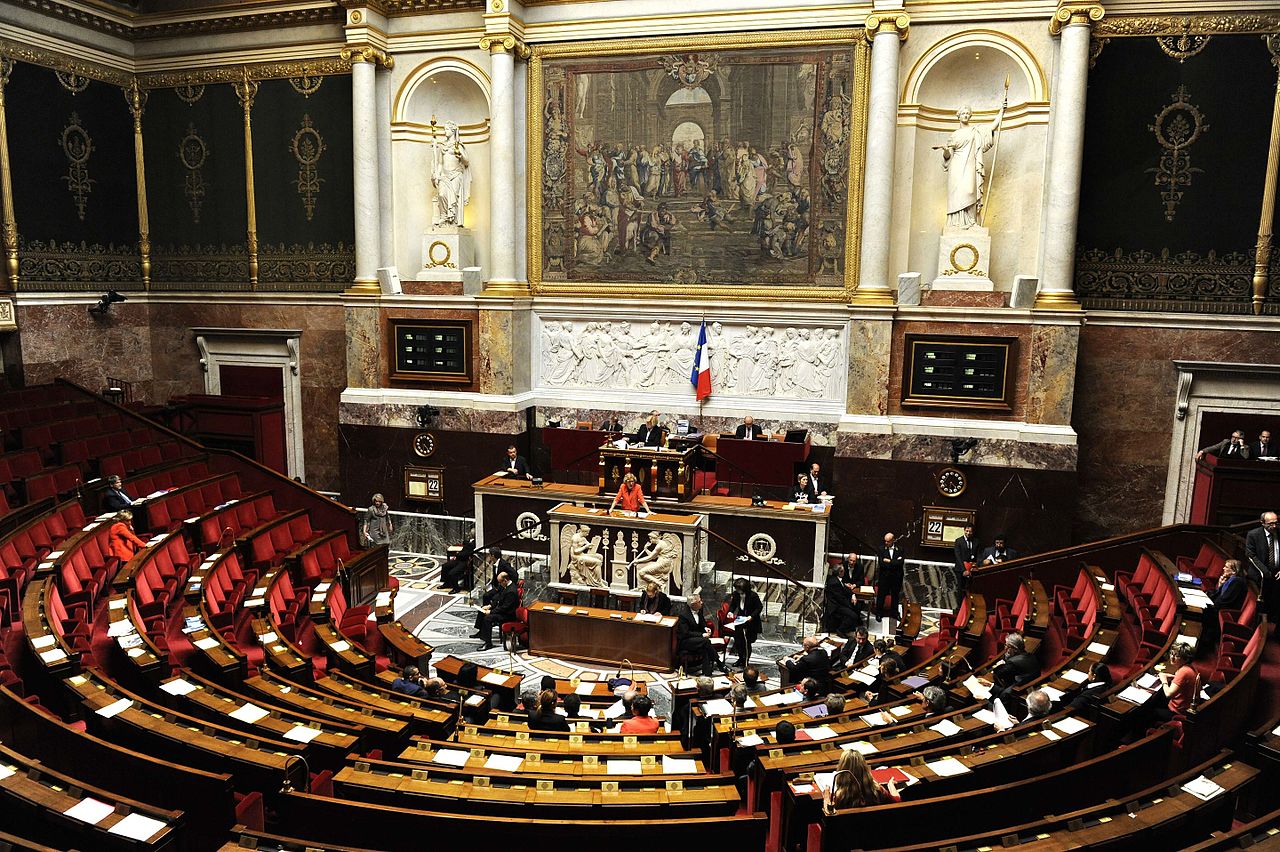

Composition and election
The Assembly comprises 577 deputies (députés), each representing a single-member electoral district. Deputies are chosen by voters in their constituencies using a two-round majority system: if no candidate obtains an absolute majority in the first round, a second round is held among leading candidates. Deputies normally serve five-year terms, though the President of the Republic has the constitutional power to dissolve the Assembly and call a fresh election under specified conditions.
Organization and internal roles
At the start of each legislative term the Assembly elects a President (speaker) who presides over debates, ensures rules are followed and represents the body in relations with other institutions. The President is usually drawn from the largest political group, and a bureau of vice-presidents, secretaries and quaestors assists with procedural, administrative and financial matters. Parliamentary groups — formed by deputies sharing political affinities — structure debate time and committee membership.
Powers, procedures and relationship with government
The National Assembly has several core powers. It initiates and votes on legislation, examines the government’s draft bills and amendments, and holds the executive to account through questions, interpellations and inquiries. In cases of conflict between the two houses, the Assembly can have the final say on most laws. A vote of no-confidence in the Assembly can force a government to resign, making parliamentary support essential to day-to-day governance.
- Main functions: legislate, control the executive, approve budgets.
- Tools: committees, oral questions, written questions, commissions of inquiry.
- Limitations: constitutional and judicial review, shared lawmaking with the Senate and the executive.
Seat, history and notable features
The official meeting place is the Palais Bourbon, situated on the left bank of the Seine in Paris. The Palace dates to the 18th century and has been adapted over time to host legislative chambers and offices. The modern National Assembly derives its current power and procedures from the Constitution of the Fifth Republic, adopted in 1958, which strengthened the role of the executive while preserving a significant legislative mandate for the Assembly.
Compared with other parliamentary chambers, the French National Assembly combines elements of strong executive oversight with robust parliamentary control tools. Its work is organized through standing committees and plenary sittings, and its composition and rules reflect the dynamics of party politics, regional representation and national debates. For further institutional details see the Assembly's official pages at Palais Bourbon information and resources on constituencies at electoral districts. The location on the left bank of the river is often noted in guides to Paris and politics alike: Seine riverside.
Notable facts include the Assembly's decisive role in budgetary approval and its capacity to hold the government to account through formal motions and questions. Over time it has been a key arena for national debate, political renewal and constitutional practice in France.
Questions and answers
Q: What is the French National Assembly?
A: The French National Assembly is one of the two houses of the Parliament of France under the Fifth Republic. It consists of 577 members known as députés (deputies).
Q: How are deputies elected to the National Assembly?
A: Deputies are elected in each constituency through a two-rounds system.
Q: Who presides over the National Assembly?
A: The National Assembly is presided over by a president normally from the largest party represented, assisted by vice-presidents from across the represented political spectrum.
Q: How long does a term for the National Assembly last?
A: The term of the National Assembly is five years; however, it can be dissolved by President of France at any time unless he dissolved it in the preceding year.
Q: Where is the official seat of the French National Assembly located?
A: The official seat of the French National Assembly is located at Palais Bourbon on left bank of river Seine.
Q: What other house makes up Parliament under Fifth Republic?
A: The other house that makes up Parliament under Fifth Republic is Senate ("Sénat").
Related articles
Author
AlegsaOnline.com National Assembly (France) Leandro Alegsa
URL: https://en.alegsaonline.com/art/68527