
National Anthem of the Republic of China (San Min Zhu Yi)
The national anthem of the Republic of China, commonly known as San Min Zhu Yi, has lyrics based on Sun Yat-sen's speeches and a melody by Cheng Maoyun. It remains Taiwan's official anthem with historical ties to the KMT.
Overview
The National Anthem of the Republic of China is the official national song associated with the Republic of China (ROC). It is commonly referred to by its opening phrase and ideological reference, San Min Zhu Yi (Three Principles of the People). The words are widely attributed to Sun Yat-sen, the founding figure of the modern Chinese republic, and the music was later composed to accompany those words. The anthem became established during the Republican era on the Chinese mainland and continued in official use after the ROC government relocated to Taiwan following the Chinese Civil War.
Image gallery
2 Images
Origins and development
The lyrics were derived from a series of speeches and writings by Sun Yat-sen that articulated the political philosophy known as the Three Principles of the People. These lines were selected and adapted into a concise anthem text in the 1920s. A distinct musical setting was composed a few years later by Cheng Maoyun to formalize the song for ceremonial use. The composition and adoption of the anthem occurred in the context of the Kuomintang's efforts to create national symbols alongside a new flag and state emblem.
Lyrics and meaning
The anthem's text expresses themes of national revival, unity, and dedication to the principles set forth by Sun Yat-sen: nationalism, democracy, and the people's livelihood. In performance it is meant to inspire civic responsibility and loyalty to the state. Because of its direct link to an ideological program, the anthem is sometimes described by the name of that program rather than by a separate title.
Usage, protocol and occasions
The anthem is used at state ceremonies, military events, school functions and other formal occasions where national symbols are displayed. Typical protocols include standing at attention, removing headwear where customary, and singing or playing the anthem during flag-raising and -lowering ceremonies. In practice, the anthem appears alongside other official musical pieces in ROC public life, such as the national banner anthem.
- State ceremonies and national holidays
- Military parades and official commemorations
- Educational and civic events
Legal status and historical context
The anthem was recognized during the Republic's years on the mainland and was formally adopted in the years before and during the Second World War. After 1945 it continued to be the anthem used by the ROC government based in Taiwan. With the establishment of the People's Republic of China on the mainland in 1949, the anthem was superseded there by a different national song and regulations governing its use changed. On Taiwan the anthem remains the official national anthem and is part of the island's repertoire of state symbols.
Distinctions and notable facts
Several points help distinguish this anthem from other Chinese national songs and party anthems:
- Its lyrics are drawn directly from the political thought of Sun Yat-sen rather than being a poetic text set to music.
- It is associated with the Republic of China as a state anthem, while other songs may function as party hymns or alternative national pieces.
- Its continued use in Taiwan contrasts with its discontinuation on the mainland after 1949.
For readers seeking primary sources and further notes on the anthem's text, composition and official adoption, see related references and records held by institutions documenting modern Chinese political and cultural history. Additional background about the anthem's author and the political movement connected to its words is available through general biographies of Sun Yat-sen and histories of the Kuomintang.
Related links: Text and translation, Republic of China, Sun Yat-sen, Kuomintang (KMT), national flag, state emblem, adoption history, Taiwan, related anthems.
Genesis
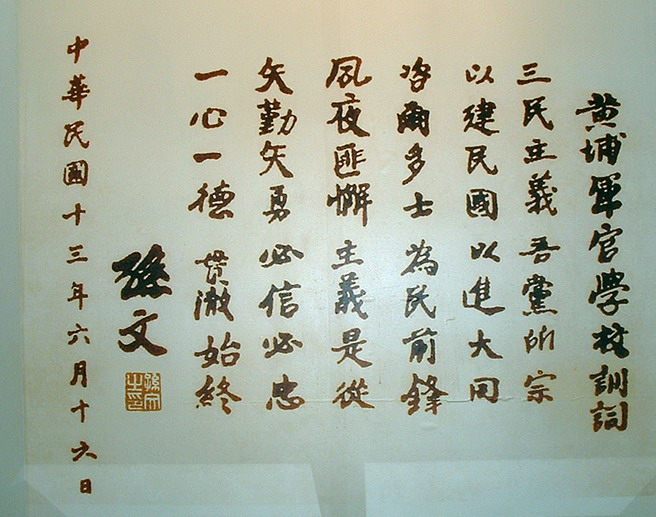
The text of San Min Chu-i was created through a collaboration of four Kuomintang members: Hu Hanmin (胡漢民), Dai Jitao (戴季陶), Liao Zhongkai (廖仲愷) and Shao Yuanchong (邵元沖).
The text was first presented on July 16, 1924, during Sun Yat-sen's opening speech at the Whampoa Military Academy.
After the success of the Northern Campaign, the KMT decided to use the lyrics as the party anthem and therefore publicly solicited suggestions for the musical accompaniment. The melody by Cheng Mao-yun (程懋筠) won the competition among 139 participants.
On March 24, 1930, several KMT party members proposed that San Min Chu-i be declared the official national anthem. However, there was strong opposition to having one party symbol represent the whole country. Therefore, the Committee for Research and Preparation of the National Anthem (國歌編製研究委員會 / 国歌编制研究委员会, Guógē Biānzhì Yánjiū Wěiyuánhuì) was established. However, this endorsed the proposal to use the Party Song as the national anthem. On June 3, 1937, the Central Bureau (中央常務委員會 / 中央常务委员会, Zhōngyáng Chángwù Wěiyuánhuì) endorsed the proposal, and in 1943 San Min Chu-i became the official national anthem of the Republic of China.
San Min Chu-i was voted the world's best national anthem at the 1936 Summer Olympics.
Text
| Chinese | Translation | |
| 三民主義,吾黨所宗, | Sānmín Zhǔyì, wú dǎng suǒ zōng, | The three people's principles, the goal of our party. |
National Anthem of the Republic of China (Taiwan)
Related articles
Author
AlegsaOnline.com National Anthem of the Republic of China (San Min Zhu Yi) Leandro Alegsa
URL: https://en.alegsaonline.com/art/68517
Sources
- english.president.gov.tw : "National anthem"