
Astrocyte
Astrocytes are star-shaped glial cells in the central nervous system that support neurons, regulate extracellular environment and blood flow, and participate in repair and signaling.
Overview
Astrocytes, often called astroglia, are a major class of glial cells found throughout the central nervous system, including the brain and the spinal cord. Their name reflects a characteristic star-like shape. Although smaller and more numerous than neurons, astrocytes perform many supportive and regulatory roles that are essential for healthy neural function. The relative abundance of astrocytes varies by anatomical region; estimates commonly place their proportion among glial cells in a range that differs across areas of the nervous system.
Image gallery
8 Images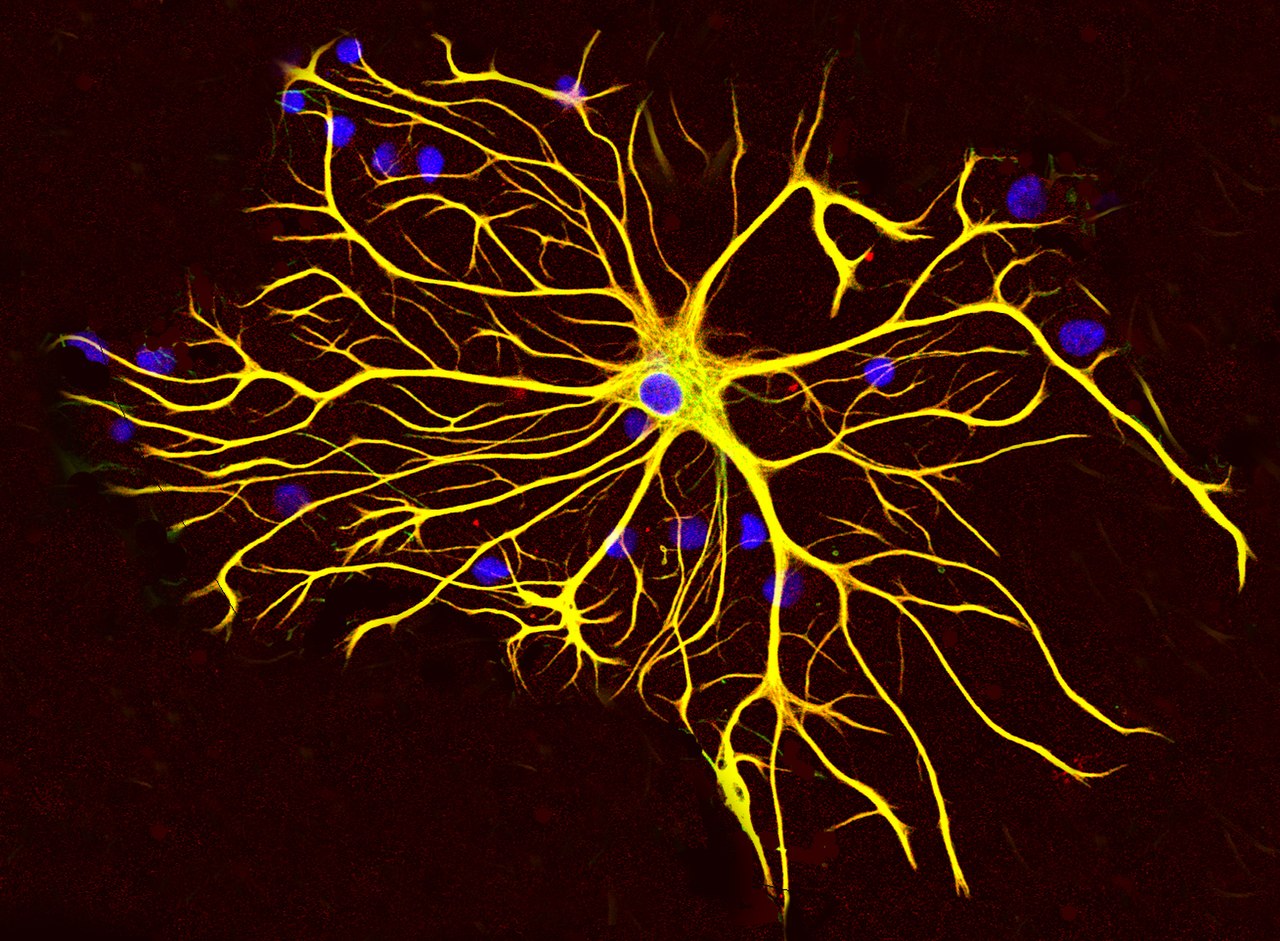


Structure and types
Astrocytes have a complex morphology: a central cell body with multiple radiating processes that contact blood vessels, neuronal synapses and the extracellular matrix. Two broad categories are often described: protoplasmic astrocytes with many fine branches found mainly in gray matter, and fibrous astrocytes with longer, less-branched processes in white matter. Their membranes contain transporters and channels that allow them to respond to and influence local ionic and chemical conditions.
Major functions
Astrocytes contribute to neural tissue in several distinct ways:
- Homeostasis: they regulate extracellular concentrations of ions such as potassium and take up neurotransmitters to limit spillover between synapses, helping maintain the local chemical environment.
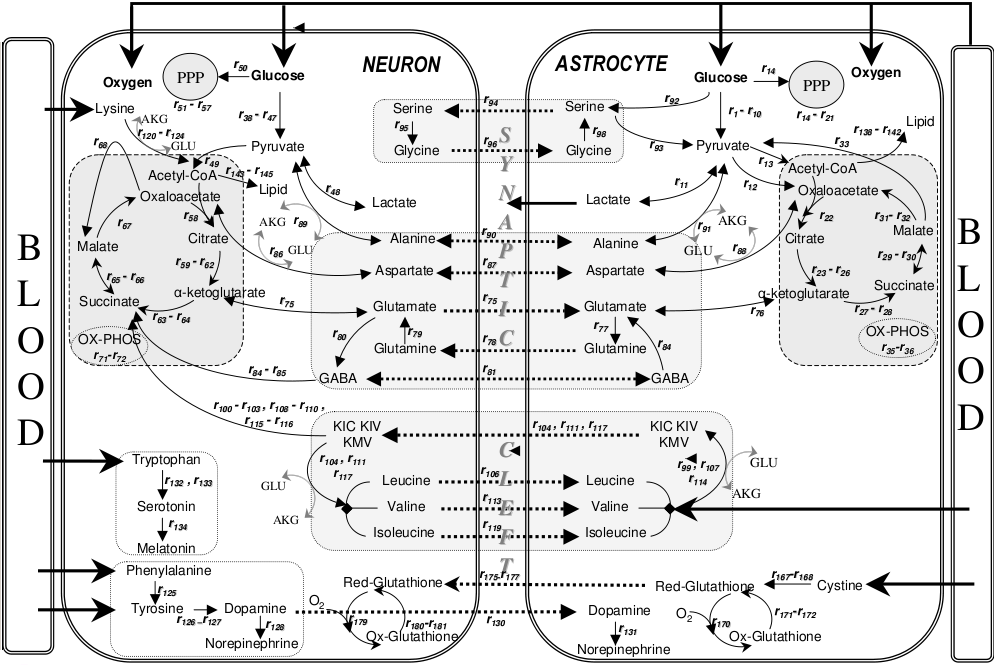
- Metabolic support: astrocytes supply neurons with metabolic substrates and help shuttle energy metabolites between blood vessels and neural tissue.
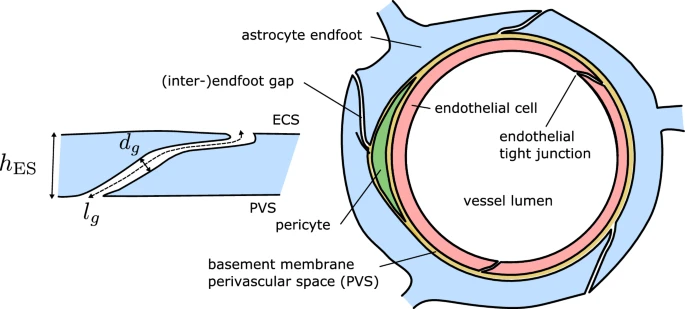
- Barrier and vascular interactions: their endfeet enwrap brain capillaries and work together with endothelial cells to support the blood–brain barrier, and they influence local blood flow in response to neural activity.
- Repair and scarring: after injury astrocytes can become reactive and contribute to repair processes, cytokine signaling and scar formation that alters tissue remodeling.
Communication and signaling
Although not electrically excitable in the same way as neurons, astrocytes communicate through chemical signaling. They exhibit intracellular calcium changes and can propagate calcium waves across networks of glial cells. These calcium signals are associated with release of signaling molecules sometimes called gliotransmitters, and they play modulatory roles in synaptic transmission and circuit function. Research into astrocytic signaling has been an active area, revealing contributions to information processing beyond classic neuronal mechanisms; this has made them a focus within modern neuroscience research.
Development, history and distinctions
Astrocytes arise during development from neural progenitor lineages and mature under influence from local signals. Histologists first recognized star-shaped glial cells with early microscopic staining methods in the 19th century; subsequent work refined their classification and functional understanding. Distinguishing astrocytes from other glia—such as oligodendrocytes and microglia—relies on morphology, molecular markers and their distinct roles in support, myelination and immune defense, respectively.
Clinical relevance and research directions
Astrocytes are implicated in a range of neurological conditions. Their dysfunction can affect ion balance, neurotransmitter clearance and blood–brain barrier integrity, contributing to disorders such as stroke, epilepsy and neurodegenerative diseases. Reactive astrogliosis is a common response to injury and inflammation. Ongoing studies investigate how astrocytes regulate synapse formation, contribute to metabolic coupling and influence recovery after injury; for example, work showing activity-linked release of Ca2+-dependent signals has broadened interest in their active roles. Researchers also examine regional differences in astrocyte populations and report that their proportion among glial cells can vary by location, often cited in studies as roughly between twenty and forty percent depending on the area.
Notable facts
- Astrocytes contact both neurons and blood vessels, making them central to neurovascular coupling.
- They play roles in development, synaptic plasticity and response to injury—functions that extend beyond passive support.
- Contemporary research continues to revise our understanding of glia from passive ‘‘glue’’ to dynamic partners in brain function; see general resources in further readings and reviews linked through specialized portals such as neuroscience overviews and institutional summaries at clinical neuroscience pages.
For accessible introductions and current reviews, consult primary neuroscience summaries and specialist texts that cover cellular neurobiology, glial physiology and neurovascular interactions.
Questions and answers
Q: What are astrocytes?
A: Astrocytes are star-shaped glial cells found in the brain and spinal cord.
Q: What proportion of glia in the brain do astrocytes make up?
A: Astrocytes make up between 20% to 40% of all glia in the brain, with varying proportions by individual regions.
Q: What are the functions of astrocytes?
A: The functions of astrocytes include helping the endothelial cells of the blood-brain barrier, providing nutrients to the nervous tissue, keeping extracellular ions in balance, and helping repair the brain and spinal cord after traumatic injuries.
Q: What significant discovery has been made about astrocytes since the mid-1990s?
A: Research since the mid-1990s has shown that astrocytes release Ca2+ ions and adjust brain functions, making them an important research area in neuroscience.
Q: What other name are astrocytes known collectively as?
A: Astrocytes are also known collectively as astroglia.
Q: Where are astrocytes found in the body?
A: Astrocytes are found in the brain and spinal cord.
Q: Why are astrocytes important for research in neuroscience?
A: Astrocytes are important for research in neuroscience due to their releasing of Ca2+ ions and their function in adjusting brain functions.
Author
AlegsaOnline.com Astrocyte Leandro Alegsa
URL: https://en.alegsaonline.com/art/6827
Sources
- doi.org : 10.1146/annurev.pharmtox.011008.145602
- pubmed.ncbi.nlm.nih.gov : 18834310