
Astigmatism: causes, symptoms, diagnosis and correction
Astigmatism is a common refractive condition caused by irregular curvature of the cornea or lens, producing distorted or blurred vision. Causes, types, diagnosis, treatment options, and when to seek care.
Overview
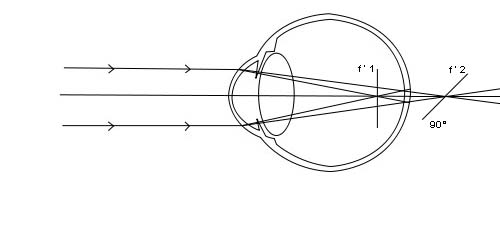
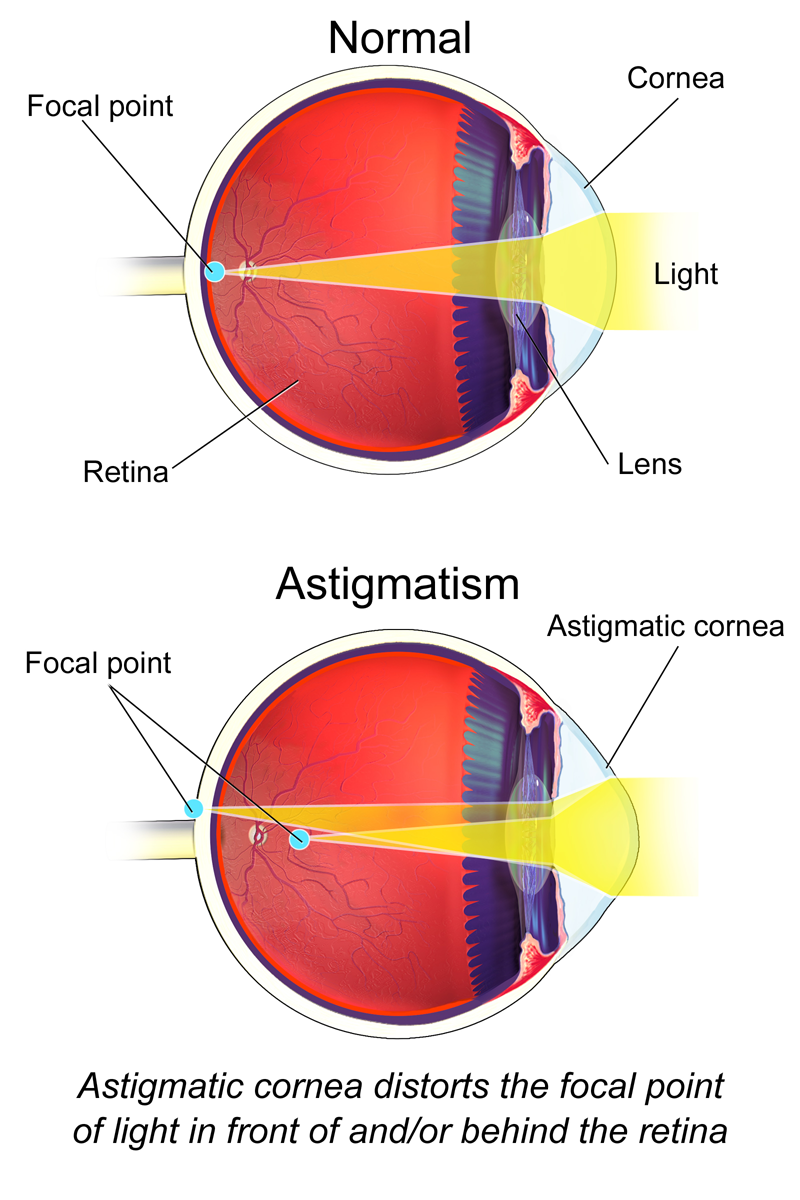
Astigmatism is a refractive condition in which the eye focuses light unequally in different meridians, producing blurred or distorted vision at near and/or distance. It arises because the optical surfaces (most commonly the cornea) are not perfectly spherical, so incoming rays form two principal focal lines instead of a single point on the retina. Astigmatism is common, often present from childhood, and frequently occurs together with myopia (nearsightedness) or hyperopia (farsightedness).
Image gallery
3 Images
Causes and types
Two main anatomical sources produce astigmatism:
- Corneal astigmatism — irregular curvature of the cornea, the clear front surface of the eye. The cornea is the usual source and is often described as steeper in one direction and flatter in the perpendicular direction. See basic corneal anatomy at cornea.
- Lenticular astigmatism — irregular shape or tilt of the eye's crystalline lens inside the eye.
Clinically astigmatism is categorized by axis (orientation) — with-the-rule, against-the-rule, or oblique — and by magnitude, measured in diopters. It may be regular (predictable meridians) or irregular (often due to injury, surgery, or disease), the latter being harder to correct with ordinary spectacles.
Symptoms and importance
People with astigmatism commonly report blurred or stretched vision, ghosting or double images, difficulty reading some letters but not others, eyestrain, headaches, and trouble with night driving or glare. In children, uncorrected astigmatism can contribute to amblyopia (reduced vision development) if not identified and treated early, so screening is important.
Diagnosis
Routine eye examinations detect astigmatism through objective and subjective tests. A refraction test determines the prescription that best focuses light on the retina; keratometry and corneal topography map the corneal curvature and reveal regular or irregular patterns. Automated instruments, trial lenses and retinoscopy are commonly used in clinical practice. For more detailed clinical descriptions see diagnostic methods.
Treatment and management
Astigmatism can usually be corrected effectively. Options include:
- Eyeglasses with cylindrical lenses that compensate for the uneven focusing.
- Contact lenses — soft toric lenses for regular astigmatism or rigid gas-permeable lenses and hybrid designs for irregular astigmatism; see general contact lens information at contact lenses.
- Refractive surgery such as LASIK, PRK, or other corneal procedures to reshape the cornea; some lens-based surgeries can address high or irregular astigmatism.
- Orthokeratology — overnight rigid lenses that temporarily reshape the cornea for daytime clarity.
Choice of treatment depends on degree of astigmatism, corneal health, patient age, lifestyle and coexisting refractive errors. Regular follow-up ensures that prescriptions remain accurate and that treatment continues to meet visual needs.
Historical notes and notable facts
Astigmatism was described scientifically in the early 19th century; early practitioners developed cylindrical optics to correct it. Small amounts of astigmatism are normal and often asymptomatic. High or irregular astigmatism warrants closer attention because it may indicate corneal disease or follow trauma. With modern assessment and correction, most people with astigmatism achieve clear, comfortable vision.
Questions and answers
Q: What is astigmatism?
A: Astigmatism is a condition in which the eye creates two images instead of one image on the retina caused by the irregular shape of the cornea.
Q: Does astigmatism affect the health of the eye?
A: No, astigmatism does not affect the health of the eye.
Q: What is the cause of astigmatism?
A: Astigmatism is caused by the irregular shape of the cornea.
Q: What are the symptoms of astigmatism?
A: The symptoms of astigmatism include blurry vision, difficulty reading letters, headaches, and eye strain.
Q: Can astigmatism be easily fixed?
A: Yes, astigmatism can be easily fixed with glasses, contact lenses, or surgery.
Q: How is astigmatism diagnosed?
A: Astigmatism is diagnosed through a comprehensive eye exam, which includes measuring the shape and curvature of the cornea and checking vision.
Q: Are eyes with astigmatism considered unhealthy?
A: No, eyes with astigmatism can be perfectly healthy.
Related articles
Author
AlegsaOnline.com Astigmatism: causes, symptoms, diagnosis and correction Leandro Alegsa
URL: https://en.alegsaonline.com/art/6805