
MythBusters: Popular Science Entertainment and Experimental Myth Testing
MythBusters is a long-running American science-entertainment TV series (debut 2003) that tested popular myths and urban legends through experiments, engineering, and controlled observation.
MythBusters is an American science-entertainment television program that premiered in January 2003. Combining elements of popular culture, engineering and experimental science, the series set out to determine whether widely held myths, movie scenes, and urban legends were plausible. The program presented its conclusions in accessible terms—typically labeling tested claims as "confirmed," "plausible," or "busted"—and emphasized reproducible demonstration over mere assertion.
Image gallery
6 Images


Format and experimental approach
Each episode followed a routine: a myth was introduced, the team proposed a hypothesis, and then designed practical tests to evaluate the claim. Tests ranged from small-scale laboratory experiments to full-scale builds and high-speed video capture. Safety protocols and repeated trials were commonly used to improve reliability, and when results were ambiguous the show often explored alternate setups or contributing factors. The series blended explanation, step-by-step construction, and visual evidence to make the scientific method approachable for a general audience.
Cast and roles
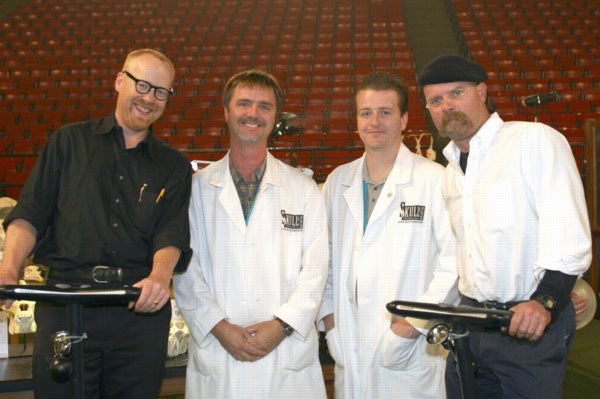
The program originally centered on two hosts who combined technical skill and on-camera chemistry. A small build team and additional specialists joined them to design experiments, build rigs, and operate instrumentation. On-screen roles typically included experiment design, fabrication, data collection, and narration of results. Over time the team evolved as contributors joined or left, but the collaborative workshop dynamic remained central to the show's appeal.
Types of myths and notable examples
- Movie myths: recreating cinematic explosions or stunts to see if they mirror real-world physics.
- Urban legends: testing claims about household hazards, food, or consumer products.
- Historical or cultural claims: evaluating whether an old tale could have occurred as described.
Examples often included dramatic demonstrations such as vehicle collisions, combustion experiments, or mechanical mock-ups; the visual nature of these tests helped viewers understand underlying principles.
Impact, criticism and legacy
MythBusters popularized hands-on experimentation and inspired interest in engineering and critical thinking. It reached broad audiences by presenting scientific ideas through entertainment. Critics sometimes noted that television constraints—time, budget, and the need for spectacle—could limit how rigorous a test could be; the show usually acknowledged such limitations and framed conclusions accordingly. Its influence is visible in educational outreach, maker culture, and other science-oriented programming.
For more information or official resources, see official site, network pages at broadcaster pages, or articles summarizing its methods and episodes at related coverage.
Questions and answers
Q: What is MythBusters?
A: MythBusters is an American scientific television show.
Q: When did MythBusters start?
A: MythBusters began on January 23, 2003.
Q: Who are the hosts of MythBusters?
A: The hosts of MythBusters are Adam Savage and Jamie Hyneman along with Kari Byron, Tory Belleci and Grant Imahara.
Q: What do the hosts attempt to do on MythBusters?
A: The hosts attempt to test whether certain myths are true or false, referred to on the show as confirmed or busted, respectively.
Q: How many episodes has MythBusters had as of September 5, 2015?
A: MythBusters has had a total of 267 episodes as of September 5, 2015.
Q: How many more episodes are coming in January 2016?
A: Two more episodes are to come in January 2016.
Q: What do the hosts on MythBusters refer to true myths as?
A: The hosts on MythBusters refer to true myths as "confirmed".
Related articles
Author
AlegsaOnline.com MythBusters: Popular Science Entertainment and Experimental Myth Testing Leandro Alegsa
URL: https://en.alegsaonline.com/art/68013