
Myriapoda: millipedes, centipedes and their relatives
A subphylum of terrestrial arthropods with elongated, multi‑segmented bodies and numerous legs. Includes millipedes, centipedes, pauropods and symphylans; important decomposers, predators and soil inhabitants.
Overview: Myriapoda is a formally recognised subphylum within the larger group of arthropods. Members are chiefly characterised by an elongated body composed of many segments, most of which bear legs. The group includes familiar millipedes and centipedes as well as smaller and less conspicuous lineages. All known myriapods are primarily terrestrial, occupying leaf litter, soil and other ground habitats. Though their name suggests tens of thousands of legs, counts vary: some species have fewer than ten legs, while the millipede Illacme plenipes is noted for having several hundred.
Image gallery
10 Images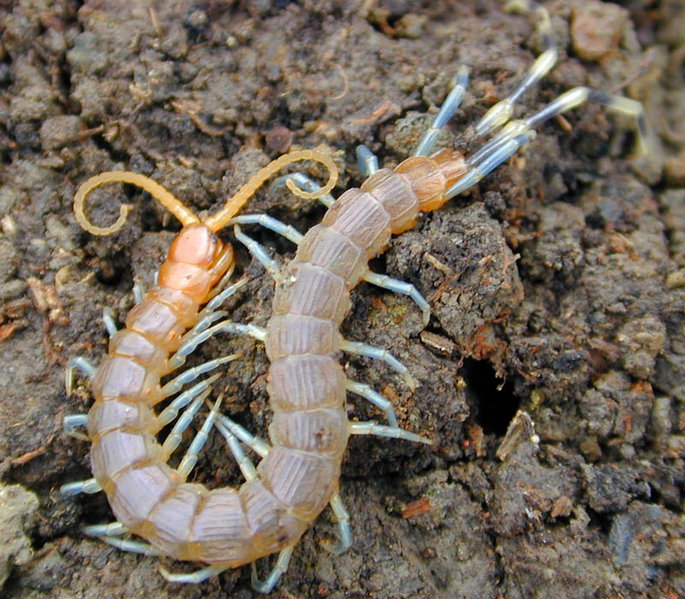


Characteristics
Typical myriapod features include a head with a single pair of antennae, mouthparts derived from modified limbs, and a trunk of many repeating segments. Respiratory systems are adapted to land, commonly using tracheae and spiracles. Development often involves anamorphosis, where juveniles add segments and legs through successive moults. Sensory structures are simple: many taxa have ocelli or reduced eyes, while others rely on chemical and tactile cues.
Classification
- Chilopoda – centipedes: mostly carnivorous, one pair of legs per trunk segment.
- Diplopoda – millipedes: mostly detritivores, many diplosegments bear two pairs of legs each.
- Pauropoda – minute, soft-bodied soil dwellers with branched antennae.
- Symphyla – small, translucent myriapods that resemble centipedes and live in soil and leaf litter.
Evolution and fossil record
Fossils attributable to myriapods or close relatives appear in terrestrial deposits as far back as the late Silurian, and some researchers note Cambrian forms with comparable body plans. Molecular and morphological studies together imply that myriapod lineages diversified early in arthropod history and that major groups separated long before their oldest clear fossils; discussions of how myriapods diversified through deep time are ongoing in paleontology and molecular clock studies. General fossil summaries and taxonomic overviews are available in specialist literature and databases (fossil records).
Ecology and human significance
Myriapods fulfil important ecological roles: millipedes break down dead plant material and contribute to soil formation, while centipedes act as predators on other invertebrates and help control pest populations. Pauropods and symphylans are less known but part of the soil fauna that influences nutrient cycling. Most myriapods are harmless to humans, though centipede bites can be painful. For identification, natural history and conservation resources, see regional guides and specialist portals represented by general links and databases (Silurian context, diversification studies, Cambrian comparisons).
Further reading and species lists are provided in field guides and online catalogues; authoritative summaries and taxonomic treatments can be consulted via curated databases and review articles (subphylum overview, arthropod context, Diplopoda resources, Chilopoda resources, terrestrial ecology, paleontological databases, Silurian references, evolutionary studies, Cambrian records).
Questions and answers
Q: What is Myriapoda?
A: Myriapoda is a subphylum of arthropods which includes millipedes, centipedes and others.
Q: How many species does Myriapoda contain?
A: Myriapoda contains 13,000 species.
Q: Are all species of Myriapoda terrestrial?
A: Yes, all species of Myriapoda are terrestrial.
Q: Why are they called Myriapoda?
A: They are called Myriapoda because their name suggests they have many legs.
Q: Which Myriapoda species has over 750 legs?
A: Illacme plenipes has over 750 legs.
Q: When does the fossil record of myriapods go back to?
A: The fossil record of myriapods goes back into the late Silurian period.
Q: In which period did molecular evidence suggest that myriapods diversified?
A: Molecular evidence suggests that myriapods diversified in the Cambrian period, although Cambrian fossils do exist which look like myriapods.
Related articles
Author
AlegsaOnline.com Myriapoda: millipedes, centipedes and their relatives Leandro Alegsa
URL: https://en.alegsaonline.com/art/67990
Sources
- ucmp.berkeley.edu : "Introduction to the Myriapoda"
- nature.com : "Biodiversity hotspots: rediscovery of the world's leggiest animal"
- ui.adsabs.harvard.edu : 2006Natur.441..707M
- doi.org : 10.1038/441707a
- pubmed.ncbi.nlm.nih.gov : 16760967
- ui.adsabs.harvard.edu : 1995Natur.376..165F
- doi.org : 10.1038/376165a0
- pubmed.ncbi.nlm.nih.gov : 7603566
- dpc.uba.uva.nl : "Morphological data, extant Myriapoda, and the myriapod stem-group"
- doi.org : 10.1016/j.ympev.2005.09.012
- pubmed.ncbi.nlm.nih.gov : 16290034
- environment.gov.au : Numbers of living species in Australia and the World · web.archive.org
- doi.org : 10.1016/j.ympev.2004.09.005
- pubmed.ncbi.nlm.nih.gov : 15579388