
Asteroid impact prediction: methods, limits, and planetary defense
Overview of how scientists predict asteroid impacts, detection methods, warning times, historical examples, and the role of planetary defense and mitigation efforts.
Asteroid impact prediction is the scientific process used to find asteroids and assess whether and when they might collide with Earth. The aim is not to catalogue every rock in space, but to identify those trajectories that intersect Earth's orbit and to estimate the probability, timing and likely location of an impact. This activity lies at the intersection of astronomy, orbital mechanics and civil protection planning. It helps prioritize follow-up observations and, when appropriate, informs mitigation options.
Image gallery
10 Images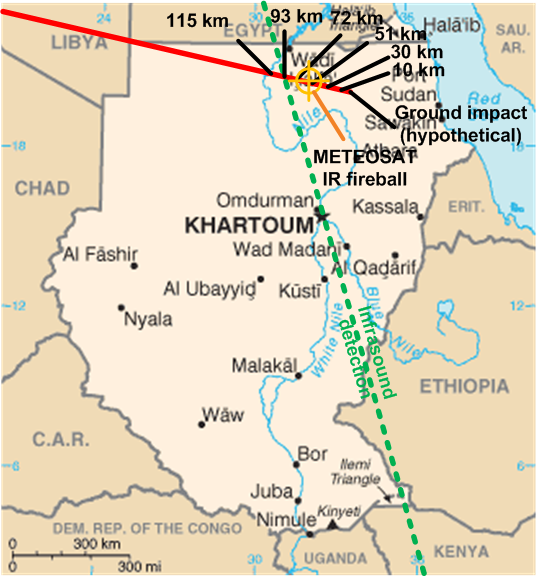





How prediction works
Prediction begins with discovery: wide-field telescopes scan the sky to detect moving points of light. When a new object is tracked over multiple nights its orbit can be calculated and then projected forward. Precision improves with more observations and with different techniques:
- Optical surveys use visible-light telescopes to detect and follow objects that reflect sunlight; these are the primary discovery tool and are often run as coordinated search programs such as survey programs.
- Infrared telescopes can measure size and albedo more directly, improving impact energy estimates.
- Radar provides high-resolution information about an object’s distance, speed and shape when it is relatively close to Earth.
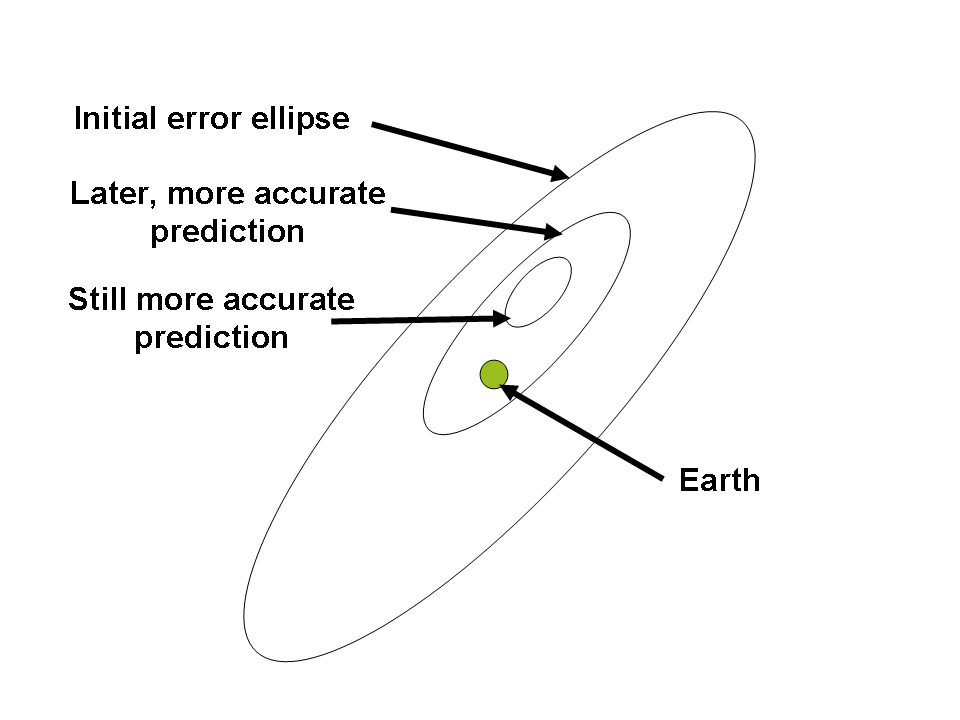
- Orbit computation and impact monitoring combine observations into probabilistic predictions; automated systems flag objects with non-negligible impact chances so astronomers can prioritize follow-up tracking.
Warning times and limits
Big asteroids—those hundreds of meters across—are bright enough to be discovered years or decades before a close approach, giving long lead times for planning. Smaller objects, down to meter-scale, are far more numerous and faint; many are discovered only days or hours before they reach Earth, or not at all before entering the atmosphere. For these smaller bodies, ground-based optical networks often lack the sensitivity or continuous sky coverage to guarantee early detection, which is why small-object prediction remains challenging. The contrast between long warning times for large objects and short or no warning for small meteors is a key practical limitation of current detection systems.
Historical context and notable events
Past incidents illustrate both the threat and the limits of prediction. The 1908 Tunguska event and the 2013 Chelyabinsk explosion are widely cited examples of airbursts caused by incoming objects that were not detected in advance. These events spurred investment in global monitoring and motivated international coordination to improve early warning and assessment capabilities. Demonstration missions and improved sky surveys continue to advance the field.
Importance, mitigation and international coordination
Impact prediction is a cornerstone of planetary defense: timely, accurate forecasts enable options such as targeted deflection of a hazardous object, or short-term civil protection measures like evacuation. Research and preparedness span astronomical detection, mission design for kinetic or other deflection techniques, and emergency planning. Agencies and networks share data and alerts across national and international frameworks; examples of such collaborative efforts can be found through portals and working groups such as Earth-focused agencies and research consortia represented at international forums.
Practical distinctions and what to watch for
When reading impact assessments, it helps to distinguish between probability and consequence: a low-probability event involving a very large body can warrant different responses than a higher-probability event from a small object. Public communication focuses on clarifying these aspects and avoiding undue alarm. Scientists publish computed impact probabilities, predicted close approach dates, and uncertainty ranges; those values are continuously updated as new observations arrive. For background on small-object populations and their detection challenges see resources on near-Earth object surveys and characterization small-body studies.
In summary, asteroid impact prediction combines observation, computation and international cooperation to reduce uncertainty and increase readiness. It is effective at finding larger threats well before impact, while detection of numerous small objects remains incomplete. Ongoing improvements in telescopes, data sharing and demonstration missions aim to shrink that gap and give society better warning and response options.
Questions and answers
Q: What is asteroid impact prediction?
A: Asteroid impact prediction is a way of warning about asteroids that may hit Earth, and when and where they will hit the Earth.
Q: How does asteroid impact prediction work?
A: Asteroid impact prediction works by finding asteroids that might hit Earth in the future. It looks for big asteroids as they can be seen easily from a long distance, many years before they come close to Earth. For smaller space rocks, telescopes are used to find them but it's not always possible to see them until they are close to Earth.
Q: How many big asteroids are there?
A: There aren't many big asteroids, but there are millions of smaller space rocks.
Q: How do we find small asteroids?
A: We use telescopes to find the small asteroids that are going to hit Earth soon, although it's not always possible to see them before they get too close.
Q: Are all asteroids visible from a long distance?
A: No, most asteroids will not be visible from a long distance as they are usually too small or faint for us to detect until they get closer to Earth.
Q: Can we predict when an asteroid will hit earth accurately?
A: Not always - because of the difficulty in detecting small asteroids until they get close enough, it can be difficult or impossible to predict exactly when an asteroid will hit earth with any accuracy.
Q: Is it possible for us to stop an incoming asteroid from hitting earth? A: In some cases yes - if we have enough time and resources available then it may be possible for us to divert or destroy an incoming asteroid before it hits earth.
Related articles
Author
AlegsaOnline.com Asteroid impact prediction: methods, limits, and planetary defense Leandro Alegsa
URL: https://en.alegsaonline.com/art/6796
Sources
- nasa.gov : "Update to Determine the Feasibility of Enhancing the Search and Characterization of NEOs"
- youtube.com : How Does NASA Spot a Near-Earth Asteroid?
- cneos.jpl.nasa.gov : "Sentry: Earth Impact Monitoring"
- lsst.org : "LSST Project Schedule"
- jpl.nasa.gov : "Federal Government Releases National Near-Earth Object Preparedness Plan"
- cneos.jpl.nasa.gov : "Impact Risk Data"
- ui.adsabs.harvard.edu : 2009Natur.458..485J
- doi.org : 10.1038/nature07920
- pubmed.ncbi.nlm.nih.gov : 19325630
- sciencedirect.com : "The trajectory and atmospheric impact of asteroid 2014 AA"
- ui.adsabs.harvard.edu : 2016Icar..274..327F
- doi.org : 10.1016/j.icarus.2016.02.056
- jpl.nasa.gov : "Tiny Asteroid Discovered Saturday Disintegrates Hours Later Over Southern Africa"