
Myco-heterotrophy: Plants That Obtain Carbon from Fungi
Myco-heterotrophy describes plants that derive some or all of their carbon and nutrients from fungi rather than from photosynthesis. Covers biology, evolution, examples, research methods, and conservation.
Overview
Myco-heterotrophy is a nutritional strategy in which a plant obtains carbon and other nutrients from fungi instead of, or in addition to, producing them by photosynthesis. Unlike typical autotrophic plants, myco-heterotrophic species depend on fungal partners for their food and are therefore considered fungal parasites in ecological terms; the interaction is a form of parasitism rather than direct feeding on dead organic matter.
Image gallery
2 Images
Biology and distinguishing features
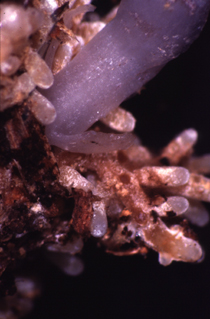
Myco-heterotrophs range from partially dependent species that photosynthesize but supplement their carbon intake with fungal-derived resources, to fully myco-heterotrophic species that lack chlorophyll and rely entirely on fungal carbon. Common morphological signs include pale or translucent tissues, reduced or absent leaves, and specialized root structures that interface with fungal networks. The physical contact is usually between the plant’s roots or rhizomes and the fungal mycelium, with nutrient transfer occurring across that junction.
Relationship to mycorrhiza and historical context
Myco-heterotrophy is closely related to mycorrhizal symbioses. In many cases it is thought to have evolved from mutualistic mycorrhizae into a unidirectional nutrient flow, where the fungus or the fungus’s associated plants supply carbon to the myco-heterotroph. Historically, non-photosynthetic plants were often labeled "saprophytes" on the assumption they digested decaying matter directly; that term is now obsolete because no plant is physiologically capable of breaking down complex organic matter the way fungi do. The older term saprophytes therefore mischaracterized these species.
Types, mechanisms and examples
Practically, myco-heterotrophs are grouped as:
- Fully myco-heterotrophic: non-photosynthetic plants entirely dependent on fungi (for example, some species in certain orchids and in the group often called Indian pipe).
- Partially myco-heterotrophic (mixotrophic): plants that combine photosynthesis with fungal-derived carbon.
Many fully myco-heterotrophic plants obtain carbon indirectly from other green plants: the host fungus is itself mycorrhizal with photosynthetic trees or herbs, creating a mycorrhizal network that channels carbon from photosynthetic donors to the non-photosynthetic parasite. This indirect dependence is sometimes described as epiparasitism.
Ecological importance and distribution
Myco-heterotrophy has evolved independently several times across flowering plants and appears in diverse ecosystems, particularly shaded forest floors where light is limiting and fungal networks are extensive. These plants play a role in underground carbon flow and influence fungal community dynamics. Their presence often signals intact, mature mycorrhizal networks.
Research approaches and conservation
Researchers study myco-heterotrophy using stable isotope analysis (to detect enriched carbon and nitrogen signatures), molecular tools to identify fungal partners, and ecological surveys of host and fungal distributions. Because many myco-heterotrophs are highly specific to particular fungi and habitats, they are vulnerable to disturbance: loss of host trees, soil degradation, or changes in fungal communities can imperil them. Conservation of myco-heterotrophic plants therefore depends on preserving the broader ecosystem and its fungal associates, including the complex mycorrhiza networks that sustain them.
For additional background on parasitic interactions and the fungal partners involved, see introductory resources on parasitism and fungal biology mycelium structure. Further technical references and databases on plant-fungal associations are available through specialized botanical and mycological literature physiological reviews and field guides that document examples once misclassified as saprophytes.
Questions and answers
Q: What is myco-heterotrophy?
A: Myco-heterotrophy is a relationship between certain plants and fungi, where the plant gets all or part of its food from parasitism on fungi, not from photosynthesis.
Q: What were non-photosynthetic plants thought to do in the past?
A: In the past, non-photosynthetic plants were thought to get food by breaking down organic matter like fungi do, and were therefore called "saprophytes".
Q: Was the previous understanding of non-photosynthetic plants accurate?
A: No, it is now known that no plant is physiologically capable of direct breakdown of organic matter.
Q: How do non-photosynthetic plants get food?
A: To get food, non-photosynthetic plants engage in parasitism, by myco-heterotrophy or direct parasitism of other plants.
Q: Where is the interface between the plant and fungal partners in myco-heterotrophy?
A: The interface between the plant and fungal partners in myco-heterotrophy is between the roots of the plant and the mycelium of the fungus.
Q: What does myco-heterotrophy closely resemble?
A: Myco-heterotrophy closely resembles mycorrhiza.
Q: What is the belief about how myco-heterotrophy evolved?
A: Myco-heterotrophy is thought to have evolved from mycorrhiza.
Related articles
Author
AlegsaOnline.com Myco-heterotrophy: Plants That Obtain Carbon from Fungi Leandro Alegsa
URL: https://en.alegsaonline.com/art/67950
Sources
- mycologia.org : "Monotropa uniflora plants of eastern Massachusetts form mycorrhizae with a diversity of russulacean fungi"
- doi.org : 10.3852/mycologia.98.4.535
- pubmed.ncbi.nlm.nih.gov : 17139846
- dx.doi.org : 10.1111/j.1469-8137.2005.01429.x
- ncbi.nlm.nih.gov : PMID 15998389
- www-mykopat.slu.se : Plants parasitic on fungi: unearthing the fungi in myco-heterotrophs and debunking the ‘saprophytic’ plant myth
- dx.doi.org : 10.1017/S0269915XO5003046
- esf.edu : Nitrogen and carbon stable isotope abundances support the myco-heterotrophic nature and host-specificity of certain achlorophyllous plants.
- dx.doi.org : 10.1046/j.1469-8137.2003.00876.x · web.archive.org
- dx.doi.org : 10.1098/rspb.2004.2807