
My Sister Eileen (1955 film)
A 1955 American musical comedy directed by Richard Quine, adapted from Ruth McKenney's stories about two sisters forging a life in New York. Stars Janet Leigh, Jack Lemmon and features Bob Fosse.
My Sister Eileen is a 1955 American musical comedy film directed by Richard Quine and released by Columbia Pictures. The picture is an adaptation of the autobiographical short stories by Ruth McKenney about two young sisters who leave their Midwestern home and try to make a living in New York City. This version reworks the original material into a song-and-dance studio production typical of mid-1950s Hollywood.
Image gallery
1 Image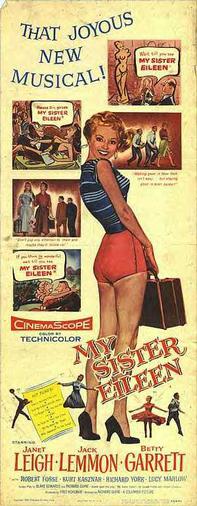
Overview and premise
The narrative centers on two sisters who relocate to Manhattan with hopes of finding work and romantic prospects. The older sister pursues writing while the younger sister seeks opportunities as an actress. The film follows their comic misadventures in a cramped urban apartment, encounters with eccentric neighbors and suitors, and a series of misunderstandings that provide the framework for musical numbers and comic set pieces.
Cast and production highlights
- Janet Leigh – one of the film’s headline stars, appearing in a principal role.
- Jack Lemmon – among the supporting cast, an early screen appearance for the actor who would become a major figure in American cinema.
- Betty Garrett – features in a prominent supporting role.
- Bob Fosse – appears in the film and contributes distinctive dance moments that draw attention to the choreography.
- Dick York and Adelle August – additional members of the ensemble.
Origins and earlier adaptations
The film’s source material originated as a series of autobiographical short stories by Ruth McKenney, published in the late 1930s and collected in a volume that celebrated New York life through comic observation. The stories were adapted for the stage and previously brought to screen in an earlier, non-musical film. They also inspired the Broadway musical Wonderful Town, illustrating the flexibility of McKenney’s characters across dramatic and musical forms.
Reception and legacy
The 1955 movie is remembered as a studio musical that updates a well-known comic property with dance numbers and light romance rather than as a strict literary adaptation. Contemporary critics tended to note its performances and production values more than faithfulness to the original stories. Over time the film has been of interest to viewers for its cast—particularly the early appearance of Jack Lemmon and the dance work involving Bob Fosse—and for how it reflects Hollywood’s midcentury approach to adapting established stage and prose works into musicals.
For readers interested in further details on performers and production credits, consult contemporary film catalogs and biographies of the principal actors and director for more in-depth context.
Questions and answers
Q: What is My Sister Eileen?
A: My Sister Eileen is a 1955 American musical comedy movie that is based on the autobiographical short stories by Ruth McKenney.
Q: Who directed My Sister Eileen?
A: My Sister Eileen was directed by Richard Quine.
Q: Who were the actors in My Sister Eileen?
A: The actors in My Sister Eileen were Janet Leigh, Jack Lemmon, Betty Garrett, Bob Fosse, Dick York, and Adelle August.
Q: When was My Sister Eileen released?
A: My Sister Eileen was released in 1955.
Q: What was the production company behind My Sister Eileen?
A: My Sister Eileen was distributed by Columbia Pictures.
Q: What was the genre of My Sister Eileen?
A: My Sister Eileen was a musical comedy movie.
Q: Was My Sister Eileen based on a true story?
A: Yes, My Sister Eileen was based on the autobiographical short stories by Ruth McKenney.
Related articles
Author
AlegsaOnline.com My Sister Eileen (1955 film) Leandro Alegsa
URL: https://en.alegsaonline.com/art/67928