
Musical mode
A musical mode is a type of scale defined by its sequence of intervals and tonal center. Modes originated in ancient Greece and medieval church music and remain important in folk, classical and jazz styles.
Overview
A musical mode is a set of pitches ordered by interval relationships and perceived around a central pitch or final. Unlike a generic scale that may be defined only by pitch content, a mode implies a characteristic sequence of whole steps and half steps (or tones and semitones) and habitual melodic gestures that give it a distinctive sound. Modes can be transposed to start on any pitch; their identity depends on the pattern of intervals, not the absolute notes.
Image gallery
6 Images


Basic characteristics and common types
In Western theory the most familiar modal system derives from the seven-note diatonic collection. When played on the white keys of the piano, starting on different notes, this collection produces seven well-known modes. Each mode has a conventional name and a typical emotional or functional quality:
- Ionian — equivalent to the modern major scale (C D E F G A B C).
- Dorian — a minor-sounding mode with a natural (major) sixth (D E F G A B C D).
- Phrygian — a minor mode with a lowered second, producing a Spanish or Eastern tint (E F G A B C D E).
- Lydian — like a major scale with an augmented fourth, often perceived as bright or dreamy (F G A B C D E F).
- Mixolydian — major with a lowered seventh, common in folk and blues (G A B C D E F G).
- Aeolian — identical to the natural minor scale (A B C D E F G A).
- Locrian — rare in tonal practice; characterized by a diminished fifth and unstable quality (B C D E F G A B).
Each mode can be described by an interval formula of whole and half steps; for instance, Ionian is tone–tone–semitone–tone–tone–tone–semitone, while Aeolian follows tone–semitone–tone–tone–semitone–tone–tone.
History and development
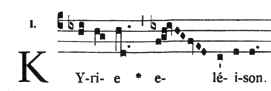
The term and many names trace back to Ancient Greek theorists and regional labels from Antiquity; this historical connection is discussed in classical sources linked to the Greek musical regions (Ancient Greek theory) and place names (Greek city names). During the Middle Ages European theorists adapted these names and organized chant into a system of church modes used in liturgical music (Gregorian and medieval chant). Medieval theory distinguished authentic and plagal forms and introduced the concept of a final (a modal tonic) and dominant or reciting tone, which shaped melodic practice more than modern tonal harmony did.
Uses and examples
Modes appear in many musical contexts. Folk melodies across Europe and other regions are often modal; traditional tunes may avoid the leading tone of major/minor harmony and thus retain modal characteristics. In Western art music, Renaissance and early Baroque composers wrote modal polyphony before major–minor tonality became dominant. In the 20th century composers and popular musicians revived modal practices for color and alternative harmonic frameworks. Notably, modal jazz uses modes as the basis for improvisation and harmonic stasis, and folk-rock often employs Mixolydian or Dorian sonorities.
Distinctions and notable facts
Modern theory typically equates Ionian with the major scale and Aeolian with the natural minor, but historical modes carried functional and melodic implications not reducible to scale content alone. The Locrian mode is unusually unstable for harmony because its tonic triad is diminished, so it rarely serves as the foundation for tonal music. Each mode also admits a plagal or "hypo-" counterpart (for example, hypodorian), a distinction important in medieval chant practice where the final remains the same but the range and tenor differ.
Learning modes can be practical: practice improvising over drone pedals, play familiar tunes beginning on different scale degrees, and study modal repertoire to recognize characteristic intervals and cadences. For a concise technical definition of scale and related concepts see scale references and interval discussions such as semitone descriptions.
For additional reading on modal systems in historical and contemporary contexts, consult introductory guides and specialized studies linked here: scale overview, Greek theory, intervals, modal names, and church modes.
Questions and answers
Q: What are modes in music?
A: Modes in music are a kind of scale. They were used by Ancient Greeks and borrowed by Medieval musicians to describe the scales used in their music.
Q: How many scales does Western music predominantly usually use?
A: Western music predominantly usually uses two scales - major and minor, which correspond to the Ionian and Aeolian modes.
Q: What is the pattern of tones and semitones between each note for the Western major scale?
A: The pattern of tones and semitones between each note for the Western major scale is tone, tone, semitone, tone, tone, tone, semitone.
Q: What is the pattern of tones and semitones between each note for the Western natural minor scale?
A: The pattern of tones and semitones between each note for the Western natural minor scale is tone, semitone, tone, tone, semitone, tone ,tone.
Q: What are some common modern modes?
A: Some common modern modes include Ionian (C D E F G A B C), Dorian (D E F G A B C D), Phrygian (E F G A B C D E), Lydian (F G A B C D E F), Mixolydian (G A B C D E F G), Aeolian (A B C D E F G A) and Locrian (B C D E F G A B).
Q: Where do mode names come from?
A: Mode names come from cities in Ancient Greece. In Medieval times they were widely used in church music.
Q: Are folksongs often modal?
A: Yes ,folksongs are often modal. An example of a well-known tune that is modal is Greensleeves
Related articles
Author
AlegsaOnline.com Musical mode Leandro Alegsa
URL: https://en.alegsaonline.com/art/67769