
Muscle: structure, function, types, and biological importance
Muscle is animal tissue specialized for contraction. This article explains types (skeletal, cardiac, smooth), basic structure, physiology, development, common conditions, and roles in movement, posture and heat production.

Muscle is a specialized animal tissue whose cells generate force through contraction, enabling movement of body parts and internal organs. When activated by nerves or chemical signals, muscle fibers shorten and thicken, pulling on attachments and producing motion or pressure. Muscles are a central component of the locomotor and internal-organ systems in vertebrates and many invertebrates; for more background see animal bodies.
Image gallery
8 Images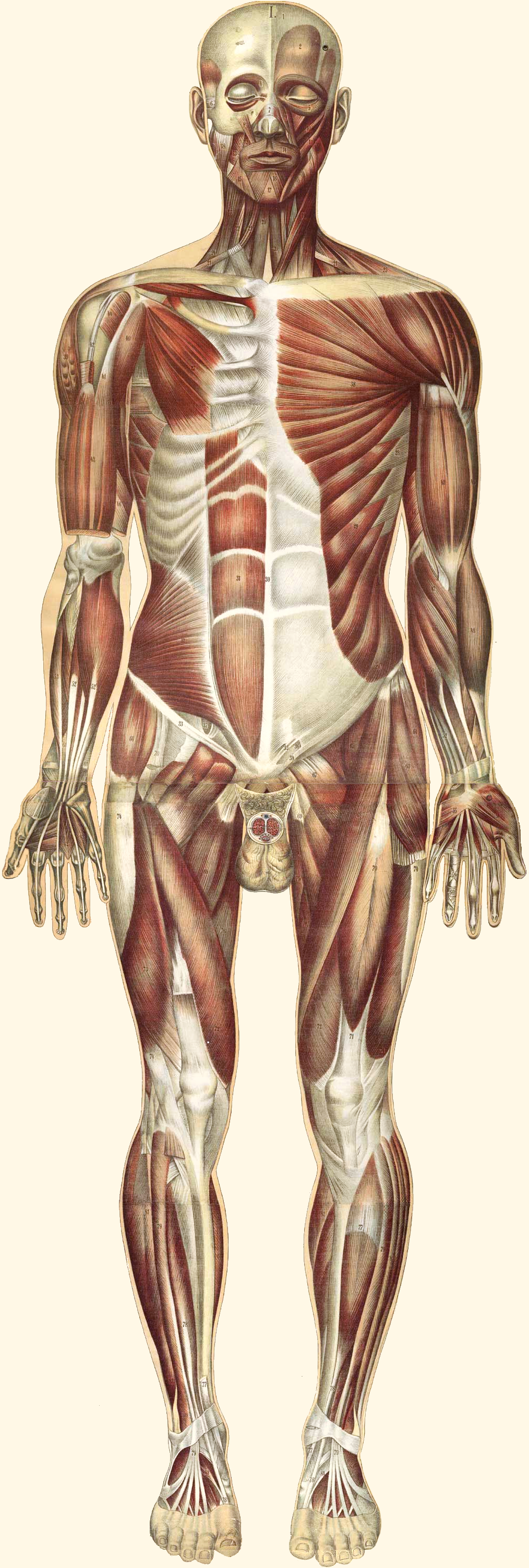


Types and basic structure
There are three broad categories of muscle in most animals: skeletal, cardiac and smooth. Each type has characteristic anatomy and roles.
- Skeletal muscle: attached to bones by tendons, under voluntary control, and composed of long, multinucleated striated fibers arranged in bundles.
- Cardiac muscle: found only in the heart, striated but involuntary, with branched cells linked by intercalated discs to allow coordinated contractions.
- Smooth muscle: non-striated, involuntary muscle in walls of blood vessels, intestines and other organs that controls diameter and flow.
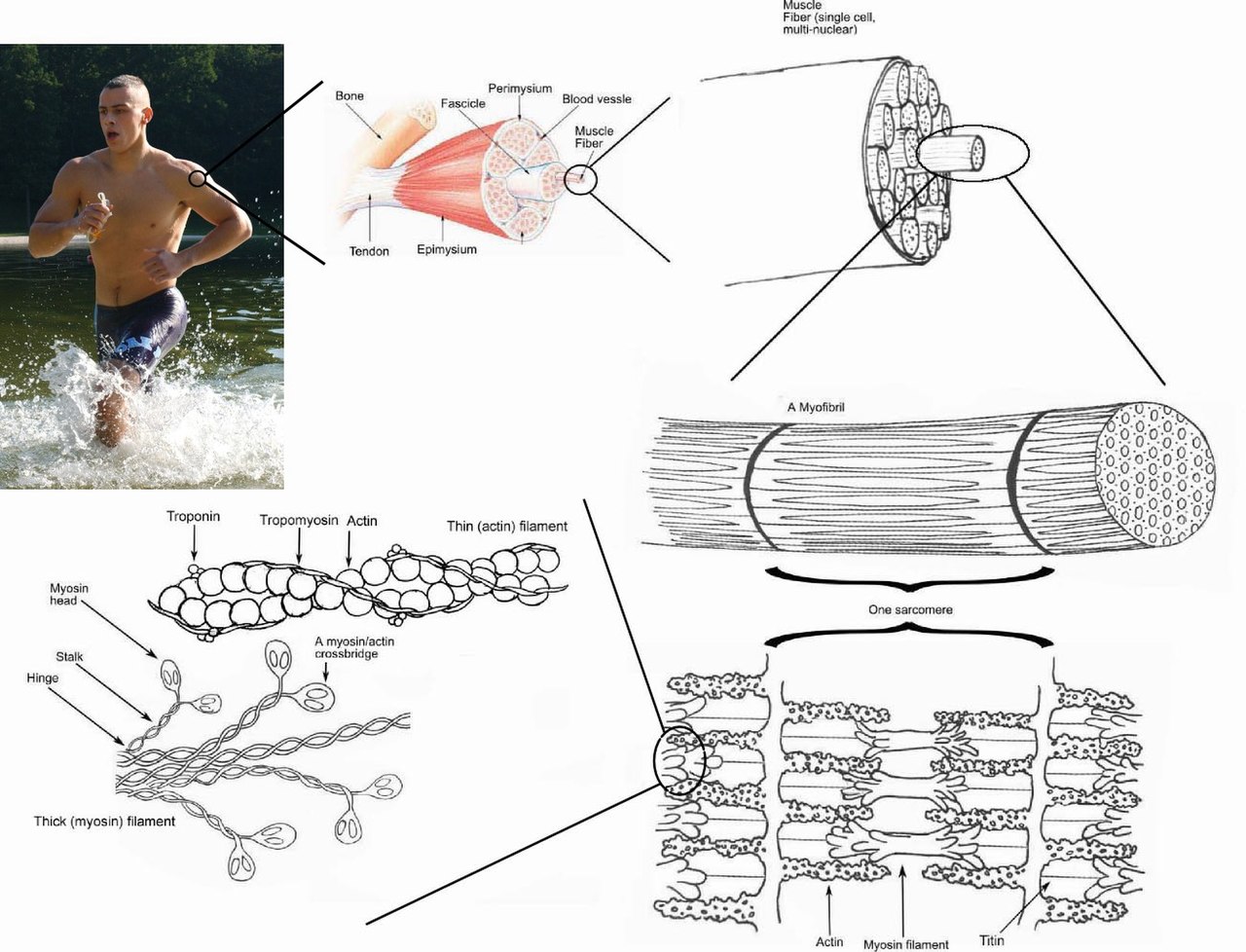
At a microscopic level, muscle fibers contain myofibrils built from repeating sarcomeres, where the proteins actin and myosin slide past one another to produce shortening. Groups of fibers are organized into fascicles and surrounded by connective tissue that transmits force.
Function and physiology
Muscles convert chemical energy, principally ATP, into mechanical work. Activation usually begins at the neuromuscular junction, where a motor neuron triggers a fiber to contract; a group of fibers supplied by one neuron is called a motor unit. Muscle actions include producing voluntary movement, maintaining posture, stabilizing joints, pumping blood and moving food through the gut. Muscles also play a key role in thermogenesis: contractions such as shivering generate heat.
Muscle fibers vary in contractile properties: slow-twitch (endurance-oriented) fibers resist fatigue, while fast-twitch fibers produce rapid, powerful contractions but tire more quickly. Regular use, exercise and loading cause adaptation—hypertrophy and metabolic changes—whereas disuse leads to atrophy.
Development, evolution and medical relevance
In vertebrate embryos most muscle develops from the mesodermal layer and differentiates into distinct muscle types. Muscular systems evolved to meet demands for locomotion, respiration and feeding and show wide specialization across species. Clinically, muscle is affected by strains, tears, cramps and chronic conditions such as inflammatory myopathies and genetic disorders like muscular dystrophies. Cardiac muscle damage from heart disease has particularly serious consequences because heart muscle has limited regenerative capacity compared with smooth and skeletal muscle.
Muscle health is integral to overall physiology: it influences metabolism, balance, and mobility across the lifespan. Understanding muscle structure and function underpins fields from sports training and rehabilitation to surgery and neuromuscular diagnostics such as electromyography.
Questions and answers
Q: What is muscle?
A: Muscle is a tissue found in animal bodies that helps us move our body parts.
Q: What is the main purpose of muscles?
A: The main purpose of muscles is to help us move our body parts.
Q: Are muscles important for human and animal bodies?
A: Yes, muscles are one of the major systems of human and animal bodies.
Q: What happens when a muscle is activated?
A: When a muscle is activated, it contracts, making itself shorter and thicker in order to pull its ends closer together.
Q: Can muscles only contract, or do they have other functions as well?
A: While their main function is to contract and help us move, muscles also play a role in regulating body temperature and assisting with digestion.
Q: What happens if a muscle is not used regularly?
A: If a muscle is not used regularly, it can weaken and atrophy over time, making it more difficult to move and perform physical activities.
Q: Can people strengthen their muscles through exercise?
A: Yes, people can strengthen their muscles through exercise and physical activity. Regular exercise can help improve muscle tone, endurance, and strength.
Related articles
Author
AlegsaOnline.com Muscle: structure, function, types, and biological importance Leandro Alegsa
URL: https://en.alegsaonline.com/art/67703