
Müller's Bornean gibbon (Hylobates muelleri)
A small arboreal gibbon endemic to Borneo, often called the grey gibbon. Frugivorous and monogamous, it brachiates through forests and faces threats from habitat loss, hunting and the pet trade.
The Müller's Bornean gibbon (Hylobates muelleri) is a small tree-dwelling primate native to the island of Borneo. Commonly called the grey gibbon or Müller's gibbon, it is one of the smaller members of the family Hylobatidae. Individuals are light-bodied and highly adapted to life in the canopy, where they move by brachiation — swinging from branch to branch with long arms and a light torso.
Image gallery
5 Images


Physical characteristics
Müller's gibbons are compact: adults average around 60–65 cm in height and weigh roughly 4–6 kg. Their pelage tends toward grey tones, which is the source of the common name, though coloration can vary. They have long arms, relatively short legs, and no tail. Like other gibbons, they possess a throat sac that helps amplify loud morning calls.
Behavior and social structure
These gibbons live in small family groups, typically a bonded adult pair and their immature offspring. Pairs are territorial and use duets — coordinated vocalizations between male and female — to advertise territory boundaries and strengthen pair bonds. Reproduction yields a single infant after a gestation of approximately seven months, and young remain dependent for several years.
Diet and ecological role
Primarily frugivorous, Müller's gibbons feed on a mix of fruits, leaves, flowers and occasional invertebrates. By consuming fruit and dispersing seeds, they play an important role in maintaining forest regeneration and plant diversity across their range.
Distribution and habitat
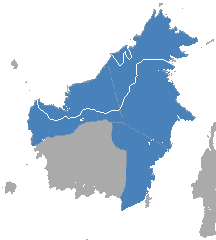
Endemic to the island of Borneo, Müller's gibbons inhabit tropical lowland and hill forests where continuous canopy allows efficient arboreal movement. They are seldom found on the ground and depend on intact forest for feeding, traveling and breeding.
Conservation status and threats
Müller's gibbon is considered at conservation risk because of rapid habitat loss, forest fragmentation, hunting and capture for the illegal pet trade. Populations have declined where forests are cleared for logging or converted to agriculture, including oil palm plantations. Conservation measures focus on protecting forest habitat, enforcing wildlife trade laws and supporting protected areas and community-based conservation programs.
Questions and answers
Q: What is the Müller's Bornean gibbon?
A: The Müller's Bornean gibbon is a primate in the Hylobatidae family also known as the grey gibbon.
Q: How much does the Müller's Bornean gibbon weigh?
A: The Müller's Bornean gibbon weighs 12 pounds (5.4 kg).
Q: How tall is the Müller's Bornean gibbon?
A: The Müller's Bornean gibbon is about 2 feet (61 cm) tall.
Q: How long can the grey gibbon live in captivity?
A: The grey gibbon can live more than 40 years in captivity.
Q: What do the grey gibbons eat primarily?
A: The grey gibbons eat primarily fruit, leaves, flowers, and invertebrates.
Q: What family does the Müller's Bornean gibbon belong to?
A: The Müller's Bornean gibbon belongs to the Hylobatidae family.
Q: What is another name for the Müller's Bornean gibbon?
A: Another name for the Müller's Bornean gibbon is the grey gibbon.
Related articles
Author
AlegsaOnline.com Müller's Bornean gibbon (Hylobates muelleri) Leandro Alegsa
URL: https://en.alegsaonline.com/art/67435
Sources
- bucknell.edu : Mammal Species of the World
- iucnredlist.org : "Hylobates muelleri"
- doi.org : 10.2305/IUCN.UK.2008.RLTS.T39888A10270564.en