
Mount Zion — hill and religious site in Jerusalem
Hill on the southwest edge of Jerusalem's Old City, home to several important religious sites, Christian and Jewish cemeteries, and a longstanding symbolic role in Jewish and Christian tradition.
Mount Zion is a prominent hill on the southwest side of Jerusalem's Old City. In Hebrew it is often called Har Tziyon, and in Arabic it is known as جبل صهيون. The hill lies adjacent to the better-known Temple Mount area (Temple Mount) and has been part of Jerusalem's religious and urban landscape for millennia.
Topographically, Mount Zion forms a distinct rise above the surrounding valleys and is contiguous with areas that today fall inside the Old City walls. Much of the hill stands within or alongside the Jewish and Armenian Quarters, and its slopes and terraces contain a mix of religious buildings, burial grounds and historic structures. There are several Christian institutions and small Christian communities in the vicinity, linked for visitors and researchers to the wider history of the site (Christian sites), and a number of Jewish cemeteries and memorial plots clustered on its slopes (Jewish cemeteries).
Image gallery
10 Images


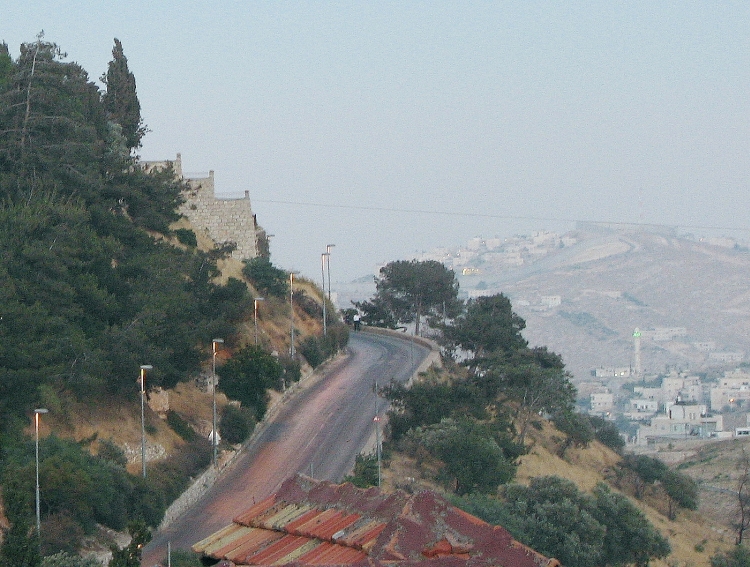

Principal sites and landmarks
- Tradition of King David's Tomb — a site venerated by some visitors and communities as the burial place of David; the identification is a long-standing tradition and is treated with caution by historians (King David).
- The Cenacle (Room of the Last Supper) — a place traditionally associated with New Testament events and frequented by pilgrims from several Christian traditions.
- Dormition Abbey and other churches — several significant churches and monastic houses occupy the hill and its immediate approaches.
- Former cable car and museum — in the modern era a small cable car once connected parts of the hill to the valley below; remnants of that installation and its engine room have been incorporated into a local museum and historic hospital complex (cable car, valley below).
The name "Zion" itself has a complex history: in ancient sources it may have designated different sectors of Jerusalem at different times, including an early Jebusite fortress and later parts of the City of David. Over centuries the meaning of "Zion" broadened beyond the physical hill to become a religious and poetic symbol in Jewish and Christian literature.
Mount Zion's layers of occupation reflect Jerusalem's changing rulers and communities — from ancient and biblical associations through medieval periods (including Crusader and later Ottoman presence) to modern times when the site has been subject to archaeological study, conservation, and pilgrimage. Because the site's sacred associations are important to multiple faiths, some identifications (for example the location of certain biblical events) are kept as devotional traditions rather than settled historical facts.
Today Mount Zion remains a compact but multifaceted destination: it is a focus for worship and commemoration, a locus of small cemeteries and monastic life, and an object of scholarly interest. Visitors often combine its churches and memorials with walks through the adjacent Old City quarters. The term "Mount Zion" also persists in broader cultural and religious language as a metaphor for Jerusalem, homeland or spiritual ideal, distinct from the strictly topographical hill.
Questions and answers
Q: What is Mount Zion?
A: Mount Zion is a hill located in the south-west corner of the Old City of Jerusalem and is an extension of Temple Mount.
Q: What can be found in the area of Mount Zion?
A: There are many little Christian and Jewish cemeteries as well as several churches in the area of Mount Zion.
Q: In which quarters of the Old City is half of Mount Zion located?
A: Half of Mount Zion is located in the Jewish and Armenian Quarters of the Old City.
Q: What is located at the top of Mount Zion?
A: The grave of King David is located at the top of Mount Zion.
Q: Was there a cable car that connected Mount Zion to the valley below and the Old City?
A: Yes, there was a small cable car that connected Mount Zion to the valley below and the Old City.
Q: What is the cable car room used for today?
A: The cable car room is currently used as a museum inside an old hospital building.
Q: What is the Arabic name for Mount Zion?
A: The Arabic name for Mount Zion is Jabel Sahyoun.
Related articles
Author
AlegsaOnline.com Mount Zion — hill and religious site in Jerusalem Leandro Alegsa
URL: https://en.alegsaonline.com/art/67121