
Mount Conner (Atila): flat‑topped inselberg of central Australia
Mount Conner (Atila) is a flat‑topped inselberg in the southwest Northern Territory. Rising about 300 m above the plain, it is geologically older than nearby Uluṟu and important in local Indigenous traditions.
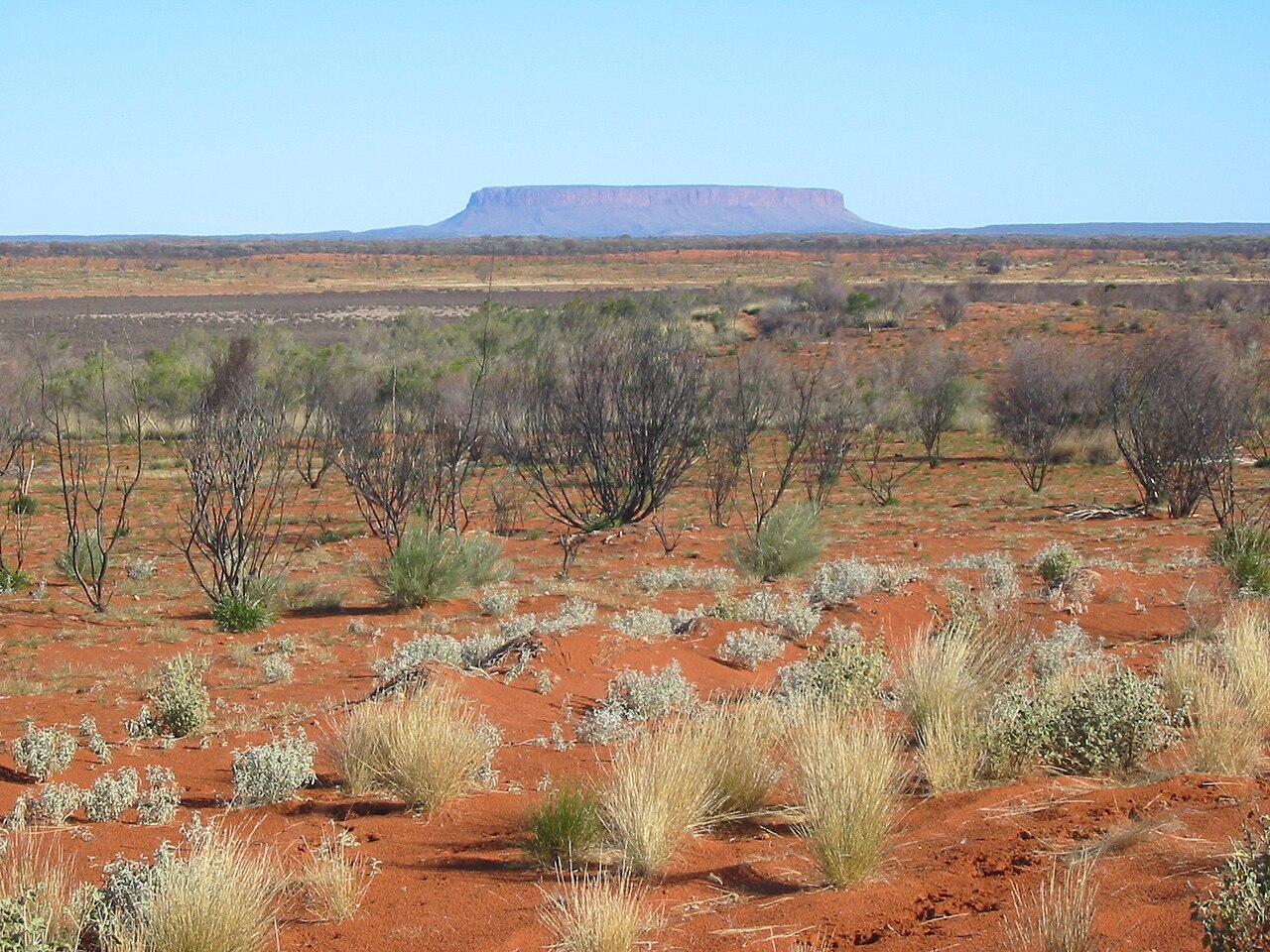
Mount Conner, often known by its Indigenous name Atila, is a striking mesa in central Australia. Located in the southwest corner of the Northern Territory, it stands roughly 859 metres above sea level and about 300 metres above the surrounding plain. The landform sits southeast of Lake Amadeus and is visible on the approach to Uluṟu from Alice Springs, where travelers sometimes mistake it for the larger monolith nearby.
Image gallery
4 Images

Geology and shape
Mount Conner is a classic flat‑topped inselberg — a solitary hill that rises abruptly from a plain — and has a broad, horseshoe profile when viewed from some angles. Its form reflects long histories of deposition and erosion. The bedrock is primarily sedimentary in origin; these layers were laid down when the region was covered by an inland sea during the Neoproterozoic and later periods. Differential weathering removed softer, overlying sediments and left behind the more resistant strata that form the present mesa. Geologists note that the rock making up Mount Conner is considerably older than the rocks composing nearby Uluṟu and Kata Tjuṯa, accounting for differences in color, texture and erosion patterns.
Names, history and cultural significance
The name Mount Conner was given in 1873 by the explorer William Gosse in honor of the South Australian politician Mountifort Longfield Conner, who was associated with colonial administration in the region (South Australian political circles). Long before European naming, the feature was and remains important to local Anangu peoples. In the Yankunytjatjara and Pitjantjatjara languages it is known as Atila (also spelled Artila, Atula, Attila or Artilla), and the surrounding country is called Atilanya.
Atila figures in Tjukurpa — the Anangu creation and law traditions — with stories connected to the nyiṉya or "ice people," ancestral beings linked to seasonal change. These narratives explain aspects of climate and landscape and attribute certain weather phenomena, notably cold weather, to the actions of those spirits. Because of its cultural role, the site is treated with respect and many details of its Tjukurpa are shared only within local communities.
Appearance, access and notable facts
From a distance Mount Conner’s flat summit and steep sides make it easy to distinguish. The cliffed rim and plateau contrast with the low scrub and salt lakes of the surrounding plain. Tour operators and highway signs point out Mount Conner as a visible landmark on routes to the Uluṟu–Kata Tjuṯa region; it has also gained a popular nickname among visitors who have mistaken it for Uluṟu. The feature’s horseshoe form is especially apparent in aerial views and is noted on many photographic guides (horseshoe).
- Type: inselberg or mesa.
- Height: about 859 m above sea level; ~300 m above plain.
- Origins: sedimentary deposition in an ancient sea and later erosion.
- Cultural name: Atila; region: Atilanya; languages and custodians Yankunytjatjara and Pitjantjatjara.
Visitors should be mindful that Mount Conner lies on land of cultural importance. Access and activities are governed by local landowners and park authorities; those seeking more information about geology, access routes and cultural context can consult regional guides and community resources for responsible visitation and further study.
Questions and answers
Q: What is Mount Conner also called?
A: Mount Conner is also called Atila.
Q: Where is Mount Conner located?
A: Mount Conner is located in the southwest corner of the Northern Territory, 75 kilometres (47 mi) southeast of Lake Amadeus.
Q: How high above sea level is Mount Conner?
A: Mount Conner is 859 metres (2,818 ft) above sea level.
Q: What type of rock does it consist of?
A: The rock of Mount Conner consists of sedimentary layers that were left behind when the area was an inland sea during the Neoproterozoic era (1Ga to 542Ma).
Q: How old are these rocks compared to nearby Uluṟu and Kata Tjuṯa?
A: The rocks of Mount Connor are 200 to 300 million years older than those found at nearby Uluṟu and Kata Tjuṯa.
Q: What shape does it have?
A:Mount Connor has a flat-topped inselberg shape, resembling a horseshoe.
Q: What do native Yankunytjatjara and Pitjantjatjara people call it?
A:Native Yankunytjatjara and Pitjantjatjara people call it Atila (also sometimes spelled Artila, Atula, Attila or Artilla).
Related articles
Author
AlegsaOnline.com Mount Conner (Atila): flat‑topped inselberg of central Australia Leandro Alegsa
URL: https://en.alegsaonline.com/art/67016
Sources
- books.google.com : The Geology of Australia
- nt.gov.au : A Guide to the Geology and Landforms of Central Australia