
Mortar (weapon): high-angle artillery for close support
A mortar is a short-barreled artillery piece that fires explosive mortar bombs in a high-arc trajectory. It provides indirect, close-support fire for infantry and can range from man-portable tubes to heavy systems.
Overview
A mortar is a type of artillery weapon that launches explosive shells, commonly called mortar bombs, on a steep, high‑angle trajectory so the projectile drops down onto a target. Mortars are classified as indirect fire systems: crews can engage targets that are not in direct line of sight by calculating azimuth and elevation. Compared with field guns or howitzers, mortars have relatively short maximum range but are valued for their simplicity, rapid deployment and ability to deliver plunging fire into trenches, urban cover and reverse slopes. See general technical context at artillery weapon.
Image gallery
10 Images




Design and components
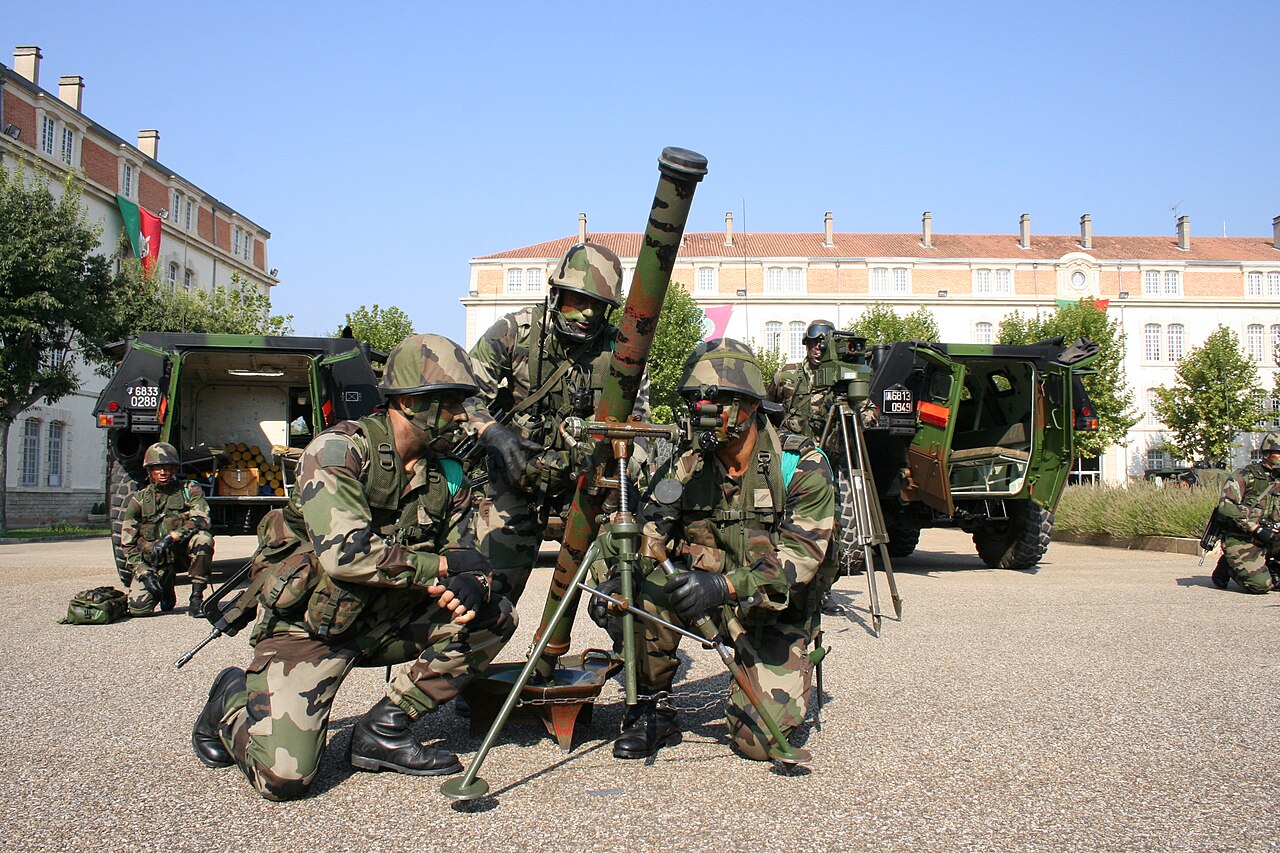
Most mortar systems share a few basic parts: a barrel or tube, a baseplate that spreads recoil into the ground, a bipod or mounting to set elevation and traverse, and simple sights or a fire-control interface. Light infantry mortars are often smoothbore, muzzle‑loading tubes with fixed firing pins; larger mortars can be breech‑loading, rifled or mounted on vehicles. A range of ammunition types is used, including high‑explosive, smoke, illumination, practice and, in recent decades, precision or guided rounds. Common terms for the ammunition are explosive shells and mortar bombs.
Types and variants
- Infantry (man‑portable) mortars: light tubes carried and operated by small crews for immediate fire support.
- Medium mortars: balance weight and range for battalion or company support.
- Heavy mortars: larger caliber systems, sometimes vehicle‑mounted, used where greater explosive effect or range is required.
- Static and special mortars: bunker or coastal installations, or mortars adapted for specialized ammunition such as guided projectiles.
Historical development
Mortars trace their roots to siege weapons of the medieval and early modern periods that lobbed stone or early explosive rounds at fortifications. The basic concept — a short, stout tube firing a projectile on a high arc — endured, and modern infantry mortars emerged with more consistent ammunition, metallurgical improvements and standardization in the 19th and 20th centuries. Mortars became ubiquitous for trench and close support roles during large 20th century conflicts, and they continue to evolve with precision munitions and electronic fire-control systems. For a concise background, consult history and development.
Tactical uses and limitations
Mortars serve multiple battlefield roles: immediate indirect fire in support of advancing troops, suppression of enemy positions, illumination of areas at night, screening with smoke rounds, and training. Their high‑angle trajectories allow engagement of targets behind cover, while light systems enable infantry units to carry organic firepower. Limitations include shorter range and reduced accuracy compared with larger artillery unless aided by modern fire control or guided rounds. Mortar crews must also consider the risk of counter‑battery detection and the need to prepare stable firing positions for heavier tubes.
Notable distinctions and practical considerations
Compared with guns and howitzers, mortars are simpler, lighter and easier to emplace, but generally trade off range and single‑round precision. Compared with rocket or missile systems, mortars are less complex and cheaper per round. Modern militaries balance a mix of mortars of different calibers to give formations on the move the ability to produce rapid, plunging indirect fire at short notice. Training, ammunition supply, and coordination with forward observers remain central to effective mortar employment.
For further technical details, ammunition specifications and contemporary usage doctrines, consult specialized military manuals and technical overviews at artillery references or the linked background resources above.
Questions and answers
Q: What is a mortar?
A: A mortar is an artillery weapon that shoots explosive shells.
Q: What are mortar bombs?
A: Mortar bombs are the type of explosive shells fired by a mortar.
Q: What is the range of a mortar?
A: Mortars do not have a long range and are typically fired at targets that are close.
Q: What is the barrel of a mortar like?
A: The barrel of a mortar is short and fires the mortar bomb at a low speed high into the air to reach its target.
Q: How long have mortars been in use?
A: Mortars have been used since medieval times.
Q: What are the different sizes of mortars?
A: Mortars are made in different sizes, from large and heavy ones to smaller, infantry mortars that can be carried by just one soldier.
Q: Why are mortars considered an indirect fire weapon?
A: Mortars are considered an indirect fire weapon because the bomb drops onto the target from above, rather than being aimed straight at it. Soldiers firing the mortar do not need to be able to see their target.
Related articles
Author
AlegsaOnline.com Mortar (weapon): high-angle artillery for close support Leandro Alegsa
URL: https://en.alegsaonline.com/art/66790
Sources
- books.google.com : "Infantry Mortars of World War II"
- encyclopedia.jrank.org : BARON VAN MENNO COEHOO... - Online Information article about BARON VAN MENNO COEHOO
- guinnessworldrecords.com : "Largest Mortar" · web.archive.org
- keesings.com : keesings.com