
Morrison Formation
A widespread Upper Jurassic sedimentary rock unit in the western United States, famed for abundant dinosaur fossils and varied floodplain, river, and lake deposits.
Overview
The Morrison Formation is a widespread rock unit deposited during the Upper Jurassic and exposed across the western United States. It is recognized as a characteristic sequence of sedimentary rock that has yielded many significant dinosaur remains and other fossils, making it one of the most productive fossil-bearing formations in North America. The formation is named after the town of Morrison, Colorado, where classic exposures were first studied.
Image gallery
10 Images



Composition and depositional environments
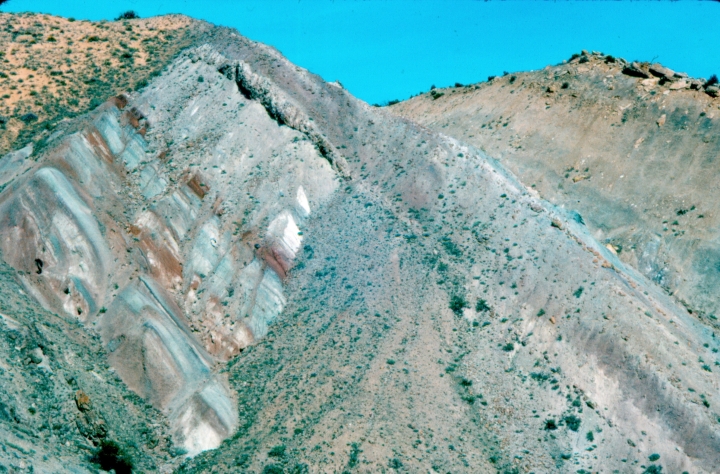
The lithology of the Morrison includes mudstone, sandstone, siltstone and occasional limestone. Colors range from light gray and greenish-gray to reddish tones. These rock types record sediments laid down in rivers, floodplains, lakes and shallow ponds. Most vertebrate fossils are recovered from greenish siltstones and lower sandstone beds that represent former channels and overbank deposits of ancient rivers and floodplains active during the Jurassic period.
Fossils and scientific importance
The Morrison is celebrated for a diverse vertebrate fauna that includes large sauropod and theropod dinosaurs, stegosaurs, and many smaller animals, plus fish, turtles, crocodile-like reptiles and plant remains. Classic genera recovered from Morrison rocks include some of the most familiar names in paleontology. These fossils have been central to research on dinosaur anatomy, ecology and behavior, and they continue to inform studies of Late Jurassic terrestrial ecosystems.
History of study and geographic extent
First recognized in the late 19th century during geological surveys, the Morrison Formation became a focus for paleontologists during the bone wars and later systematic fieldwork. It extends through several states, appearing in badlands, cliffs and quarries where erosion has exposed the layers. Because the formation varies in thickness and local appearance, regional studies correlate its members across basins to understand ancient environments and sediment sources.
Uses, distinctions and notable facts
- Scientific value: a primary source for Late Jurassic terrestrial fossils and paleoecological information.
- Architectural/industrial aspects: some sandstones serve as local building stone and some units contain mineral resources studied by geologists.
- Stratigraphic character: the formation sits above older, often marine or marginal marine rocks and is overlain by younger Cretaceous deposits in many areas.
Together, the Morrison's varied rocks and exceptional fossil record make it a key formation for understanding North American landscapes and life near the end of the Jurassic. For more detailed maps, stratigraphic charts and specimen records see resources linked here: age overview, lithology, distribution maps, dinosaur lists, regional summaries, mudstone data, sandstone data, siltstone data, limestone occurrences, fossil catalogs, depositional studies, Jurassic context.
Questions and answers
Q: What is the Morrison Formation?
A: The Morrison Formation is a geological formation laid down in the Upper Jurassic, located in the western United States and named after Morrison, Colorado.
Q: What type of rock does it contain?
A: The Morrison Formation contains mudstone, sandstone, siltstone and limestone.
Q: What color is it?
A: The colour of the Morrison Formation is light grey, greenish gray, or red.
Q: Where are most fossils found within this formation?
A: Most of the fossils occur in the green siltstone beds and lower sandstones of the Morrison Formation.
Q: When was this formation created?
A: The Morrison Formation was created during the Upper Jurassic period.
Q: Why is it called "Morrison"?
A: It is called "Morrison" because it was first discovered near a town called Morrison in Colorado.
Q: What makes this formation so important for dinosaur fossil discoveries?
A: This formation has been very fruitful for dinosaur fossil discoveries due to its sedimentary rock composition which preserves fossils from rivers and floodplains from millions of years ago.
Related articles
Author
AlegsaOnline.com Morrison Formation Leandro Alegsa
URL: https://en.alegsaonline.com/art/66763
Sources
- doi.org : 10.1016/j.sedgeo.2004.01.004
- worldcat.org : 0026-7775
- worldcat.org : "Speak to the earth and it will teach you : the life and times of Earl Douglass, 1862-1931 (Book, 2009) [WorldCat.org]"
- nps.gov : "Dinosaur National Monument Statistics"