
Moritz Wagner (1813–1887) — German explorer and biogeographer
German explorer, naturalist and geographer whose fieldwork in North Africa, the Americas and the Caucasus led to early ideas about geographic isolation and speciation that influenced evolutionary thought.
Overview
Moritz Wagner was born in Bayreuth in 1813 and died in Munich in 1887. A trained German naturalist, collector and geographer, he combined long field expeditions with comparative studies of plants and animals. His career blended travel writing, specimen collecting and theoretical reflection at a time when natural history and evolutionary ideas were rapidly changing.
Image gallery
1 Image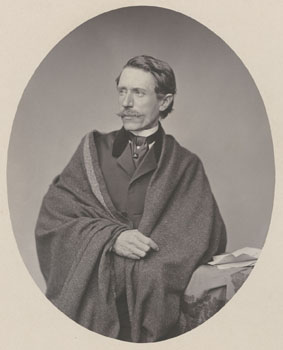
Explorations and fieldwork
Wagner spent three formative years (1836–1839) in and around Algiers, where intensive collecting and observation of local fauna led him to pay special attention to geographically restricted forms. He later travelled extensively in the Americas from 1852 to 1855 and visited numerous Caribbean islands, collecting specimens and noting distributional patterns. In May 1843 he toured the region of Lake Sevan in Armenia, adding comparisons across widely separated regions to his empirical base.
Major journeys
- Algiers expedition, 1836–1839
- North America, Central America and Caribbean tour, 1852–1855
- Field visits in the Caucasus and Armenian highlands (including Lake Sevan), 1843
Contributions to biology and biogeography
From comparative studies of flightless beetles and other organisms, Wagner concluded that geographical separation could be a primary factor in the origin of distinct forms. He argued that isolation in space — for example on islands or in isolated mountain valleys — could lead populations to diverge and eventually form new species. This emphasis on geographic isolation anticipated later formalizations of what is often called allopatric speciation.
Wagner's conclusions were controversial in his day and were not always aligned with dominant interpretations of natural selection. Some contemporaries resisted his strong emphasis on migration and separation as the chief drivers of change, while others found his field evidence persuasive. Today his work is generally seen as an important early contribution to the study of species distribution and evolution, especially for highlighting the role of physical barriers in diversification.
Writings, legacy and personal life
Wagner published travel accounts and scientific essays based on his expeditions; these combined geographic description with taxonomic notes and reflections on origins of species. His approach influenced later biogeographers and students of speciation by stressing detailed field observation and the mapping of species ranges. He was the brother of the physiologist and anatomist Rudolf Wagner, and his later years were marked by declining health. In 1887 he died by suicide in Munich, leaving a mixed legacy as both an intrepid collector and a provocative theorist whose ideas about isolation remain part of evolutionary biology's foundation.
For further reading on Wagner's travels and scientific ideas consult specialized histories of nineteenth‑century natural history and biogeography or archival editions of his travel narratives and essays. Primary-source collections and annotated translations can illuminate how his observations fed into broader debates about species and distribution.
Questions and answers
Q: Who was Moritz Wagner?
A: Moritz Wagner was a German explorer, collector, geographer, and naturalist who lived from 1813 to 1887.
Q: What was Wagner's important discovery in natural history?
A: Wagner's important discovery in natural history was that geographical isolation could play a key role in speciation, based on a study of flightless beetles.
Q: Was Wagner's idea about speciation initially accepted by the scientific community?
A: No, Wagner's idea about speciation was initially rejected by the scientific community.
Q: How did Wagner's idea about speciation turn out to be important in the theory of evolution?
A: Wagner's idea about speciation turned out to be important in the theory of evolution because it shows how isolated populations can evolve independently and become new species.
Q: Where did Wagner travel from 1852 to 1855?
A: from 1852 to 1855, Wagner travelled through North and Central America and the Caribbean, accompanied by a companion.
Q: What region did Wagner tour in May 1843?
A: In May 1843, Wagner toured the Lake Sevan region of Armenia.
Q: How did Wagner die and at what age?
A: Wagner committed suicide in Munich at the age of 73.
Related articles
Author
AlegsaOnline.com Moritz Wagner (1813–1887) — German explorer and biogeographer Leandro Alegsa
URL: https://en.alegsaonline.com/art/66703