
Morganucodon: an early mammaliaform and its role in mammal evolution
Morganucodon is a small, early mammaliaform from the latest Triassic–earliest Jurassic. Known from abundant fossils, it shows a mix of primitive and mammalian traits important for understanding mammal origins.
Morganucodon is an early mammaliaform genus that lived around the transition between the Triassic and Jurassic periods. It is commonly placed at the base of the mammal stem and is often cited in discussions of how true mammals evolved and differentiated from their reptile-like ancestors. The age of the horizons that produced Morganucodon fossils is interpreted as either latest Upper Triassic or earliest Jurassic, reflecting the close temporal position of this animal to a major interval in vertebrate history. Overview and classification provides context for its placement among early mammal relatives.
Fossils of Morganucodon are unusually abundant and well preserved for an animal of this age, which has made it a focal taxon for study. The richest material was recovered from fissure fills in Glamorgan in southern Wales, where the species Morganucodon watsoni was first described. Other fragments and specimens with comparable anatomy have been reported from several localities, and the geological attribution of the Welsh fissures—whether latest Triassic or earliest Jurassic—has been debated by specialists. Glamorgan finds and field reports frequently cite the Welsh material, while regional stratigraphic treatments discuss the timing near the Triassic–Jurassic boundary (stratigraphic debate). Additional comparative material has been noted in broader surveys of early Mesozoic mammals (age context, boundary studies).
Image gallery
10 Images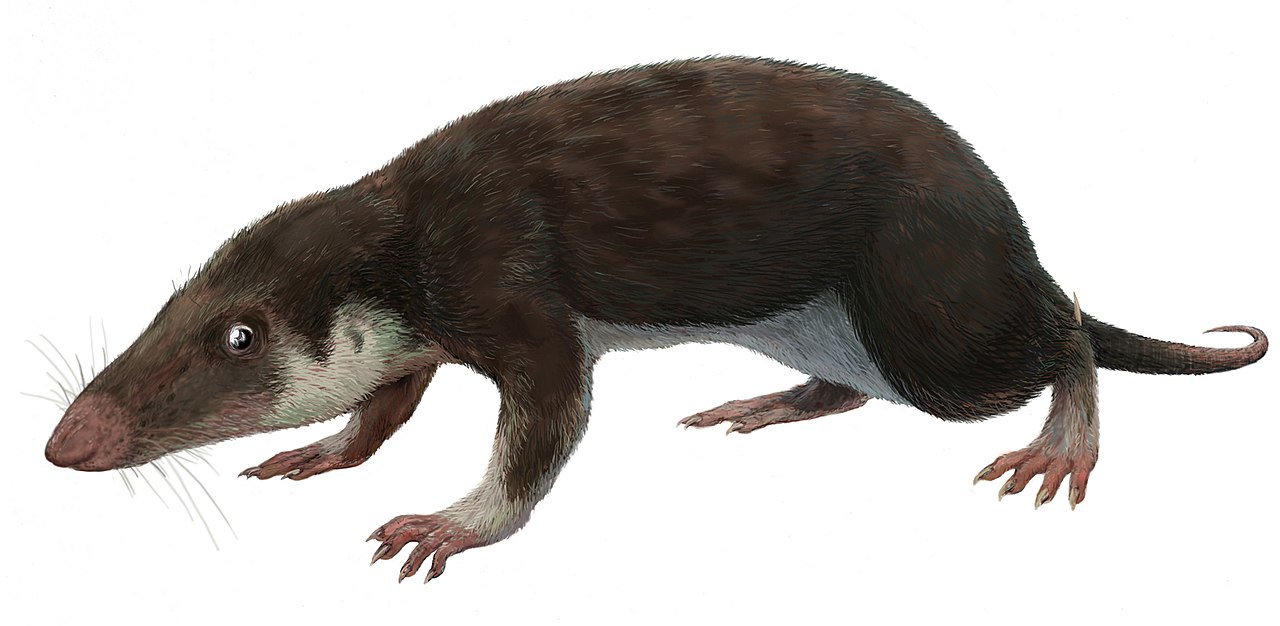
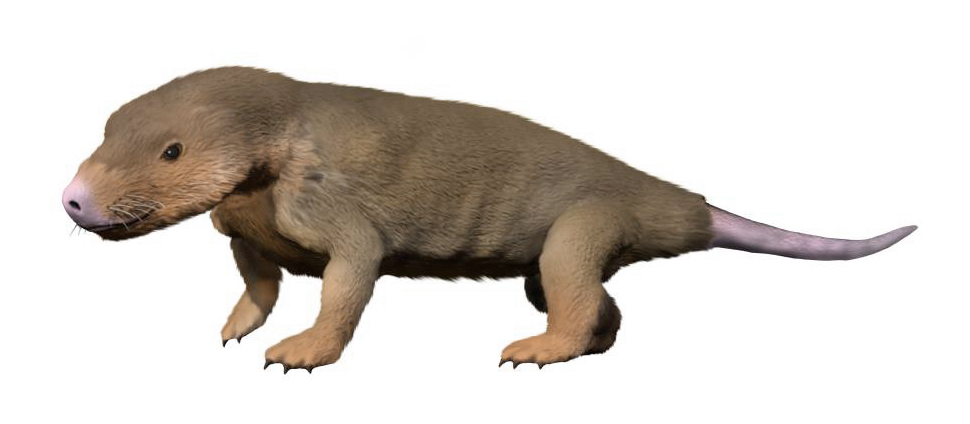


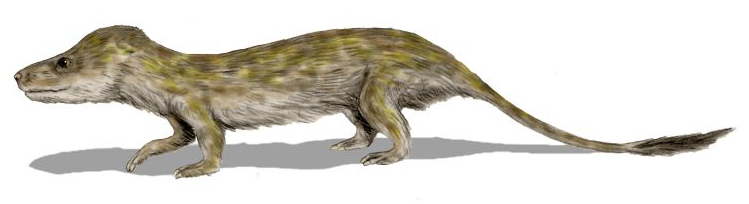
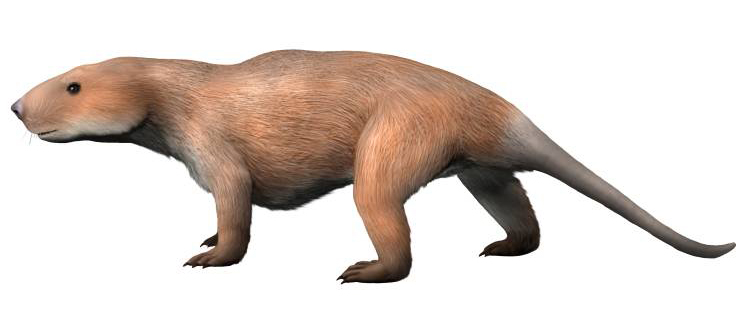
Physical characteristics and anatomy
Morganucodon was a small, shrew- to mouse-sized animal; skull estimates are commonly given at roughly 2–3 cm in length with a total body length (excluding tail) near 10 cm, making it comparable in size to small modern insectivores. Its skeleton and teeth combine primitive and derived features typical of 'mammaliaforms':
- Heterodont dentition with differentiated incisors, canines and cheek teeth showing precise occlusion—an adaptation for more efficient processing of food.
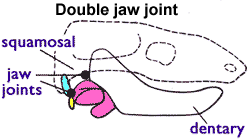
- A transitional jaw articulation. Morganucodon retains the primitive articular–quadrate contact while also showing a developing dentary–squamosal joint characteristic of true mammals; this mosaic condition documents an important step in jaw and middle‑ear evolution.
- Postcranial proportions consistent with a small, agile terrestrial animal; limb posture and joint structure suggest more erect and agile locomotion than in many contemporaneous reptiles.
Paleobiology and ecology
Interpretations of Morganucodon's lifestyle are based on its size, tooth morphology and limb anatomy. The tooth shapes and occlusion pattern indicate an insectivorous or small‑vertebrate diet, relying on shearing and crushing of prey items rather than plant processing. Many researchers infer nocturnal habits for early mammaliaforms like Morganucodon because of their small size and likely competition with diurnal reptiles, but direct evidence is circumstantial. Features tied to growth and metabolism have been explored to assess whether early mammaliaforms had elevated metabolic rates relative to non-mammalian ancestors, although precise physiological inferences remain cautious.
Because Morganucodon is represented by well-preserved jaws and teeth, as well as other elements in some assemblages, it has been central to reconstructions of feeding mechanics, jaw evolution, and the sequence by which jaw bones became incorporated into the mammalian middle ear. These anatomical findings make Morganucodon a key taxon for understanding how classic mammalian traits appeared piecemeal across a lineage rather than all at once. For further reading and specimen documentation see regional collections and comparative paleontological summaries (classification reviews, chronological studies).
Notable facts: Morganucodon first appears in the fossil record at approximately 205 million years ago and its detailed fossil record—especially from Wales—permits fine-scale anatomical study. The genus remains important in textbooks and research because it exemplifies the mosaic nature of evolutionary change at the origin of mammals: small body size, precise occlusion, and an intermediate jaw‑ear configuration document transitions that culminated in the mammalian radiation.
Questions and answers
Q: What is Morganucodon?
A: Morganucodon is an early mammaliaform genus that lived during the latest Upper Triassic or earliest Jurassic.
Q: Where is most of the well-preserved material of Morganucodon found?
A: Most of the well-preserved material of Morganucodon is found in Glamorgan in Wales.
Q: What is the size of Morganucodon's skull?
A: Morganucodon's skull is 2-3 cm in length.
Q: When did Morganucodon first appear?
A: Morganucodon first appeared about 205 million years ago.
Q: What is the general appearance of Morganucodon?
A: In general appearance, Morganucodon would have looked like a shrew or mouse.
Q: Is it possible to determine whether the rock fissures where Morganucodon remains were found are latest Triassic or earliest Jurassic?
A: According to Kemp, it is impossible to say whether the rock fissures, where the remains were found, are latest Triassic or earliest Jurassic.
Q: Is abundant material of Morganucodon available for study?
A: Yes, unlike many other early mammals, Morganucodon is known from abundant and well-preserved material.
Related articles
Author
AlegsaOnline.com Morganucodon: an early mammaliaform and its role in mammal evolution Leandro Alegsa
URL: https://en.alegsaonline.com/art/66687
Sources
- wikidata.org : Q131813
- species.wikimedia.org : Morganucodon
- eol.org : 4527147
- fossilworks.org : 39753
- gbif.org : 4826329
- irmng.org : 1207534